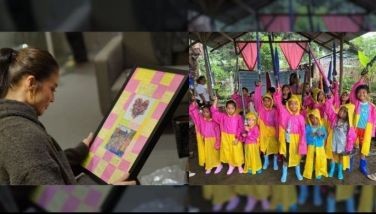


Charlie and the Rubber Chocolate Factory
 (Editor’s note: After graduating cum laude from BS Management Engineering at Ateneo de Manila University, Gena Valerie U. Chua marched right off to an investment bank where she has been working for over a year now. Her passions include movies, travel, music, books, photography and above all, advocacy.)
They never pronounced my name right. It was my first summer in college, that sporadic time of the year when trees shed their leaves even as the sun burns every inch of your skin. Most of my summers until then were filled with classes in photography, sports and newfound hobbies. This year was going to be different. This summer, I was going to be a teacher.
Two dozen eager faces watched as I helplessly tried to introduce myself. I could hear myself speaking in a voice that shook uncontrollably, and I did not recognize the words that slid off my tongue. Speaking in front of a crowd had been one of my strongest points in high school, which should have made this an effortless task, given that these kids were at least four years my junior and thus much less critical. It was refreshing to find faces that did not pretend to be bored because they were too overwhelmed to be bored, yielding easy smiles that did not become self-conscious smirks.
These were brilliant children who came from impoverished families. They went to public schools where 60 students filled a room with a maximum capacity of 20, and when it rained they could not come to class because the roofs leaked and the halls were flooded. Some of them went to school starving, because their parents could only afford one meal a day. I had expected to see bitterness printed on their small faces — the kind of animosity I saw in street hawkers on my way to school every day. I could not have been more mistaken.
I stood in front of them, immobilized. Staring at me expectantly was the future of a nation I have learned to love above any other, in spite of my foreign ancestral roots. I suddenly felt the weight of the world on my shoulders. Where did one start, in a valiant attempt to share the exquisiteness of English literature? I saw them fidget in anxiety: most of them barely spoke any English. I thought about rattling off my favorite poets, or explaining to them the wisdom of selected short stories. Instead I spoke in their native language — assuring them that if they came to class with a little more courage, they might actually learn to stop being afraid for good.
In the way only a 20-year-old’s ego could believe, I thought I was going to give them the best three months of their lives. It was certainly the best three months of mine. Nothing else could have or would ever give me what those children unconsciously did. I applied to the program hoping to teach my students the greatest lessons in life; I finished with gratitude, realizing they had taught me more. My students made me realize why I cannot stop working for the future of this nation: there is too much to lose. Every time someone gives in to frustration and says this country will never be better, I remember those brilliant eyes hungry for knowledge that poverty has denied them.
I asked about their quietness, and was met with embarrassment. They were ashamed to admit that they knew nothing of what I was teaching, things they should have learned years ago. I wanted to take that humiliation away, the same humiliation that devours so many of our countrymen who think they can never be better. It is the humiliation produced by eating from garbage, by having to beg in streets for a few coins, by not being able to read in any language. It is the humiliation beneath greased faces and tattered clothes, the humiliation that keeps them jobless, malnourished and uneducated.
On our last day together, I came early to class and scribbled on the dirty blackboard:
There is really nothing you must be.
And there is nothing you must do.
There is really nothing you must have.
And there is nothing you must know.
There is really nothing you must become.
However, it helps to understand that fire burns,
and that when it rains, the earth gets wet.
The poem was supposedly translated from Japanese, but nobody has ever traced it to a single author. My students stared at the blackboard, their big puppy eyes trying to figure out what it meant. Why was their teacher telling them there was nothing they must be, or do, or know — weren’t these things the very reason they sat in class through their hunger? I told them then: the first five lines of this poem are something they will hear a lot of as they go on through life, life that seems so much harder for them than it is for others. It is a reality that people will not expect very much from them, that the survival rate for graduating from high school, much less college, continues to go down. If you give up and fail, I told them, many will just huff and say that they expected nothing more from you all along.
And maybe that’s easy to understand: they tried so hard after all, who can blame them for not wanting to try anymore and to settle for mere survival? But I told them to remember that everything has its consequences. So much of what your life is meant to become lies in your own hands. The choices you make will be with you forever. It may seem that there is more room for them to fail, but in truth there is much less. Their parents beat all odds to send them to school in sheer hope that they will make something of themselves, that they will be better than those who came before them. If they fail, they will not only be disappointing their parents; they are also taking away hope from their own children — hope that life will not have to be as hard on them. Education is the greatest equalizer. Their books do not care how much money they have in their pockets. If they continue to strive — and they have come so far already, being at the top of their classes — then maybe they will help eradicate what they were here in spite of.
That was more than four years ago, but I still believe every word I told my students. Education is the greatest equalizer, but what I couldn’t bring myself to tell them is this: how can it equalize social strata when the very education itself is not equal? No matter how hard these kids try, what are their chances if the kind of education they are getting is so obviously below par? What happens when the education we are selling so strongly becomes the very thing that fails them? I knew then that I will keep teaching if only for this: to let them realize that there is a future waiting for them, a future filled with hope that lies only in their hands. I want them and their children after them to know the sweet taste of chocolate, the milky melts-in-your-hand kind and not the rubbery tasteless ones they are so used to. Most of all, I want them to understand without humiliation and with an absolute sense of conviction that the world is — and can still be — a beautiful place to live in.