


Yes, we can eliminate cervical cancer by 2030!


The statistics are alarming. Every day, 12 Filipino women die of cervical cancer, one of the most preventable and treatable forms of cancer.
To address this global challenge, the World Health Organization set a global strategy on Nov. 17, 2020 to reduce cervical cancer cases to below four per 100,000 women — “90-70-90” — in Asia and Latin America by the year 2030.
To achieve this goal, “90-70-90” means that 90 percent of girls must be fully vaccinated with HPV vaccine by the age of 15; 70 percent of women must be screened with a high-performance test by 35 years of age and again at 45 years of age; and that 90 percent of women identified with cervical disease receive treatment, 90 percent of women with pre-cancer are treated, and 90 percent of women with invasive cancer are managed.
While there are already laws in place, the question remains: How can the Philippines achieve this target?
At the recent 2025 Cervical Cancer Elimination (CCE) Summit, medical experts, policymakers, and advocates rallied behind an ambitious but achievable goal: to eliminate cervical cancer as a public health problem by 2030.
Held under the theme, “One Community Against HPV: Innovations Enabling Cervical Cancer Elimination in the Philippines,” the summit identified clear, science-driven pathways against the deadly human papillomavirus (HPV).
While a national HPV immunization program for young girls — both in public and private schools — is being implemented, experts agree that coverage remains far too low, public awareness is inconsistent, and screening technologies are unevenly distributed especially in rural and underserved communities.

of the Multi-Omics Research Program for Health; and Dr. Jean Anne Toral of the Society of Gynecologic Oncologists of the Philippines
The time to act is now
Often referred to as a silent killer, cervical cancer shows no symptoms until its later stages — when treatment becomes more difficult and less effective.
And so, the implementation of these three key pillars — vaccination, screening, and treatment — are critical in eliminating cervical cancer in the country.
During the event, experts urged the launch of a nationwide multimedia campaign to build trust, especially in communities where access to healthcare is limited.
On vaccination, the Philippines should be on its way to improving CCE interventions as nonavalent HPV vaccine is also undergoing review by the DOST-Health Technology Assessment (HTA) and, with positive recommendation, could also help DOH upgrade its vaccine to global standards soonest.
On the diagnostics front, AI-powered screening tools and HPV self-testing kits were presented as cost-effective innovations to improve access and accuracy.
“The future of cervical cancer elimination will not rely only on hospitals,” said Dr. JB Torral, ob-gyn oncologist. “It lies in empowering women to take control of their health — at home, in their barangays, and within their own communities.”
The summit also put emphasis on the recently released regional guidelines from the Asia and Oceania Federation of Obstetrics and Gynecology (AOFOG), which outlines a tiered set of recommendations to combat the preventable disease:
• Wider HPV vaccination coverage. Not just for girls aged nine to 14 but for both males and females aged nine to 26, with possible expansion up to age 45. You read that right. Males need HPV vaccination, too, because they are at risk of HPV-related diseases such as anal cancer, anal warts, and the incidence of head and neck carcinomas.
• Adoption of nonavalent (9vHPV) vaccine which offers protection against nine types of HPV, including the most dangerous cancer-causing strains.
• Inclusive programs that cover high-risk populations.
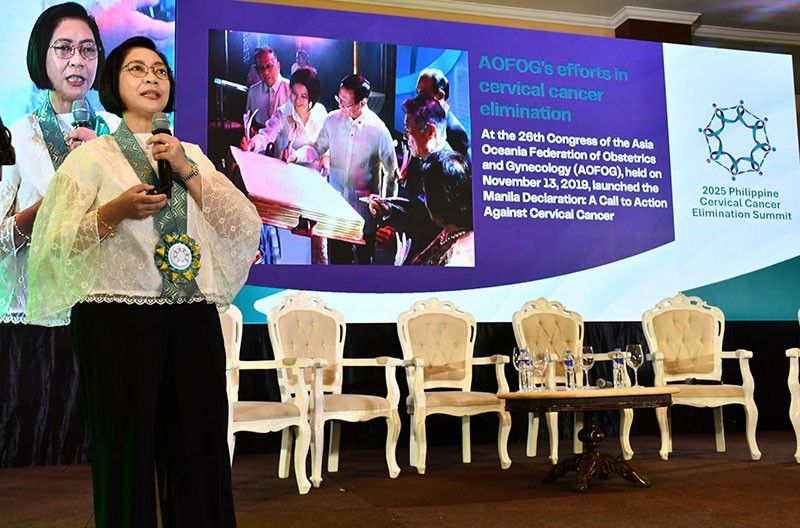
AOFOG is a federation of national societies of obstetrics and gynecology in the Asia-Pacific region, focused on improving women’s health and well-being. AOFOG aims to promote the practice of obstetrics and gynecology, reduce health disparities, and advance women’s health in the region.
“Science clearly shows that vaccinating boys not only protects them, but also reduces transmissions and strengthens herd immunity,” said Dr. Kenneth Tse of AOFOG.
Supporting AOFOG’s call is the groundbreaking multi-omics research from UP Manila. Funded by the Department of Science and Technology, the research confirmed that Filipinas face a broader range of HPV strains than previously accounted for — making 9vHPV vaccine essential.
This vaccine is now available in private clinics here in the country but not yet included in the national immunization program. The Health Technology Assessment (HTA) Council is reviewing its adoption from government funding.
It’s time to update the national HPV strategy based on the real needs of Filipinas.
Lastly, the summit reaffirmed its commitment during the AOFOG Manila Declaration, which was first launched in 2019, to eliminating cervical cancer as a public health problem in the country by 2030.
This initiative is consistent with the Philippine Development Plan 2023-2028 and the Magna Carta for Women, both of which emphasize gender-responsive health services, social protection, and equitable access to care throughout the stages of a woman’s life.
Through data-driven reforms, community engagement, and bold adoption of new technologies, the summit emphasized that cervical cancer is preventable, and the time to act is now.