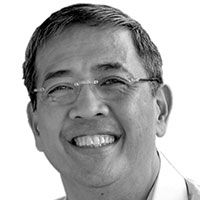
Tancho Baes, a modern missionary

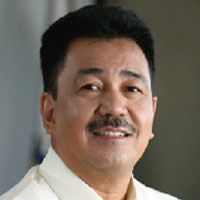
I am always struck by people who give up comfortable careers abroad to come home and get their hands dirty – literally – in our soil. Tancho Baes is one of them.
For 25 years, Tancho built a life in Canada, eventually managing a North American sales team for Sage, the accounting software company, while based in Vancouver. It was a good life by any measure. But in January 2014, three weeks of volunteering in Tacloban in the wake of Typhoon Yolanda changed everything for him. Confronted by the devastation and just as much by the resilience of the people he met there, he felt called to come home and serve God among the poor.
He did not wait for the perfect plan. The following month, without telling anyone, Tancho resigned from Sage by faith and began preparing to leave Canada for good. As these things sometimes happen, Hope for the Nations Canada was, unbeknownst to him, already looking for someone to lead its Philippine arm. By September of that year, he was in Davao as executive director of Hope for the Nations Philippines.
What I appreciate about Tancho’s approach is his conviction that transformation cannot happen from a distance. He spent his first four years living full-time in the slums of Davao City, working alongside at-risk children. It was there, immersed in urban poverty, that he noticed something many of us in development work have long suspected: the families crowding into informal settlements had, for the most part, started out as farmers. They had left the land because the land could no longer support them. Nationally, the pattern holds – roughly 64 percent of our 17.62 million poor, or about 11.35 million Filipinos, still live in rural areas.
This is the same conclusion that brought me, years ago, to plant my own roots in coffee farming in Amadeo. You cannot fix rural poverty from the city. You have to go where the land is.
So in late 2019, Tancho and his team made their way up to the mountains of Baguio District in Davao City (not the Baguio of Luzon, he is always careful to clarify). Two years later, with his friend and fellow Vancouverite Scott Louie, he co-founded Hectares of Hope – a sister organization built specifically to address rural poverty at its source, while Hope for the Nations Philippines continued its work with children in the city. The two remain legally separate but share one aim: communities that are both productive and healthy, where families find transformation that is physical, emotional, mental, social and spiritual all at once.
Today, Hectares of Hope farms a little over three hectares, growing heirloom tomatoes, rainbow carrots, capsicums, butternut squash, beets, cherry belle radishes, herbs and leafy greens – the kind of produce our better restaurants are always hunting for. And indeed, their harvest now reaches some of Davao’s most celebrated kitchens, including Tatler Philippines awardees Pilgrim, Bairrada, Made Simple, Hey Monday and Clean Café, as well as distributors Mother’s Choice and Century House. The Gaisano supermarket chain has begun buying on a trial basis too, which tells me there is real room to grow beyond the restaurant trade.
More than 50 farmers and support farmers, most of them from the Bagobo Klata tribe, have passed through the program since it began; 28 are currently engaged, earning fair wages while receiving hands-on mentorship. Their heirloom tomatoes, I am told, have already caught the attention of chefs from Manila and Cebu at the Davao Food and Wine Festival, and the story has reached audiences well beyond Mindanao through Erwan Heussaff’s FEATR platform and Tatler Philippines.
What sets the model apart, for me, is its patience. Hectares of Hope works on a seven-year pathway, moving farmers through four deliberate stages – from secure, dignified employment, to deeper training in crop care and quality standards, to taking on production planning and cost management as if running their own business and finally to full community ownership and governance. The goal, after seven years, is for Hectares of Hope to step back into a purely advisory and market-access role, leaving farmers who once started as hired hands now running the farm themselves.
It is a small operation by the numbers – three hectares, 28 farmers – but the interest it has generated is far bigger than its footprint. A city, which cannot yet be named pending a signed Memorandum of Agreement, has already allocated 10 hectares for Hectares of Hope to replicate the model, with three more informal invitations from other communities waiting in the wings. The ambition, in time, is to refine this and scale it across rural Mindanao and beyond.
Tancho sums it up in three words that I think should be etched somewhere in every development office in this country: “Opportunity, not charity.” For him, farming is not simply an economic platform – it is a pathway to dignity, to stronger families and to communities that can finally stop sending their children to the city in search of a future the land itself could have given them.
Hectares of Hope Corporation is based in Calinan, Davao City. For more information, visit www.hectaresofhope.com.


- Latest
- Trending