Two to go

Every State of the Nation Address begins with a speech. But long before the President steps onto the podium, the nation has already spoken. It speaks through the price of diesel at the pump. Through the harvest lost to another storm. Through the mother deciding whether today’s budget goes to rice or transportation. Through the fisherman wondering if he can still afford to sail tomorrow.
As President Ferdinand R. Marcos Jr. prepares to deliver his fifth SONA on Monday, the atmosphere is described by the Palace as “simple yet dignified,” being devoid of celebrity directors or A-list performers. This sobriety reflects a nation standing at a critical crossroads, grappling with global economic turbulence while celebrating hard-won legislative reforms. That is perhaps fitting because the challenges facing the country require less spectacle and more substance.
The economic landscape of 2026 presents a stark contrast to the optimistic projections of the 2022 SONA. Four years ago, the administration envisioned an economy growing by 6.5 to 8.0 percent annually. Today, economic growth has slowed to just 3.0 percent by the final quarter of 2025. Government debt, once projected to fall below 60 percent of GDP, now stands above 63 percent. Inflation may have eased to 1.8 percent, but every Filipino knows that lower inflation does not automatically mean lower prices. Families are still paying more than they did just a few years ago. These are not merely economic indicators. They represent millions of households stretching every peso further than it was ever meant to go. Today, with diesel prices hovering between P78.59 to P89.84 per liter, our transport sector remains under severe financial strain. Every peso added to fuel costs ripples across the economy, from jeepney fares to food prices.
At the same time, recent weather disturbances have already caused over P6.3 billion in damage to agriculture and infrastructure. Thousands of our overseas Filipino workers continue to face uncertainty as geopolitical conflicts force government agencies to prepare for possible mass repatriations. These figures remind us that crises rarely arrive one at a time. They converge into what experts now call a polycrisis or multiple challenges reinforcing one another until they become one national burden. Yet numbers do not only measure our problems. They should also measure our response.
Throughout my consultations with the people, I have found that their concerns are remarkably consistent. They are not asking for miracles. They are asking for a fair opportunity to provide for their families, to earn an honest living and to know that the government is prepared when difficult times come. Public service is not measured by the number of speeches we deliver, but by the number of lives we improve.
Over the years, I have seen how timely assistance can help communities recover from disasters and restore livelihoods. Thousands of families have received emergency relief, food assistance and livelihood support during times of crisis, not because charity is the answer, but because government and communities alike have a responsibility to ensure that no Filipino is left behind while longer-term solutions are being built. Compassion, however, must always be matched by strategy.
The P25.7-billion School-Based Feeding Program, expected to benefit 4.6 million learners, is more than a nutrition initiative. It is an investment in human capital. Extending feeding days from 120 to 200 recognizes that the child who is properly nourished is more likely to stay in school, learn effectively and contribute productively to our nation’s future.
The proposed $128-billion Pax Silica initiative offers another opportunity. By developing a 4,000-hectare advanced manufacturing ecosystem focused on semiconductors, artificial intelligence and high-value industries, the Philippines has the chance to move beyond exporting raw materials and toward exporting innovation. We cannot build a 21st century economy while relying on 20th century industries.
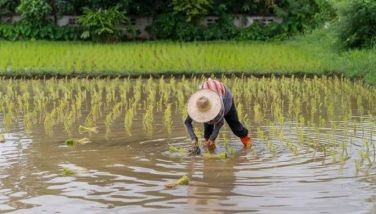
Food security also requires the same long-term vision. This is why I have championed the proposal to establish a Congressional Commission on Agriculture. We cannot continue responding to every harvest shortage and every typhoon as isolated emergencies. Agricultural reform must become strategic rather than reactive if we hope to shield Filipino families from recurring food inflation.
Likewise, strengthening the Philippine Coast Guard through the planned acquisition of 46 additional vessels is not solely about territorial defense. It is about protecting the maritime routes that sustain our economy, our fisheries and our place in regional trade. Even amid these long-term reforms, the government has continued providing immediate relief.
More than P238 billion has been allocated to cushion the impact of rising fuel costs and global energy volatility. However, as I have consistently argued in my push for the Right to Information, these interventions must be matched by ironclad transparency.
I understand that the President and his economic managers are already working on concrete solutions to these challenges. I look forward to hearing their plans. I stand ready to support any legislation or policy that genuinely champions the needs of our people. The converging problems we face today leave no room for ambiguity; they show us exactly what must be done in these crucial final years of the administration. The time for planning has passed; the time for execution is now.
As we await this year’s State of the Nation Address, the more important question before us is whether every budget approved, every law enacted and every policy announced ultimately creates measurable improvements in the daily lives of ordinary Filipinos. Every peso entrusted to the government should produce hope. Because the heart of nation-building has never been politics, it has always been the people.
While many feel that the sun is setting, they forget a lot can happen in two years. Things can still change for the better. Just two to go – let’s make it count.


- Latest
- Trending