I saw the greatest Senate
In third and fourth year high school, I would save my baon so I could take a jeepney ride to go to the Senate once a week near Luneta Park, usually on Fridays. In those days, there was no such thing as No ID, No Entry for Senate visitors; no need for a QR code to enter the august halls of what was then the most prestigious legislative assembly in Asia.
In white shirt and khaki short pants, I would sit at the orchestra seating area, first row, separated only by a solid narra wood railing from the senators. You could touch the senators, in flesh and blood, looking so respectable in their white suits of gabardine fabric. Back then, the senators’ conscience was as white as their clothing.
The years were 1964 and 1965. That was the best Senate the Philippines ever had. I saw Ferdinand E. Marcos presiding as Senate president. Senators in action were a sight to behold.
There was respect and camaraderie. The language was perfect English; Spanish was their other language. No Tagalog then. Oratory was first class. Verbal insults were delivered in such elegant language and nuance you wouldn’t notice immediately you just suffered an uppercut. Answers to interpellation offered lessons rich in law, history, public policy, moral uprightness and educational brilliance. There were no crying ladies. No shouting and boxing matches, on and off session hall. There were no fashion shows; no use of tablecloth as formal garb at the rostrum. Senators’ offices did not serve double duty for marijuana sessions, beauty enhancement work, nor storage rooms for maletas of cash.
In the 1960s batches of senators were several Bar topnotchers – Marcos, Jose W. Diokno, Juan Liwag, Emmanuel Pelaez, Jovito Salonga, Tecla San Andres Ziga, Rodolfo Ganzon, Lorenzo Sumulong and Arturo M. Tolentino, to name some. The nationalist and anti-collaborator prosecutor Lorenzo Tañada was there too. He was UP Law and a Harvard Law masters. Tecla San Andres Ziga was the first woman Bar topnotcher. She was senator of the 1960s. Eva Estrada Kalaw was the only woman in the Fifth Congress. She was a beauty-and-brains queen and journalist and had a master’s degree in social work. Jose Roy and Dominador Aytona were lawyer-economists. Soc Rodrigo was a lawyer-poet. Wenceslao Lagumbay had a master in comparative law at George Washington University.
Up to the late 1960s, a third of 24 senators then were Bar topnotchers or topnotch lawyers. Several were tycoons who made money the old-fashioned way – through hard work and entrepreneurship –Fernando Lopez, Gil Puyat, Gaudencio Antonino. There were perennial reformers and orators like Raul Manglapus and Manuel Manahan.
Back in the 1960s, you could approach your senators anytime. As a campus journalist, I asked for an interview with Senator Jose W. Diokno. He sat down with me for two hours in his Senate office to explain the Investment Incentives Act of 1967 (Republic Act 5186), the law that created the Board of Investments (BOI). I also asked to interview Beningo “Ninoy” S. Aquino Jr., elected senator in 1967. He met with me briefly and told his young chief of staff, Raul S. Roco, 26, to explain to me, a campus journalist, the law that would lower the voting age. For two hours.
By tradition, the Senate was the training ground for future presidents. And presidents were usually Bar topnotchers. In fact, eight presidents were Bar topnotchers – Manuel Quezon, Sergio Osmeña, Manuel Roxas, Jose P. Laurel, Elpidio Quirino, Carlos Garcia, Diosdado Macapagal and Ferdinand Marcos Sr. During their time as presidents, the Philippines became the second most prosperous country in Asia, after Japan.
In fact, I believe the Philippines was the most prosperous or richest country in Asia from the late 1930s to the late 1960s – four decades of solid economic growth unmatched then anywhere in the region. Japan was devastated by two nuclear bombs. True, Manila was devastated but it was because of the US Army bombing which levelled the city designed by the famous Burnham. The master urban blueprint of Manila was designed by renowned American architect-city planner Daniel Burnham in 1905. Known as the Burnham Plan, it envisioned Manila as a tropical Washington DC with wide boulevards, grand waterfront parks and majestic neoclassical government buildings.
Today, you are a college dropout, a plain housewife, a general, an economist, a bigotilyo or simply a bum, or a bigtime plunderer – you run for president. It’s the next best thing to doing nothing. Because of the declining quality of presidential material lately, I have been training my dog to run for president.
Why a dog for president? Well, a dog is loyal to his master. He won’t steal. A dog is a good guard. He will protect the West Philippine Sea. A dog has more bark than bite. He won’t kill people. A dog has sharp sense of smell. He won’t do or deal with drugs. Of course, dogs have no first ladies.
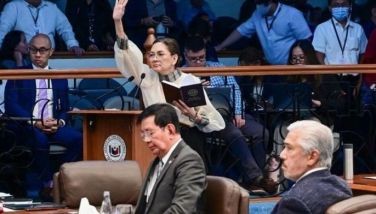
Today, in the present Senate, senators behave worse than fighting cats and dogs.
A third of senators today are siblings – good ones, bad ones, in between. A third of senators today are movie stars or broadcasters. Two are being hunted for being murderers – criminals against humanity. Five are facing cases of plunder or massive stealing of taxpayers’ money. Two are being investigated for stock market manipulation. A number are swindlers. They don’t keep their promises. There are a few lawyers, but not Bar topnotchers. The lawyer-senators are known for things other than excellence in law. And nearly all senators love money – for the fun and fund of it.
Why did the Senate decline to its present nadir? Answer: the abolition of the two-party system, the Nacionalista and the Liberal Party.
Until 1972, the NP and LP competed for power. To capture Malacañang, the party must first capture the Senate. To capture the Senate, you needed quality candidates – the Bar topnotchers. To capture Malacañang, you needed quality candidates – the Bar topnotchers.
* * *
Email: [email protected]


- Latest
- Trending