Special Report: Philippine Airlines during the COVID pandemic
A Phoenix at Sunrise
(2nd of 4 parts)
MANILA, Philippines — Within weeks, the COVID-19 pandemic plunged the world into a deep public health and economic crisis that devastated global aviation, laid waste to economies and killed millions of people.
By February 2020, the Philippine government had canceled all flights to and from mainland China, Hong Kong and Macau in a futile effort to contain the virus.
By March, with the virus spreading, the government imposed a national quarantine and halted all commercial flights – the longest extended grounding of PAL’s scheduled services since World War II.
Only special repatriation and cargo charters were allowed to fly.
When commercial flights restarted in June 2020, travelers and airlines faced severe restrictions. Governments worldwide, and even local government units throughout the Philippines, imposed their own entry barriers and regulations.
Consequently, Philippine travel volumes collapsed by 75 percent, from about 30 million passengers in 2019 to just seven million in all of 2020.
PAL canceled tens of thousands of flights, displaced millions of passengers and lost more than $2 billion in revenue.
Know the difference between a catastrophe and an inconvenience
– Bruce Lee
In March 2020, PAL was out of cash. It had almost no revenue, billions of dollars in debt, hundreds of millions of dollars’ worth of deliverable fuel hedges that were deeply underwater, hundreds of millions of dollars in refund demands and was almost out of hope.
Almost.
Except that PAL’s crews never gave up.
Neither did Kapitan.
When the M/V Diamond Princess was quarantined in Yokohama Harbor in February 2020, television broadcasts showed its cruise passengers being herded onto buses and repatriated by Japanese health and law enforcement personnel dressed in full PPE – the reality of the crisis crystallized for the world.
In that climate of fear surrounding an unknown and deadly contagion, PAL was asked by the Philippine government to fly to Tokyo and repatriate the hundreds of Filipino crew members stranded on the vessel.
PAL senior executives and board members were concerned about potentially carrying the virus to Manila.
Everyone was concerned about the safety of our crews.
I said on a call with officials that we would go if we could get 14 volunteers to crew each of two Airbus A330s, thinking we would be lucky to get enough volunteers for the mission.
I was wrong.
Hundreds volunteered.
The crew group chats erupted with messages, mostly saying things like:
“Isn’t it our job to bring Filipinos home? What are we the flag carrier for?”
And: “We’ll go. Just get us PPE.”
And so we did. And they did.
And they kept doing it.
All through the pandemic.
A little over a week later, on an early Saturday morning conference call with the president and senior officers of one of PAL’s key creditor banks, PAL’s CFO was asked, “How much cash do you have?”
With less than two months on the job, he answered without equivocation:
“Just over six hundred thousand dollars.”
The bankers prepared for PAL’s demise.
That Monday, Kapitan injected $50 million of emergency liquidity into PAL.
The crews wouldn’t give up. Neither would he.
The bank cancelled the press release.
Months later, at a meeting attended by key executives and family members, Kapitan was heard to say that he
would “go all-in on PAL, even if he had to sell everything else.”
By the time the restructuring was completed in December 2021, Kapitan had injected $133 million into PAL to keep it aloft and then raised another $505 million in Debtor-in-Possession financing to complete the US Chapter 11 restructuring and assure PAL’s future.
Purpose
PAL found a reason to live.
As the pandemic dragged on, crews in the air and ground personnel responded cheerfully and courageously to a call to purpose: fly Filipinos home.
PAL flew thousands of repatriation missions to five continents, bringing home hundreds of thousands of OFWs. Filipinos in Barbados, Miami, Algiers and Beirut looked up to see the Philippine flag on the tails of widebody jets on runways foreign to PAL.
The Philippines didn’t have the equivalent of the USAF Military Airlift Command to fly emergency missions.
It had PAL.
We flew to places as diverse as Algeria, Italy, Pakistan, Uzbekistan, Lebanon, the Maldives, the Caribbean, India and Tunisia, carrying out these missions at a time of great need and great fear.
PAL built a network of repatriation charters to airports throughout the Philippines so OFWs could return to
their hometowns after landing and enduring arrival quarantine in Manila, mounting more than 3,500 such flights and carrying more than 300,000 of an estimated 545,000 displaced Filipinos home.
PAL, working with the government, set up “sweeper” flights for Australians, Canadians, Britons, Americans, Kiwis and others, gathering over 17,000 stranded visitors across various islands and bringing them to Manila or Cebu, and then home, earning the appreciation of their governments. The Australian Foreign Minister, among others, lauded PAL for the “mammoth effort” in successfully orchestrating one of the largest repatriation efforts conducted by an Australian Embassy during the COVID crisis.
PAL also repatriated the remains of hundreds of Filipinos who had died overseas of COVID and other causes.
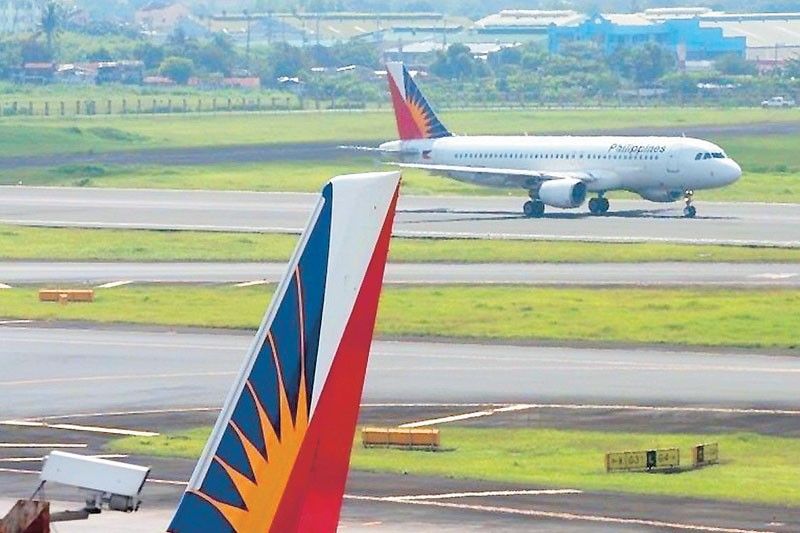
On one such flight, after the coffins had been reverently laid on the tarmac, the Philippine Air Force band struck up the national anthem. Everyone saluted the flag on the tail of the PAL aircraft – the only flag visible on the apron of Villamor Air Base.
I suppose this was what it meant to be the flag carrier.
Bankruptcy
The first few months of the pandemic were traumatic.
In March, PAL was almost bankrupt. By April, we had lost our first colleague to the virus, a veteran training captain who had been infected on the ground.
In May, the Philippine government told us that emergency funding was not an option.
(In June, I had surgery for a compound L2 fracture on top of everything else).
Airlines around the world were receiving loans and bailouts from their governments. But the Philippine government had millions of OFWs it might have had to bring home, and over 100 million citizens to keep safe.
PAL was on its own.
Kapitan’s emergency liquidity was essential, but not sufficient to keep PAL alive.
So, we built a plan.
(To be continued)
Editor’s note: In this special series, former Philippine Airlines president and COO Gilbert Santa Maria takes us inside the flag carrier’s fight for survival during the COVID-19 pandemic, a time when nearly every airline across the globe grappled with the worst turbulence. This is the story of PAL’s remarkable turnaround, told by one who was at the helm when the airline faced one of the toughest periods in its 85-year history. A similar version appeared on Yale Insights.





- Latest
- Trending