Church in the crosshairs of Venice

No matter how many times you’ve seen films by one filmmaker, say in this case the auteur Lav Diaz, you try to decipher what new things he has to say, what novel innovations he has devised through the years in his capacity as the cinema’s elderly guard.
In “Makikiraan Po (Let us through, dear ancestors),” which premiered in Venice last Friday, Sept. 10 and won the Brian Award (Premio Brian), Diaz again mines the dialectic in cinema, training his sights this time on the Catholic church, part and parcel of the ever dubious establishment.
For some reason, resolution comes out best on desktop personal computer, with its duotone hues giving a sense of bleeding oil painting, the filmmaker basking in his palette of blue and gray. When cast on smart TV, picture is just as clear, but mostly standard black and white, or was it just that the computer screen had reflected a sheen of previously inconceivable magic?
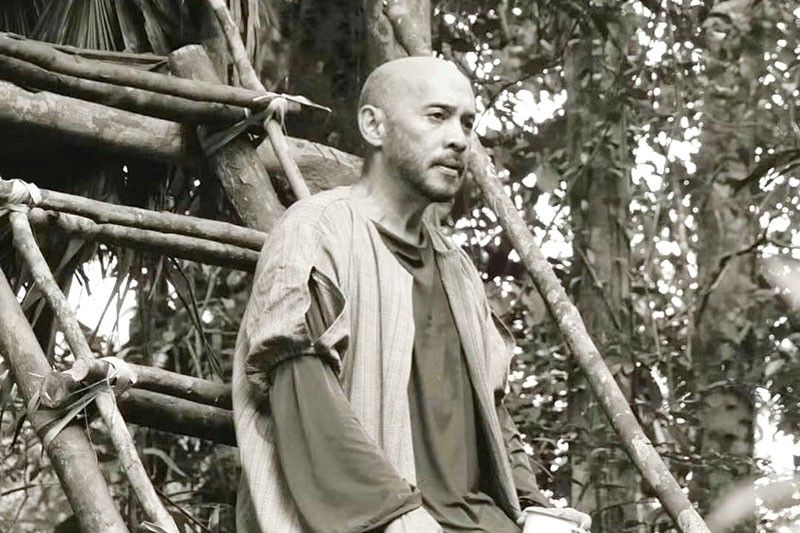
Bart Guingona plays the role of Padre Enciso, supervising the building of churches in Islas Filipinas in early 17th century, through the help of engineer Alejo Smith (Daniel Palisa). In the process of building a church in a remote place, many of the menfolk are killed by bandits or spurious elements while hauling marble and other material to the construction site.
As the unholy father has the pick of the widowed folk all while drinking tuba with Smith, he comes in direct conflict with the indigenous pre-Hispanic folk wisdom courtesy of Babayeng Indimatandog (Isabel Sandoval) a babaylan healer who travels the hills with her sibling (igsuon) Himamat played by Ronnie Lazaro. Both portray their characters effectively with minimal dialogue.
Christian Bables plays Dungwen, bastard son of the priest who despises his father, perhaps for good reason, who has no choice but to lead a contingent of marble haulers from station one to station nine in the fastnesses of the unnamed island, which setting we later learn in the credits is actually Sampaloc town in Quezon province, an idyllic place that can harbor an early century vibe and where Diaz has decided to set up shop far from the hassle of civilization as we know it.
The escort party includes a motley band of surviving menfolk, with the unlikely names of Mang Tugis, Higante and Diego, while zigzagging up and down the hills trying to elude the bandit group of Baribari (Yul Servo, reuniting with Diaz decades after “Batang West Side”).

Everything proceeds at its minimal best, though a memorable scene is the kamayan dinner of Himamat and Baribari with his band of brigands, in which the guest diner imitates the bandit chief in partaking of the repast and throwing bones over their shoulder.
A bit disturbing is how random extras and support wield their walking sticks and canes like guns or long arms, as if this were a natural actuation of anyone in authority, or anyone trying to protect a great wealth obtained after a great crime. Or is this omnipresent sense of foreboding to be taken seriously?
After the series of films that starred the now semi-reclusive John Lloyd Cruz, Diaz has come up with a new serial volume with Lazaro in the lead, and it seems the passing of that torch occurred in “When the Waves are Gone (Nang Mawala ang Mga Alon),” where both of them appeared. That serves as the bridge between the two distinct runs, with nothing lost as both are brilliant actors.
A workmanlike Diaz has also learned to self-edit, as “Makikiraan Po” has the most manageable running time in the director’s work in more than a decade, perhaps since the hourlong “Butterflies Have no Memories.” But cinema is never measured by length, rather by structure, cinematography, narrative, faithfulness to the artist’s vision of why he set out making films in the first place.

While not ranking among the best of the lot in my appreciation, “Let Us Through, Dear Ancestors” still is an important work in Diaz’s filmography, as it hints of progress in his dialectics and aesthetics set in the little town of Sampaloc, which he has practically singlehandedly put on the map, thanks also to the articles of the writer Totel de Jesus who personally made trips to Quezon province to interview Diaz.
Which ancestors are we pleading with to let us through? That alone gives food for thought, whether it be Padre Enciso, Himamat, Dungwen, Babayeng Indimatandog, Baribari, Higante or Tay Oni, given our mixed mongrel heritage. But that doesn’t make it any less valid as a purveyor of Philippine cinema wanting to break through to the other side, at a festival of a country where the Church holds headquarters.
“Makikiraan Po’s” next stop is in Busan in October, where it forms part of the local contingent along with Rafael Manuel’s “Filipiñana.”



- Latest
- Trending