


The Notebook’ cast gives Manila production its heartbeat
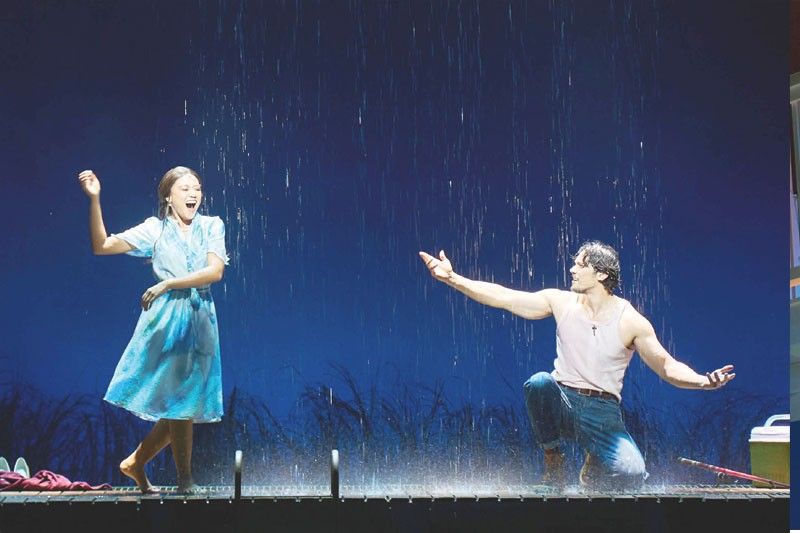
MANILA, Philippines — Based on Nicholas Sparks’ beloved novel and the acclaimed film, “The Notebook The Musical” tells the enduring love story of Noah and Allie — a romance that unfolds across decades, from the exhilaration and recklessness of young love to the profound tenderness of a lifetime together.
At its heart is Older Noah, who continues to tell their story to Older Allie, whose memory has been slowly taken away by dementia. Ultimately, it is a story about love, memory, choice, sacrifice and the extraordinary power of a shared life.
And the Manila production succeeds because it understands that, at its core, “The Notebook” is not about spectacle. It is about people.
The production by Theatre Group Asia, led by Chris Mohani as executive director and Clint Ramos as artistic director, is beautifully mounted at the Samsung Performing Arts Theater and confidently directed by Fil-Am director Nicholas Polonio. For a relatively young director, Nicholas demonstrates a mature understanding of the emotional architecture of the material.
One of the things I particularly appreciated was the simple, fluid-moving set. In an age when productions can sometimes rely heavily on LED screens and technology to fill every inch of the stage, it was refreshing to see restraint.
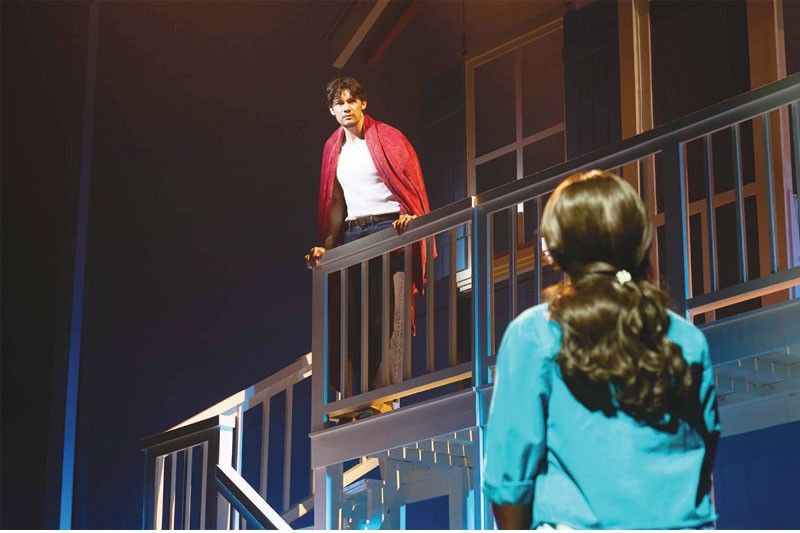
It actually gave the audience more room to imagine. To me, those blank spaces became more than an aesthetic choice — they seemed to juxtapose the emptiness of the mind, particularly the fragmented and fading memories of an older character living with dementia. What initially appears to be an absence of scenery gradually takes on meaning, reflecting the gaps, spaces and uncertainty within Older Allie’s mind.
In that sense, the minimalist staging becomes part of the storytelling itself. Blank spaces become lakes, houses, streets and memories. The moving set pieces become part of the narrative rather than merely decoration. Sometimes less really does allow the audience to see more.
Nicholas also makes an interesting artistic choice by overlapping the timelines and, at pivotal moments, placing different versions of the characters within the same theatrical space. It can be read as an artistic representation of Older Allie’s perspective, where memories, the present and the past coexist simultaneously. In a sense, we are experiencing memory the way Allie experiences it.
With such simple staging, one could also imagine the production working beautifully in a smaller, more intimate venue. There are moments when the emotional intimacy of the story almost begs for a space where the audience could feel even closer to these characters. Ultimately, it is the cast that gives this production its heartbeat.
Standout performances
Celeste Legaspi as Older Allie brings extraordinary tenderness and dignity to the role. There is something deeply moving in her quiet vulnerability as a woman struggling to hold on to the fragments of her own story.
Rodolfo Vera as Older Noah is equally affecting, bringing warmth, patience and an unmistakable sense of devotion to the man who continues to tell their story even when the woman he loves can no longer remember it.
Sheena Belarmino as Younger Allie captures the youthful energy, impulsiveness and romantic excitement of a young woman discovering love and herself, while Benedix Ramos as Younger Noah brings sincerity, charm and youthful energy to their relationship.
Although Benedix looks somewhat younger than the Middle-Aged Allie he is paired with, his commitment and chemistry with Sheena make their romance believable and capture the innocence and impulsiveness of young love.
Laurence Mossman as Middle-Aged Noah effectively carries the character through one of the story’s most important transitions, bridging the Younger Allie we have come to know with the Older Allie whose memories are beginning to fade.
And then there is Morissette.
For me, the standout performance of the evening belongs to Morissette as Middle-Aged Allie, who completely transforms herself into the character with seemingly effortless ease. She was on it from beginning to end.
She was funny when she needed to be, vulnerable when the story demanded it and completely committed during the dramatic moments. Allie came alive in Morissette.
And the audience clearly felt it. Her songs were consistently met with applause, not simply because of the vocal prowess we have come to expect from her, but also because she was telling the story through the songs. The voice served the character rather than the other way around.
That’s an important distinction in musical theater. You can have a technically spectacular singer who stops the show with a note. But when an artist makes the audience forget they are watching a singer and instead makes them feel the character’s joy, frustration, longing and heartbreak, that is storytelling. Morissette achieved that.
Carla Guevara-Laforteza, playing both the nurse and Middle-Aged Allie’s mother, makes the most of two very different roles, creating a contrast between characters of vastly different social status. The shift in stature, authority and character is subtle yet unmistakable — an impressive display of range that only a seasoned veteran like Carla can deliver.
Floyd Tena as Middle-Aged Allie’s Father provides an important emotional presence, particularly where family expectations collide with Allie’s own choices.
Markki Stroem as Middle-Aged Allie’s fiancé, though a relatively short role, makes a memorable impression. His commanding presence underscores the difficult choice Allie faces between the life she has built and the love she has never truly let go of.
Together, the cast creates a convincing emotional journey across three stages of Noah and Allie’s lives.
There is something particularly gratifying about seeing a young Filipino-American director like Nicholas take on such a well-known property and make artistic choices rather than simply reproducing what audiences may already know. His interpretation gives the Manila production its own identity.
And perhaps that is the biggest compliment I can give “The Notebook: The Musical”: it made me feel something.
In a theatrical landscape increasingly surrounded by technology, elaborate visuals and spectacular effects, the production reminds us that a good story, strong performances, beautiful music and a little imagination can still be more than enough.
Because ultimately, love doesn’t need an LED wall. It just needs to be felt.





- Latest
- Trending


