


In Shanghai, the C-drama effect feels real
Call it the “Pursuit of Jade” effect.
A Chinese drama binge upped the level of excitement — and curiosity — over a recent visit to China.
Earlier trips to Xi’an more than a decade ago for the Terracotta Warriors, and to Zhangjiajie, whose landscapes helped inspire the Hollywood megahit “Avatar,” were memorable in their own way.
But my first-ever C-drama experience — “Pursuit of Jade” even became one of the most-watched titles on Netflix Philippines — primed yours truly for a first-ever visit to Shanghai last month, joining a mixed group of STAR editors and executives, led by president and CEO Miguel G. Belmonte and editor-in-chief Ana Marie Pamintuan.
The moment we arrived, taking the high-speed maglev from the airport into the city — capable of speeds faster than Japan’s bullet train, our tour guide claimed — the experience already felt more charged.
Though for an entertainment journalist, Shanghai has always been interesting as a destination. It has been called the birthplace of Chinese cinema, after all.
Besides its long film history, its contrasts of heritage sites and high-rises make it easy to understand why places, even those not directly used as filming locations, can still feel connected to what audiences have seen or loved onscreen.

But that’s getting ahead of the story.
Our itinerary showed different sides of Shanghai: industrial, commercial, historical, fantastical and futuristic. Somehow, all of them still fed into the same impression — that the city understands the power of visuals.
Our first stop was SUS Environment’s Baoshan Renewable Energy Utilization Center, a waste-to-energy facility-turned-park — worth P40 billion, if converted to pesos, we were told — which is envisioned to become a “people-centered urban oasis” for science education, culture, sports and entertainment, among others.

With its “mountain rising” concept, the place could actually pass for a C-drama setting if you let your imagination run a little wilder than usual. Think hardworking garbage collector. A billionaire boss. Plot twist: the female lead is actually a skilled fighter. Our business editor even jokingly pitched a title: “Trash Landing on You.”
From there, the group moved to the Oishi/Liwayway China Co. Ltd. headquarters, which was like a pop-culture mini-museum, complete with photo booths, images of celebrity endorsers, merchandise and some art installations.

The story about the proudly Filipino snack company’s arrival in China tells of how a city can inspire real-life decisions, including business ones. We learned that films featuring Shanghai inspired Filipino business mogul Carlos Chan to set up his first overseas headquarters in the city in the ’90s, according to his son, now Oishi/Liwayway Global chairman Larry Chan.
Afterward, we were brought to Panlong Tiandi, a modernized centuries-old water town. With its lighted lanterns, canals, stone bridges, white-walled cafes and other commercial spaces, and old-style lanes, it could easily appeal to anyone who had fallen into the rabbit hole of C-dramas.
Meanwhile, the more familiar “screen-ready” Shanghai came the next day.
At the City God Temple of Shanghai, the traditional architecture, curved rooftops and narrow pathways mirror the visual language of many historical dramas. Along the way, you also bump into people dressed in period costumes, adding to that effect.

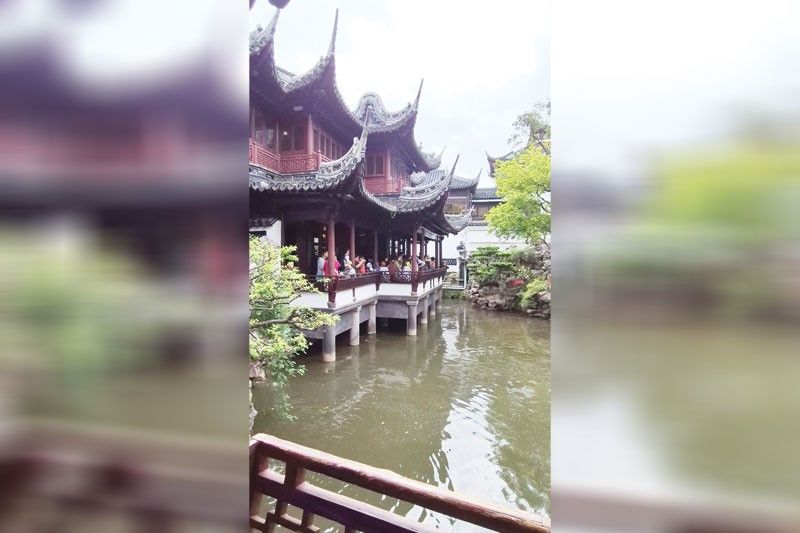
Same scenes at the nearby Yu Garden, where pavilions, ponds and winding pavements — the Jiangnan style of old Shanghai — make it feel rather poetic, not palatial, and if I may say so, make our selfies look like they came straight out of a classical painting.
It’s worth arriving early, which we did, to have more time to check out the nearby bazaar. Some of the less pricey pasalubong we found — White Rabbit candies and all kinds of teas — were also here.
After all the legwork, upon the recommendation of our tour guide, I decided to wind down at their homegrown milk tea chain shop, Auntea Jenny or Hu Shang Ayi, which roughly translates to “Shanghai Auntie.” I told them to surprise me and was given the signature drink, Taro Mochi Milk Tea. Waiting time here could take at least 45 minutes to an hour due to the sheer number of orders.
The next-day stop was full-on modern and “futuristic”: Shanghai Tower and the surrounding Lujiazui financial district.

Shanghai Tower, the third-highest tower in the world, offers immersive experiences, from the entrance where a video presents the extent of Shanghai’s skyline development from 1843 to 2026, all the way to the view deck and its top floor, where you can find its so-called tuned mass damper, which reduces the tower’s movement against strong winds. This engineering feature is presented as an otherworldly art space with lighting, multimedia, projection and laser elements.
By evening, the Huangpu River cruise gave us the kind of Shanghai image that feels familiar even before you see it in person: The famous waterfront promenade The Bund on one side, and the Pudong skyline on the other. This cityscape has found its way to Hollywood blockbusters such as “Mission: Impossible III” and “Skyfall.”
An evening trip is ideal, when the riverside buildings light up and the vibe just feels... electric.
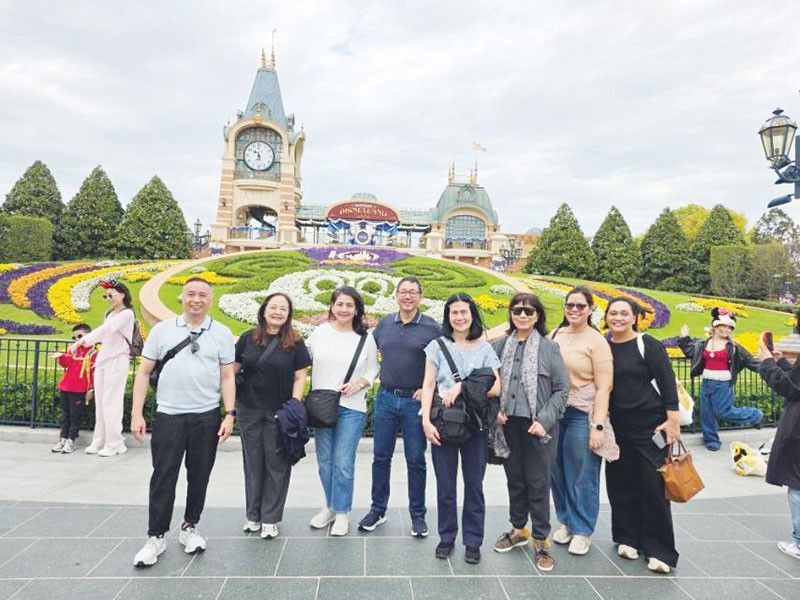
The next day was devoted to Shanghai Disney Resort because, as they say, a trip to Shanghai is not complete without seeing the home of the “tallest, largest and most interactive” Disney castle in the world.
But brace yourself for the long walk, which is not so ideal for seniors. Our tour guide quipped, “But you’re not yet old, you’re still young.” But seriously, the place is best for young people and kids, while those who are not comfortable with long walks might have to opt out.

Just before dusk settled in, the group dropped by the postcard-pretty Taikoo Li Qiantan and nearby Qiantan Park, fronting the Huangpu River. It is a well-curated urban respite with more than 60 plants and features, which vary at times depending on the season and flowering period, in its three-dimensional landscape.
Last but not least, the five-day itinerary made room for history, including a visit to the location of one of the country’s most defining political moments, the Site of the First National Congress of the Communist Party of China. Interestingly, it’s tucked inside fashionable Xintiandi, where cafés, boutiques and polished stone lanes now draw the city’s stylish crowd.

Altogether, this entire trip somehow reflected what makes Shanghai stand out: its past and present, heritage locales and high-energy districts. And of course, somewhere in between all that is where the “Pursuit of Jade” or C-drama effect comes in.
There’s a recent report from Xinhua where China appears to be taking film tourism more seriously this 2026, turning films and dramas into a tourism engine by linking them directly to travel, shopping, dining and local spending.
Instead of treating movies as just box-office products, the strategy is to use them to drive visitors to filming locations and nearby cities through themed travel routes, filming-location tours, hotel promotions, restaurant tie-ins and shopping discounts.
So they have campaigns such as “Travel with Films,” “Taste Cuisine with Films” and “Shopping with Films” with the goal of generating income even after a film or show ends its run. There’s a lesson to be learned here by our local film industry.


- Latest
- Trending


