Mixed gains, challenges and the chase for resilience
Agriculture in 2025
MANILA, Philippines — The local agriculture sector closed 2025 with flashes of recovery, renewed pressure from climate disruptions and a policy landscape still struggling to keep pace with structural weaknesses that have kept farm productivity among the lowest in Southeast Asia.
Data from the Philippine Statistics Authority (PSA) showed modest growth across key sub-sectors, driven mainly by better palay harvests, stabilizing feed costs and intervention programs designed to modernize production.
However, the year was also marked by devastating typhoons, the emergence of new animal disease threats across the region, and global commodity swings that once again tested food security planning.
Rice rebounds,
roadblocks remain
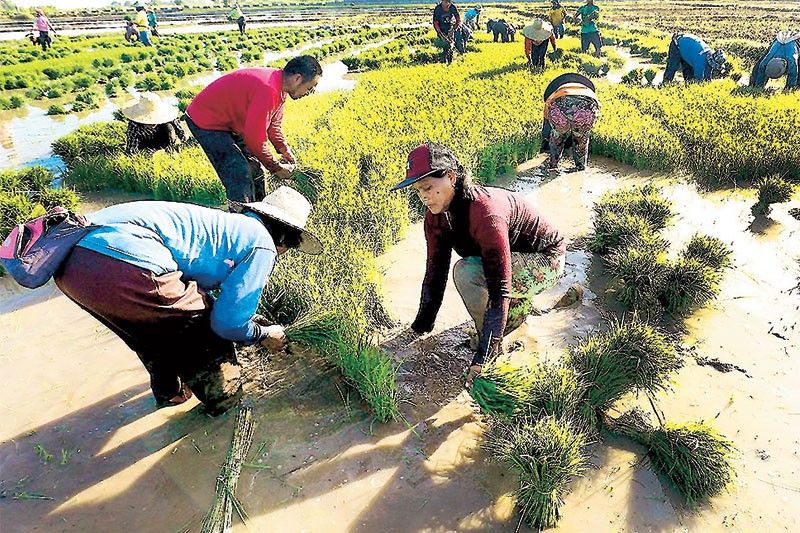
Palay output expanded this year after irrigation upgrades and increased access to certified seeds helped farmers recover from the uneven rains that hampered production in 2024.
The Department of Agriculture (DA) projects that the country’s output of the staple grain will be 19.61 million metric tons to 19.89 million MT, lower than initially expected but still close to the 2023 all-time high of 20.06 million MT and will exceed the 2024 production of 19.09 million MT.
But even with improved harvests, the administration’s long-promised P20-per-kilo rice remains far from reach.
As of Dec. 12, well-milled rice in Metro Manila still retails at P44.75 per kilo, while regular milled rice averages P38.95 per kilo, based on DA monitoring.
To bridge the gap between retail prices and its affordability pledge, the government has moved ahead with a nationwide rollout of its P20-per-kilo rice program, targeting vulnerable and remote communities.
The DA said 429 sites are now operating across all 82 provinces under its “Benteng bigas, Meron na!” initiative, with the next phase focused on expanding coverage to as many as 15 million households in 2026.
The push toward mechanization continued, with the government aiming to complete the construction of 27 new rice processing facilities by the end of the year as part of efforts to modernize post-harvest systems and improve the rice supply chain.
Livestock, poultry push forward
The livestock sector, still recovering from African swine fever (ASF) outbreaks earlier in the decade, showed signs of normalization, although small backyard raisers remained vulnerable.
Although no major outbreaks were recorded this year, overall livestock production still declined.
PSA data showed production from July to September reached 514.39 thousand MT, down by 1.6 percent from 522.74 thousand MT a year earlier, mainly due to a 1.4-percent decline in hog output.
The local livestock sector also scored a significant win after the government announced in September that it would allocate P18.6 billion in annual co-investment opportunities for the industry under Republic Act 12308, also known as the Animal Industry Development and Competitiveness Act.
In contrast, poultry remained a bright spot, with third-quarter production climbing by 10.7 percent to 785.10 thousand MT, driven mainly by a 12.4 percent increase in chicken output.
The sector also gained a layer of protection after regulators cleared a new avian influenza vaccine for commercial use in August.
The DA said the Food and Drug Administration (FDA)-approved Volvac B.E.S.T. AI plus ND provides immunity against the highly pathogenic H5N1 strain and velogenic Newcastle disease, giving poultry growers the much-needed safeguard against viruses that continue to pose threats to both food security and public health.
Mid-year, the DA and Bureau of Animal Industry issued multiple advisories after regional monitoring networks reported the spread of peste des petits ruminants in neighboring Southeast Asian countries.
While no domestic cases were confirmed, the alerts prompted tighter surveillance for goats and sheep and renewed calls from veterinarians for stronger biosecurity protocols, especially in backyard and smallholder farms.
The DA issued several measures halting the importation of pork products from Taiwan and Spain amid reports of the dreaded ASF from those markets.
Of policy reforms and subsidies
After a series of hearings early in the year, Congress advanced several bills aimed at strengthening agricultural agencies, institutionalizing reforms and expanding crop insurance coverage.
The National Food Authority’s shifting role remained under debate, with proposals ranging from expanded buffer stocking to stricter coordination of imports.
The DA has also requested that Congress increase the government’s crop insurance subsidy to P8 billion, from approximately P4 billion, to provide coverage for up to 4.2 million agricultural workers, aiming to shield them from climate risks and rising production costs.
Under the proposed 2026 General Appropriations Act, the Philippine Crop Insurance Corp. (PCIC)’s subsidy remains at P4.5 billion, the same level as in 2022.
It said only 2.3 million farmers are currently insured under the PCIC, which represents just over half of the country’s agricultural workforce.
The country’s salt sector has also called for greater government support, urging faster action on key policies which include the release of a P210-million support fund.
The Philippine Council for Agriculture and Fisheries said stakeholders want the Department of Budget and Management to fully utilize the nine percent tariff share earmarked for sector development.
Price ceilings, shaky floors
Food prices remained a point of tension near the end of 2025 as the DA implemented maximum suggested retail prices for key commodities to manage volatility in markets for vegetables and meat.
The DA set the price ceiling for red onions at P150 per kilo earlier this month, citing rising prices from overseas sources, and also capped the prices of white onions and carrots at P120 per kilo.
A similar approach was implemented for several pork cuts, with a cap of P370 per kilo for liempo (pork belly) and ceilings of P350 per kilo for kasim (pork shoulder) and pigue (pork ham).
Agriculture Assistant Secretary Genevieve Guevarra said retailers who fail to follow the suggested prices will first receive show-cause orders and that repeated violations could trigger legal action for profiteering.
She noted, however, that penalties remain relatively mild, including fines and possible imprisonment of up to six years, raising questions among observers about the effectiveness of enforcement in curbing overpricing.
While penalties include fines and imprisonment of up to six years, enforcement remains difficult in practice, making it challenging to hold violators accountable.
Farm-to-market fiasco
Corruption and mismanagement continued to shadow one of the agriculture sector’s most critical infrastructure programs, the construction and rehabilitation of farm-to-market roads (FMRs).
In mid-September, Agriculture Secretary Francisco Tiu Laurel Jr. ordered a comprehensive audit of all FMR projects, following a high-profile corruption issue involving flood control projects under the Department of Public Works and Highways (DPWH) that drew massive national attention.
As of late November, the DA has uncovered eight “ghost” projects – either unfinished or substandard, with missing roads – all located in Davao Occidental, spanning the years 2020 to 2023.
The FMR projects have a combined value of P100 million, small in comparison to the suspected billions of pesos involved in the DPWH corruption scandal.
Audits are ongoing in Luzon and Mindanao, with plans to complete the nationwide review by the first quarter of next year.
Following the audit, the DA has established a new watchdog unit to ensure the proper implementation of its infrastructure programs, as the department prepares to take over the management of FMR projects from the DPWH starting next year.
A sector still waiting for its breakthrough
The sector ends the year in a better position than 2023 and 2024 in some areas, but not by much, and certainly not enough to secure long-term stability without deeper reforms.
As 2025 draws to a close, the agriculture sector remains a paradox: essential yet underperforming, full of potential yet routinely undermined by weather, diseases, policy gaps and structural inertia.
But for the average Filipino, the measure of progress is simple: higher yields, stable prices and protection from shocks that have repeatedly undone hard-won gains.
Until those conditions are consistently met, the country’s agricultural sector will remain on fragile ground, bearing both the weight of the country’s food security and the promise of an economy that cannot fully grow without it.



- Latest
- Trending