Veto sought vs election delay / No choice but to hike fares

Veto the postponement of barangay elections. That will spare Bongbong Marcos from presidential embarrassment.
Forty-two-year-long election lawyer Romy Macalintal wrote BBM twice to uphold suffrage. Frequent arbitrary resetting of barangay and Sangguniang Kabataan elections (BSKE) violates the right to vote and be voted upon.
If granted Malacañang audience, Macalintal will explain to BBM the frivolities of the postponement bill:
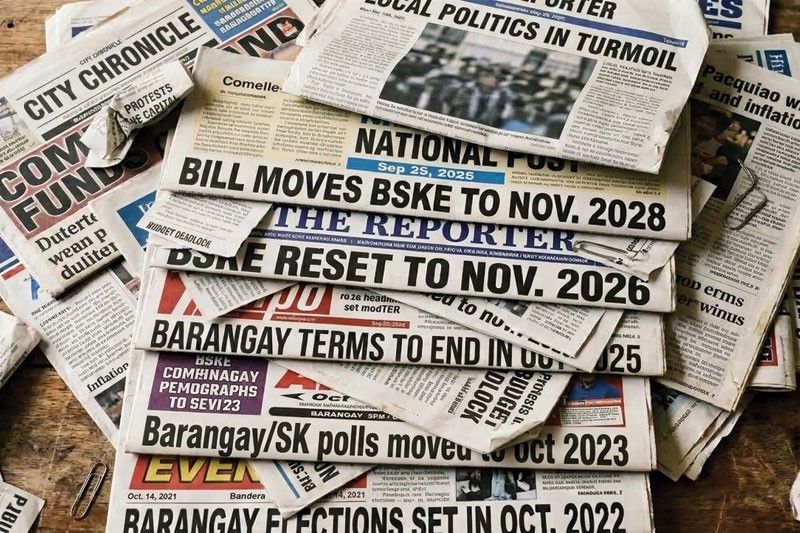
• The October 2022 BSKE was delayed by a year to October 2023. Still, the Supreme Court ruled that 2023 electees would have served the old three-year term by October 2025.
• Congress then “set the term” to four years, delaying the October 2025 election to November 2026.
• Now Congress wants to “fix the term” to five years, so is again postponing the November 2026 election to Nov. 2028.
• During the Sept. 9 Senate plenary deliberation, Joel Villanueva asked why they said that a four-year term was sufficient but they now want five years. Sponsor Chiz Escudero replied: “Wala pong partikular na pag-aaral sa nagdaang batas na pinasa natin, partikular sa four-year term.”
• Escudero added: “Mula nang tumayo ako para depensahan, i-sponsor ang panukalang ito, wala akong pinapangakong ito na ang huling [postponement].”
• During the Sept. 1 House deliberation, Tony Tinio asked why they are extending the terms to five years right after extending it to four. Sponsor Henry Oaminal replied, “Laws are continuously evolving and we here in Congress continue to do our work, part of which is to consult different stakeholders.”
• Oaminal added: “Since the law was passed, several stakeholders, including grassroots leaders such as barangay and SK officials, expressed to us that a four-year term would be insufficient.” Tinio retorted: “E natural, sino mang elective official kapag tinanong mo, ‘Okay ba kayo i-extend ang term natin?’ Siyempre sasabihin nila, yes.”
• Oaminal stammered that during committee hearings, Comelec officials endorsed the postponement to November 2028 because of “oil crisis and international wars.” Yet all this time, Comelec Chairman George Garcia has been announcing readiness: ballots are printed, and P8 billion has been spent.
• Another Congress alibi to scrap the Nov. 2026 election is that it falls on the 2nd, All Souls Day, when Filipinos traditionally visit their dearly departed at cemeteries. Yet it was Congress that set it for the first Monday of November this year.
• Legislators need barangay/SK officials to campaign for them in the May 2028 congressional-local elections. That’s why they’re extending BSKE to November 2028. Quid pro quo. But the nonpartisan rule for BSKE will be violated.
Legislators couldn’t distinguish “tenure” from “term,” Macalintal alerted BBM: “I am certain you would not want the Office of the President to give legal life to an erroneous law that is patently unconstitutional, vague, defective, and violative of the right of suffrage. Your veto will save the administration from such legislative missteps.”
* * *
The last time government allowed bus and jeepney fare increases was June 2005. Diesel price spiked at that time to P45 per liter. Salaries of bus and jeepney drivers and conductors, and prices of spare parts were much lower then.
Today, 21 years later, diesel rates are more than double at P105 per liter. Wages have increased several times in all regions; it rose another P60 a day just this month in Metro Manila. Inflation has tripled the price of spare parts.
Jeepney drivers and cooperatives are griping. Earnings from a whole day’s “pasada” goes to fuel alone. Nothing left to take home. They can no longer amortize the “modern jeepneys” that government forced them to purchase in lieu of the dirty, noisy traditional ones that ran on reconditioned engines.
Banks that lent money for modern jeepney purchases – especially government-owned DBP and Landbank – are in danger. They will be forced to repossess units that jeepney men can no longer pay for. Those repossessed units will rot from unuse. Nobody will ply routes. Commuters will suffer.
Bus operators are also groaning. To save on fuel, payroll, and spare parts, they alternately field buses only every other day. Micro and small entrepreneurs are most inconvenienced. They cannot simply switch to motorcycles due to rutty and flooded roads.
“Fare hikes are a last resort,” Transport officials said on Tuesday. Yet they have no more funds to subsidize bus and jeepney fuel.
It’s just a matter of time. When fares are hiked, all else will follow: food, water, medicines, clothing, toiletries, school and office supplies, rent, kitchenware, hardware.
* * *
Catch Sapol radio show, Saturdays, 8 to 10 a.m., DWIZ (882-AM).
Follow me on Facebook: https://tinyurl.com/Jarius-Bondoc



- Latest
- Trending