A peek into what really happens behind the scenes of Philippines showbiz

There is no crazy quite like showbiz crazy, and perhaps that is precisely why “Call My Manager” has struck such a nerve with Filipino audiences.
The Philippine adaptation of the acclaimed French series “Call My Agent” has become the No. 1 series on HBO Max Philippines, and frankly, it is a position the show rightfully deserves and happened organically because the show — just two episodes in — is that good!
Beneath the celebrity cameos, outrageous situations, backstage drama and seemingly impossible showbiz scenarios is something remarkably familiar: the uniquely Filipino entertainment industry, with all its glamour, pressure, humor, insecurity, ambition and wonderfully complicated relationships that now we are starting to share with the world.
Directed by Erik Matti, with Reality MM and Dondon Monteverde behind the project as well, “Call My Manager” brings together a powerhouse cast led by Judy Ann Santos, Edu Manzano, Gina Alajar and RK Bagatsing. But what makes the series particularly compelling is not simply the star-studded lineup. It is the way it holds up a mirror to the industry itself.
For those of us who have spent years working in Philippine showbiz, there are scenes that make you laugh because they are so absurd, followed almost immediately by the realization that they are actually not that far from reality. Just names that were changed on cam — or not. You be the judge. Wink, wink.
Take in the following scenarios: a superstar whose career needs rescuing; an artist being told that perhaps a physical transformation is necessary to revive a fading career; talent wars; rivalries; red-carpet confrontations, plus stars fighting over opportunities; managers trying to keep everyone happy while simultaneously putting out fires; publicists maneuvering behind the scenes; and, of course, the entertainment press watching, reporting and sometimes becoming part of the story.
The series understands that showbiz is not simply about celebrities being famous. It is an ecosystem, and every person inside it has a role to play.
Judy Ann Santos, who gets to experience the industry from the perspective of a talent manager rather than a superstar, clearly embraced that change in point of view.
“I actually had fun when direk Erik pitched the concept to me. I didn’t have to think about it. Let’s do it. Akin na ’yan. It’s mine,” she said.
And perhaps that is one of the reasons her performance works so well. Judy Ann knows the world she is portraying. She understands what it means to be the person everyone is looking at, but the series allows her to explore what happens to the people whose job is to make sure the star remains standing.
Edu also pointed to what I think is one of the show’s most important contributions.
“I think we will leave with a greater appreciation for people behind the scenes,” he said.
That is something audiences may not immediately expect from a series that promises chaos and comedy, but it is actually one of its greatest strengths.

Because Philippine pop culture tends to focus on the people in front of the camera, we know the stars, their projects, their relationships and their controversies. We talk about who is hot, who is making a comeback, who is being paired with whom and who has supposedly fallen out with whom. But behind every celebrity is an entire network of people whose work is rarely at the forefront, but they, too, have oftentimes even more colorful stories to tell.
“Call My Manager” gives those people a story. And, in a very unexpected way, it also gives some members of the entertainment press the opportunity to see our own profession from the other side of the fence. I know this because we were actually part of it.
We made a cameo in the series as ourselves, together with fellow members of the showbiz press, including Jojo Gabinete, The Philippine STAR Entertainment editor Nathalie Tomada, Marinel Cruz, Tessa Mauricio-Arriola and the late Mario Dumaual.
There is something particularly surreal about watching yourself play yourself. Normally, we are the ones covering the actors. We are the ones arriving at events, attending press conferences, interviewing stars, waiting for our turn and trying to get the story that will make it into the day’s entertainment news.
But on set of “Call My Manager,” even for a short time, we experienced what it was like to be on the other side of the fence. We waited and waited and waited some more, like everyone, who has a sequence, does. Extra or lead star, that is the case.
There were long hours on set, the uncertainty of when our scene would actually happen and, ultimately, the very real possibility that what shot might not even make it into the final cut. It was a small but incredibly valuable lesson in patience, and one that made us appreciate the efforts our production teams and talents give every time.
As members of the press, we often see only the finished product. We see the polished performance, the premiere, the interview, the red carpet and the final episode. We don’t always see the hours of preparation, the waiting between takes, the repeated scenes and the uncertainty that comes with production.
Being there reminded us that showbiz is built on an enormous amount of patience, and most importantly, the secret sauce of longevity in the biz — pakikisama.
An actor can spend an entire day on set for a scene that may last only a few minutes. A production team can work for hours to create something that audiences consume in seconds. And a performer can give everything to a scene without ever knowing whether it will survive the final edit.
That experience gave me an even greater appreciation for the people who do this every day. It also made the show’s depiction of the entertainment industry feel even more personal.
Gina Alajar, who plays a role that is inspired by showbiz matriarch Mother Lily Monteverde, explained that the series is inspired by real-life happenings in show business, although the production deliberately avoids naming names.
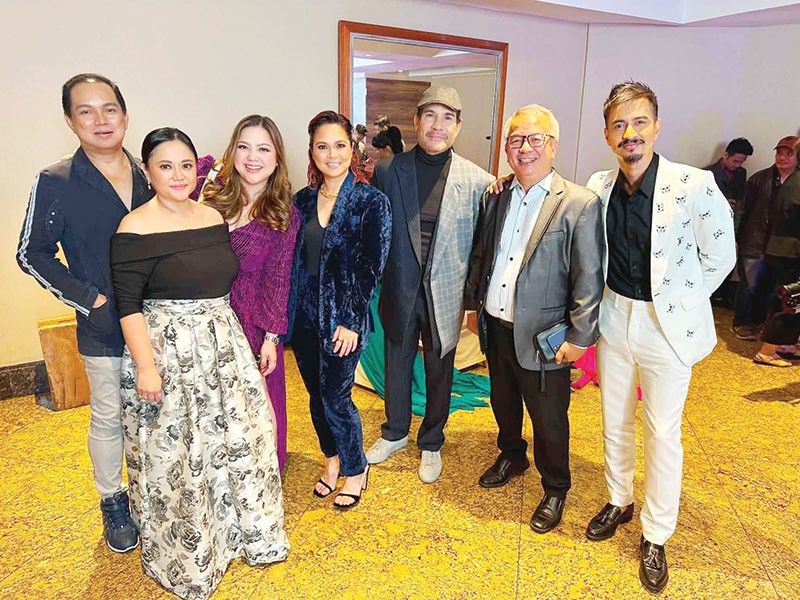
“The whole series is inspired by real-life happenings in show business. We don’t want to name names. But if people are observant inside the entertainment world, they would be able to guess who these people are,” she said.
And that is where the fun begins. You don’t necessarily need the show to tell you who inspired a particular character or situation. If you’ve been following Philippine showbiz long enough, you will probably have your own theories. That is also why the casting of actual celebrities and entertainment personalities as themselves is such a clever decision.
There are hundreds of cameos throughout the series, including A-list actors and familiar faces from the entertainment industry. Seeing them participate in a fictionalized version of the world they actually inhabit creates a fascinating blur between reality and fiction.
Director Erik himself acknowledged that this was part of the appeal.
“It’s really fun to look at on screens because you don’t know if it’s real or not,” he said.
Exactly. That blurred line is what makes “Call My Manager” so entertaining, but it is also what makes it culturally significant.
For decades, Philippine entertainment has been telling stories about love, family, poverty, ambition and success. Now, we have a series that is turning the spotlight inward and telling a story about the business of showbiz itself, and how fun and chaotic it is.
The director described the series as a love letter to the industry, with the late Mother Lily serving as one of the inspirations behind the project. That detail makes the show even more poignant.
Mother Lily ushered in a strengthened era when movie studios, producers, stars, directors, journalists and theater owners were all part of one interconnected entertainment ecosystem. Her influence stretched across generations of Philippine cinema, and her legacy is deeply woven into the history of local show business.
For Erik, “Call My Manager” became an opportunity to celebrate that world while also poking fun at its absurdities.
“We wanted to bring in as much love in the show because we might not be able to do another show like this again,” he said. “We put in all the love that we could. It’s heartfelt and endearing.”
That love is important because the series is not really making fun of showbiz from the outside. It is laughing with it. The people involved understand the industry well enough to know that behind every ridiculous story is usually a human being trying to survive a business that can change overnight.
One day, you are the biggest star in the country. The next day, people are asking whether you are still relevant. One project can revive a career. One bad decision can change its trajectory. A manager can be a confidant, negotiator, protector, therapist and firefighter all at once.
And the entertainment press, for better or worse, is often right there in the middle of it while it unfolds.
That is why I think “Call My Manager” deserves its position at No. 1 on HBO Max Philippines. It is entertaining enough for audiences who simply want a fun, outrageous series, but it also rewards viewers who know the industry and is a treasure find to those uncovering it. For those of us who have lived around Philippine showbiz for years, there are layers of recognition in almost every episode.
And for audiences who don’t work in entertainment, perhaps the biggest takeaway is the one Edu mentioned: a greater appreciation for the people behind the scenes because celebrity is only the visible part of the machine.
There are managers, producers, writers, directors, stylists, publicists, assistants, production crews and yes, journalists, who help create the stories that become Philippine pop culture.
And judging by the fact that Filipino audiences organically have made “Call My Manager” the No. 1 series on HBO Max Philippines, it seems we are more than happy to watch our own beautiful, complicated, completely bonkers world reflected right back at us. Go tell your friends about this if you haven’t.





- Latest
- Trending