What Filipino films still need to reach the Oscars
MANILA, Philippines — Has a Filipino film ever come close to at least an Oscar shortlist?
Year after year, the Philippines sends an official entry to Hollywood’s biggest awards event with the hope that one Filipino film will finally make it to the shortlist, if not all the way to a nomination.
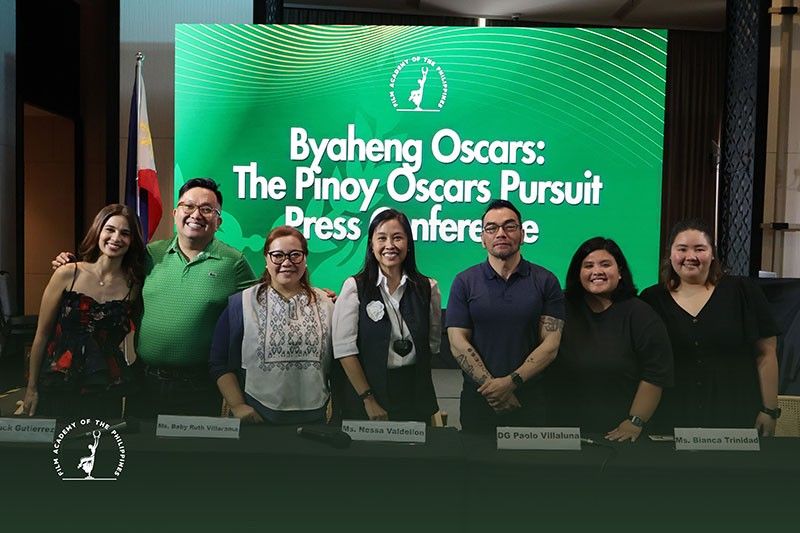
But at the recent “Biyaheng Oscars” Q&A session, the discussion made clear that the country’s elusive Oscar dream is not simply about choosing a good film and sending it abroad.
A good film, according to Film Academy of the Philippines (FAP) director-general Paolo Villaluna, is only the beginning.
“To be candid, of course, the first baseline is a really, really good film,” he said.
The bigger challenge, he explained, is understanding and building the full campaign system that can help a Filipino film reach the actual voters of the Academy of Motion Picture Arts and Sciences.
“Previously, hindi pa natin na-master yung lay of the land and how campaigns actually run,” Villaluna said, adding that there is “a rolling mechanism in the world na hindi tayo parte” and where “ang laking pera umiikot.”
“It is not very fair for a developing country like us,” he said.
Still, he stressed that the problem has never been the absence of worthy Filipino films.
“In terms of good films, we’ve always had (them),” he said.
In the same breath, he pointed to the strength of Filipino filmmakers, voices and stories, saying that Filipino cinema has long proven itself in A-list festivals and other global spaces.
What has been more difficult to reach, he said, is the Oscars because “meron siyang kampanya.”
“Baseline is dapat magandang pelikula at boses ng Pilipino, Pilipinong pelikula,” Villaluna reiterated. “And then if the stars align, it goes into festivals, makakuha ng North American distributor and then the funding comes in.”
As for the government’s commitment to the Oscar campaign, Villaluna stressed that there’s already a budget intended for the official selection to reach the shortlist stage.
According to FAP’s “Pinoy Oscars Pursuit” grants program, the country’s Best International Feature Film entry may receive a maximum total grant of P25 million, provided it meets certain criteria. These include a premiere and victory in an A-list festival; a North American distributor with a track record of handling films that have been nominated, shortlisted or have won at the Oscars; or three major awards before the country selection.
But he said there is no fixed amount yet for a possible nomination campaign, which would require a much bigger budget.
If a Philippine entry makes the shortlist, he said the Film Academy can formally ask the national government for additional support.
Still, he stressed that the existing commitment is not just talk.
“The commitment right now… the numbers that we showed you, hindi siya bola. Naka-budget na siya and it’s really meant for the Oscar campaign,” he said.
Past efforts
For filmmaker Baby Ruth Villarama, who attempted to secure an Oscar consideration for her maritime documentary “Food Delivery: Fresh From the West Philippine Sea” under the Best Documentary Feature category last year, one lesson from past efforts is the need to start early. The campaign itself cannot be treated as an afterthought.
“We came in late in the game. We came in during the Academy season,” she said. “But once you make your film and you have the intention to bring it to the campaign, the production itself is a marketing strategy.”
“The strategy is really important. The quality of the campaign — like the trailers, is it globally resonant? And the positioning of these trailers, the positioning of the kits, the luncheons, how do you do the press tour — very important siya,” Villarama continued.
She pointed out that in Hollywood, even the first day of shooting can already become part of the campaign.
“Kumbaga, there has to be a solid timeline and of course, institutional support,” she said. “No film can ever reach global without institutional support.”
Other experiences also proved that the Oscar effort does not begin when a film is submitted as the country’s official entry. It can start years earlier — in the development, timing and positioning of the work itself.
Speaking about their experience with “Magellan,” the country’s 2025 Oscar selection for the Best Feature Film, Bianca Trinidad said that timing of the release of the Lav Diaz film, which even took seven years to develop, was also part of the strategy.
“It was also about the perfect time to release the film,” Trinidad said. “It was also having that decision-making to say maybe we had to wait or let certain things happen to be able to get the ball rolling for a film.”

According to her, “Magellan” had the advantage of being built around a “universal figure” but seen through a distinctly Filipino lens.
“Thankfully, in our film, in ‘Magellan,’ the Filipino identity could not be stronger,” she said.’
“The story could not be more relevant because you can tie it to everything that’s been going on until now.”
Villaluna, nevertheless, reminded the press that the Oscar campaign is ultimately about reaching voters.
“Guys, don’t forget, there are like 10,000 Academy members in the world,” he said. “And 60 percent of Academy members are actually global. So ang nililigawan mo ng pelikula ay yung 10,000 voters na bumoboto.”
“Kahit magpadala tayo year in, year out, pero hindi natin maabot yung mga actual na taong boboto, it’s going to be a waste,” he added.
This is why North American distribution has also become an important part of the conversation. Asked if the Film Academy provides support in connecting local productions with North American distributors, Villaluna said it is not officially part of their mandate, but they try to help.
“To be honest, it’s not part of our mandate,” he said. “However, as part of extra effort, when we go to film festivals, we actually get in touch with North American distributors to get partnership networking lang and then try to sell the Filipino film.”
But he also noted that distributors choose the films they believe can travel, compete or perform well. “Magellan,” for one, was picked up after being seen abroad.
“We’re so happy na Janus actually picked up ‘Magellan,’” he said. “The distributor saw the film in Cannes and then they said, ‘You know what? We want to distribute this.’”
The Film Academy, however, is not looking only at the country’s official entry for Best International Feature Film.
Asked how aggressive the FAP would be in pushing Filipino films in other Oscar categories — with some observers noting that documentaries or shorts could offer another route — Villaluna said they are open to supporting campaigns beyond the main international feature race.
“Last year, we supported Best Documentary and Best Short, so we actually are open to other categories,” he said.
Again, they are willing to support as long as the producers have a credible plan and are confident they can mount the campaign.
‘National honor’
But just how important is an Oscar nomination or a trophy to our filmmakers?
Weighing in on the matter during the Q&A session were film producer Achi Bautista, representing “Filipiñana,” which has already screened at Sundance and Berlin, and Nessa Valdellon of GMA Pictures, speaking for the animated film “58th,” which is joining Annecy Animation Film Festival in France.
Valdellon said the pursuit carries the weight of something larger.
“This is a national honor,” she said. “You’re carrying years of hopes of all of the filmmakers in this country.”
Bautista, on the other hand, said the dream is not only about the trophy but also about what it could mean for Filipino talent.
“More than the trophy, it’s the recognition of the Filipino talent and voices,” she said. “Yun naman po yung lagi naming ipinaglalaban — na madala namin yung Filipino talent on the global stage.”
She added that an Oscar nomination or win could symbolize a stronger creative economy, more work for Filipino film workers and more credibility for the Philippine media and creative industry.
“Pag sakaling ma-nominate or manalo, all eyes na yun,” she said.
Meanwhile, filmmakers seeking consideration as the country’s official entry must transmit their submissions by July 31. FAP will announce its local shortlist in August and name the official Philippine entry to the Oscars in early September, at the start of Philippine Film Industry Month, ahead of the national deadline to submit to the Academy of Motion Picture Arts and Sciences at the end of September.
A National Selection Committee of seven Filipino film practitioners, each approved by the Academy of Motion Picture Arts and Sciences, then picks the official country nominee. The program follows the Academy’s support for the current campaign season, in which “Magellan” was named the official Philippine entry for Best International Feature, alongside support for Filipino contenders in documentary, short film and original song categories.
Villaluna was candid when asked when the Philippines almost made it to the Oscar shortlist.
“To be honest, wala,” he said, explaining that some claims of a film being close may have come only from prediction sites.
He mentioned “Magellan,” which appeared in prediction sites last year, but was not shortlisted. He also said the Philippines has never been shortlisted, and that in Southeast Asia, making it to the Oscars remains rare.
Still, despite the realities of funding, distribution, voter access and the country’s long wait for its first Oscar shortlist placement, the mood in the room was not one of resignation.
“Hope springs eternal,” so to speak.
“Not only hope,” Villaluna said. “It’s the faith that it will happen.”


- Latest
- Trending