AMRO slashes growth outlook for Philippines in 2026

MANILA, Philippines — The Philippine economy may struggle to meet even AMRO’s sharply downgraded 3.4-percent growth forecast for 2026 unless public construction rebounds significantly in the second half, as elevated inflation and weak investment continue to weigh on domestic demand.
Following its annual consultation visit, the ASEAN+3 Macroeconomic Research Office (AMRO) lowered its 2026 growth forecast for the Philippines to 3.4 percent from the previous target of 4.1 percent. It also lowered its 2027 projection to 4.8 percent from 5.5 percent.
AMRO chief economist Dong He said achieving the new gross domestic product (GDP) forecast would hinge heavily on a recovery in government infrastructure spending following a sharp contraction in public investment.
“Public construction has to accelerate in order for domestic demand to be stronger to even achieve the 3.4-percent forecast we have,” he said. “That already assumes a significant pickup in the third quarter and the fourth quarter of public construction.”
AMRO mission chief Jinho Choi said the economy has been hit by an external supply shock alongside a domestic demand shock, causing gross domestic product growth to decelerate for four consecutive quarters through the second quarter.
Growth this year is expected to be dragged down by weaker private consumption amid high inflation and the steep decline in public investment.
However, Choi said a gradual recovery in public construction and strong exports should provide some support in the second half.
He warned that any delay or weaker-than-expected recovery in public investment could further dampen growth momentum and prolong the cyclical downturn.
Despite lowering its growth projections, AMRO also reduced its inflation forecasts due to a milder outlook for global oil prices.
Inflation is now projected to average 5.4 percent this year, down from its previous estimate of 5.7 percent, before easing to 3.8 percent in 2027 from the earlier forecast of 4.1 percent.
The 2026 forecast remains above the Bangko Sentral ng Pilipinas (BSP)’s two to four percent target range, while the 2027 projection falls within the target.
AMRO said elevated inflation reflects oil prices remaining above pre-conflict levels as well as second-round effects on non-energy items such as food, transportation and services.
On monetary policy, AMRO said further rate increases may be necessary if underlying price pressures remain persistent.
“Further rate hikes would be warranted if core inflation remains elevated and persistent, or inflation expectations show signs of becoming de-anchored,” Choi said.
He said the BSP’s two rate hikes since April were “very appropriate” given the speed of the oil-price pass-through and the emergence of second-round effects.
However, AMRO did not prescribe a specific path for interest rates, stressing that future decisions should remain forward-looking and dependent on incoming inflation, demand and external sector data.
Meanwhile, AMRO expects the Philippines’ current account deficit to widen to 3.9 percent of GDP this year from 3.3 percent in 2025, mainly due to higher energy import costs.
The peso has also weakened amid broad dollar strength, the deterioration in the Philippines’ terms of trade and weaker investment confidence following the growth slowdown.
Still, He said the exchange rate has largely moved in line with economic fundamentals and has not become a major amplifier of external shocks. AMRO also considers the country’s foreign exchange reserves adequate.
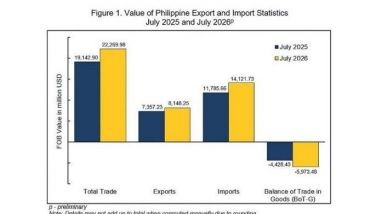
Providing some support to the outlook, AMRO expects Philippine exports to grow by around 10 percent this year as the country benefits from continued global demand for electronics and semiconductors driven by the artificial intelligence boom.
Over the medium term, AMRO said the Philippines should move its semiconductor industry into higher-value activities such as advanced and wafer-level packaging.
It also urged the information technology and business process management sector to expand into more knowledge-intensive and AI-complementary services, including cybersecurity, software, healthcare and global capability centers.




- Latest
- Trending