


Chongqing: Where growth meets green
MANILA, Philippines — Chongqing in southwestern China is a pleasant surprise to any visitor — quintessentially Chinese yet cosmopolitan, too. One can choose a favorite photo backdrop from the estimated 14,000 to 20,000 bridges in this city dubbed the Bridge Capital of the World, or enjoy its gastronomic adventures centered on mostly hot dishes.
But Chongqing is also so much more than that. It is a concrete example of how growth and sustainability can go hand in hand.
I was part of a delegation from The STAR, led by our president and CEO Miguel Belmonte and editor-in-chief Amy Pamintuan, that visited the city last month and saw some of these sustainability efforts.
‘Sponge City’
Home to 30 million people, Chongqing, for instance, is recognized for its sponge city concept.
To address flooding, a problem in many Chinese cities, Chongqing has turned to rain gardens, permeable pavements and retention ponds, systems which absorb rainwater.
In 2023, Chongqing’s first demonstration “sponge” garden opened to the public in the city’s Yubei District, marking another step toward its embrace of the concept, according to a report by China Daily.
“The garden, which is part of Chongqing Central Park, covers an area of about 700 square meters and is equipped with sustainable water systems that can collect and purify rainwater runoff from approximately 2,000 sqm of impermeable ground in a nearby plaza, according to the Chongqing Municipal Department of Housing and Urban-Rural Development.
“The garden also supports sustainability, and is planted with decorative, long-living plants. Water stored in the overflow ports from multiple gardens can be redirected to sustain the plants through a network of pipelines and sprinklers,” the report also said.
True enough, during our visit, we saw wide expanses of greenery and pocket gardens.
Transit-oriented development
We also saw and experienced firsthand Chongqing’s efficient transport system, seamlessly linked to a number of transit-oriented developments.
Chongqing, nestled among steep mountains, focused on developing extensive metro and monorail systems, alongside mixed-use structures around the different stations.
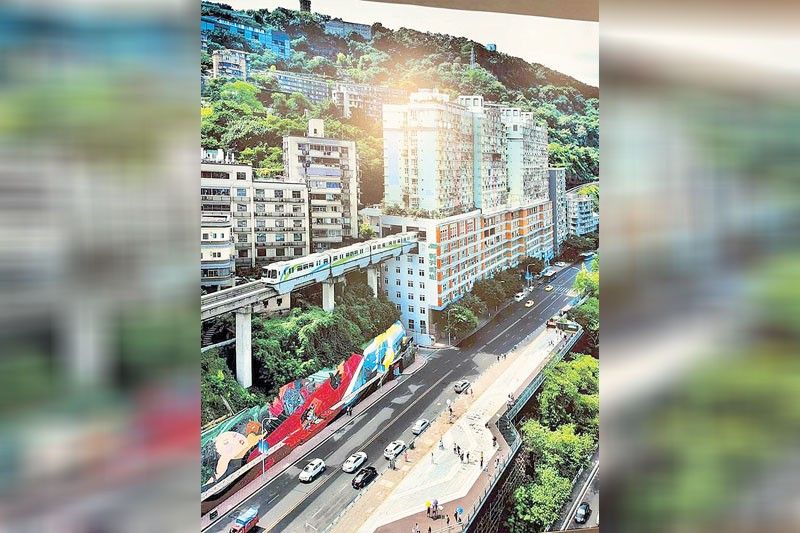
During our visit, we took the train from the famed Liziba Station, which features the iconic “train-swallowing” residential building. The station is part of a functioning light rail line, much like our MRT and LRT, but with the interesting, quirky passenger experience of being “swallowed” by a residential building as the train passes through it.
In all, Chongqing’s rail system successfully navigates the city’s mountainous terrain while helping reduce congestion and emissions.
Around the municipality, we also walked through compact neighborhoods.
These streets are pedestrian-friendly, with pathways that follow the contour of the land — steep, straight, curved, uneven and what-have-you.
The result is reduced dependence on private vehicles.
Maybe this is why traffic is generally light, as we saw during our visit.

Green mountains and clear waters
But one does not need to go around Chongqing to see all of the municipality’s sustainability initiatives.
At the Chongqing Planning Exhibition Hall, we saw a glimpse of Chongqing’s ecological civilization strategy, including its efforts to protect the Yangtze River and manage its mountains, forests and other natural resources.
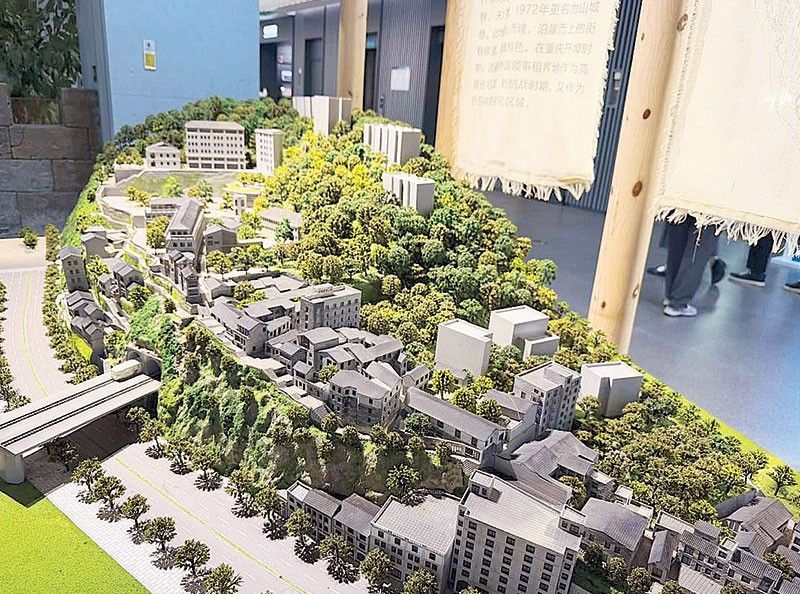
At the master plan section of the hall, there is a scale model depicting Chongqing’s layout.
It lies on a sprawling bed of sand and provides a glimpse of the municipality’s spatial planning, urban renewal and rural revitalization, all of which incorporate sustainability principles.
To put it simply, it is a model of Chongqing’s metropolitan layout and future development plans.
On the ground floor, we also saw charming immersive zones.
For instance, we were able to go back in time as we walked through reconstructed scenes of Old Chongqing. There are mocked-up homes, butcher shops and neighborhood eateries.
There are also VR cinemas where visitors can experience the geography of Chongqing.
“The Chongqing Planning Exhibition Hall serves not merely as a museum of urban development but as a learning center for sustainable cities. Through immersive exhibits on ecological conservation, low-carbon development, Yangtze River protection and integrated land-use planning, visitors gain an understanding of how Chongqing is balancing rapid urban growth with environmental stewardship. The hall’s educational programs and interactive displays reflect China’s broader effort to engage the public in sustainable urban planning,” according to the local government’s website, english.cq.gov.cn.
Against this backdrop, Chongqing is increasingly viewed as a model for sustainable urbanization in rapidly growing inland cities.
Those who think sustainability can’t be integrated into a place’s way of life must visit Chongqing.
Here, growth is not only possible but sustainable.


- Latest
- Trending


