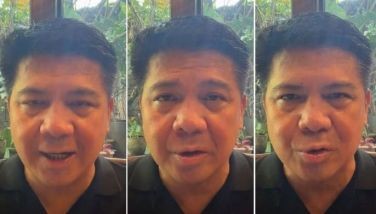
"Diverticulitis " -The president's state of health
"Diverticulitis" is admitted both by the audacious presidential spokesperson, Usec Claire Castro, as well as by the president himself. Is this a serious ailment? Does this medical condition impede, restrain, impair, or prevent the president's exercise the powers and duties of his office?
"Diverticulitis" is a medical condition adversely affecting the digestive system which occurs when small bulging pouches, called "diverticula" develop along the lining of the large intestines and become enlarged, inflamed, or infected. Common symptoms that affect the well-being of the person is severe pain in the left side of the stomach, exacerbated by fever nausea and irregular bowel habits.
The whole nation of over 117 million Filipinos, including 12 million who are working or residing in more than 180 countries all over the world are interested and have the right to know whether or not the head of state and head of government is healthy. His state of health is very crucial as we are facing a serious economic crisis caused by the Iran war.
President BBM is the commander-in-chief of all our armed forces and all the police forces, he has complete control over the Cabinet and supervision over all local governments. The president appoints all members of the Cabinet, all secretaries, undersecretaries, assistant secretaries and regional directors, and all justices, all judges, all prosecutors, all ambassadors, consuls and other diplomats, as well as all generals, colonels, admirals, commodores, and other high officials of government.
It is important that the president is not only physically fit but also of sound mind and is not suffering from any debilitating disease. Under Section 11 of Article VII of the Philippine Constitution, whenever the president transmits to the Senate president and to the speaker of the House his written declaration that he is unable to discharge the powers and duties of his office, forthwith the vice president shall assume as acting president.
Considering that the vice president is also facing a grave and imminent danger of being impeached by the House, and may be facing a trial before the Senate as an impeachment court, then we shall have a problem when the president is not in perfect health. It is like a family where the father is sick and the mother is having a problem with the law.
Under the same constitutional provision, if and when the president is too sick as to be unable to make a written transmission to the Senate and the House, then a simple majority of the Cabinet may do so, with the same effect. The president may contradict the Cabinet transmission by sending his own written transmission that he is healthy and can do the job as usual.
Section 12 of Article VII provides that in case of a serious illness of the president, the public should be informed of his true state of health. It is then the right of the people to know. If the president is the peoples' employee or public servant, then the Filipino people have the perfect right to know.
When President Manuel Quezon was sick and was convalescing in Saranac Lake in the State of New York, Vice President Sergio Osmeña Sr. was running the government. After Quezon died, he assumed the presidency. After President Manuel Roxas died due to a heart attack while delivering a fiery speech in Clark, Pampanga, Vice President Elpidio Quirino assumed the office of the president.
When President Ramon Magsaysay died in that plane crash in Mt. Manunggal, Balamban, Vice President Carlos P. Garcia forthwith took his oath in our embassy in Canberra, Australia. He was then attending a SEATO conference and he needed to assume immediately to avoid a vacuum that could trigger a coup d’état.
The president is alive and kicking. Long live the president.


- Latest