Ancient Philippine map debunks China’s imagined sea boundary

Communist China notoriously endorses fake historical sites for UNESCO recognition. Example is Chi Lin Nunnery in Hong Kong. Built only 14 years before its 2012 nomination, the Tang dynasty-style complex was exposed as “bogus antiquity.”
After UNESCO cited it in 2015 as a World Heritage Site, Tangya Tusi City Ruins in Hubei was reinvented for tourist photography via “ancient walls.” Xixia Imperial Tombs at the foothills of Helan Mountains was modified instead of preserved to fit modern tourism.
While built in the 1700s, Putuo Zongcheng Temple in Chengde, Hebei was a mere replica of the one in Tibet. Dozens of ancient buildings in Lhasa, including Potala Palace Historic Ensemble, were demolished and transformed after UNESCO honors in 1994, 2000 and 2001.
Most notorious of Communist China’s concoctions is the nine-, now ten-dash line. Drawn without geographic coordinates, it encompasses territorial and exclusive waters of the Philippines, Vietnam, Brunei and Malaysia. Beijing uses it to falsely claim the entire South China Sea. The sham boundary sometimes has eight, even 11 dashes.
Manila bases its territory on genuine maps and documents.
The 1875 Carta General del Archipiélago Filipino includes the Spratly Islands and Scarborough Shoal. Capitán Claudio Montero produced it as head of the Spanish-era Philippine Hydrographic Commission. Madrid’s Direccion de Hidrografia published it.
The US government used the map as basis for the 1900 United States-Spain Treaty of Washington. This was after realizing that the Spratlys, Scarborough, Batanes and Sibutu were parts of Islas Filipinas but not included in the 1898 United States-Spain Treaty of Paris.
The US Colonial Government reissued the 1875 Carta General del Archipiélago Filipino in 1899, 1900, 1901 and 1902. In the 1928 Islas Palmas arbitration, the US stated in its legal memo that the 1875 map “is both an American official and a Spanish official map” of Philippine territory.
Citing the map, Commonwealth President Manuel Quezon inquired with the US if the Philippines should patrol Scarborough. US State Secretary Cordell Hull replied on July 27, 1938 that: “In the absence of other claims, the Shoal should be regarded as included among the islands ceded to the United States by the American-Spanish Treaty of Nov. 7, 1900.”
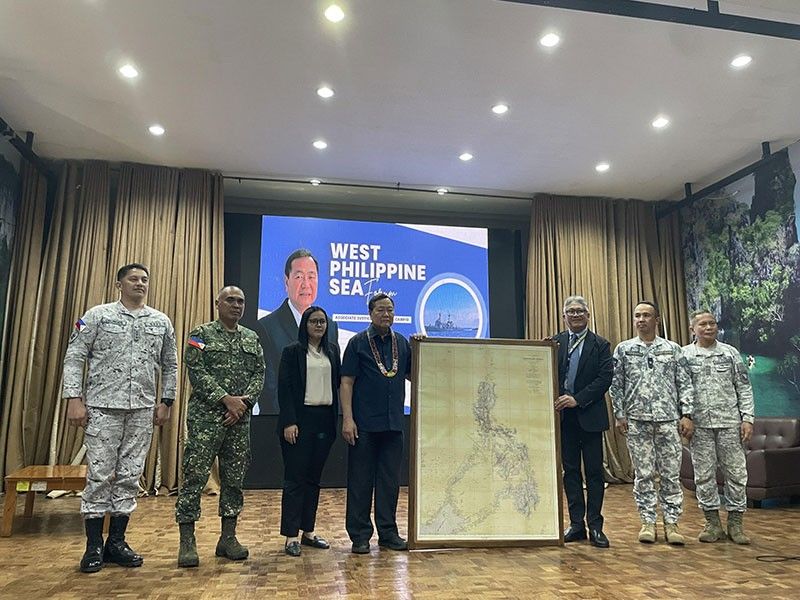
Retired Supreme Court Justice Antonio Carpio recently came upon a 124-year-old print of the 1902 reissue. Purchasing it from a Cebu antiquarian, Carpio donated the map to the National Library.
Two other ancient maps show the Spratlys and Scarborough to be Philippine territory. The 1734 Murillo Velarde map features depth soundings. So does the 1808 Carta General del Archipiélago de Filipinas.
Carpio’s friend Mel Velarde bought the rare print of the 1734 Murillo Velarde map at an auction. It is exhibited at the National Museum.
Communist China penciled its changeable nine-dash line in 1950.
* * *
Costly yet unreliable electricity hinders General Santos City’s bid to become Mindanao’s industrial hub. GenSan’s woes can worsen. The ongoing Iran conflict threatens to choke fuel supply for power generation.
Members of South Cotabato Electric Cooperative-II are to weigh two competing ways out of their predicament. SOCOTECO-II covers GenSan, Tupi in South Cotabato and Sarangani province.
On one hand is Ignite Power and Energy Corp., a joint venture of boxing icon and GenSan native Manny Pacquiao’s MP Holdings with tycoon Enrique Razon’s Primelectric Holdings. Ignite proposes partnership with the cooperative to modernize distribution.
Should members accept, Ignite would take over SOCOTECO-II’s assets. Substations, transformers, lines and poles would be rehabilitated and upgraded. Ignite frames the arrangement as partnership rather than takeover. SOCOTECO-II would retain its cooperative identity, management structure and ownership of real properties.
The joint venture is to tap Primelectric’s power distribution experience. Prime has reduced system losses and improved power supply through MORE Power in Iloilo City, Negros Power in Negros Occidental and Bohol Light in Tagbilaran. These distributors now charge among the Visayas’ lowest electricity rates with high customer satisfaction.
On the other hand is Manila Electric Company, which offers full privatization of SOCOTECO-II. Meralco’s takeover of the cooperative can stop any more three-hour daily blackouts.
With 120 years in the industry, Meralco supplies electricity to over eight million residential, commercial and industrial customers in 39 cities and 72 municipalities. Frustrated customers in towns adjacent to Meralco’s franchise are clamoring to be put under its service. Only last month 2,000 residents of Laiya, Batangas petitioned Meralco for coverage.
Meralco proposes to convert SOCOTECO-II into a stock corporation. Members-owners are to become shareholders and receive annual dividends. If ever, it would be the first electric cooperative to incorporate. Meralco plans to modernize operations and upgrade distribution lines and metering. Meralco proposes that SOCOTECO-II will still own the assets and retain employees.
Ignite and Meralco’s proposals diverge in how they will be approved. Ignite’s joint venture will require approval of majority of all SOCOTECO-II members via plebiscite. Meralco’s privatization plan would be decided by a simple majority of those who participate in a referendum.
Regardless, both proposals deserve urgent scrutiny as South Cotabato and the wider SOCCSKARGEN region face rising power demand amid frequent outages. No one deserves blackouts. GenSan must have its chance to become a growth corridor.
More than bringing in investments, these proposals involve public interest. Customers deserve stable electricity and must not be made to suffer through inconsistent service.
For SOCOTECO-II’s member-owners, the choice is less about competing corporate narratives and more about which plan can deliver measurable gains and bring relief to their power-strapped communities. Their choice will influence not just the future direction of the cooperative but also the economic prospects of the communities that it serves.





- Latest
- Trending