10,000 Kaizen ideas could make you broke if…

What is the actual, monetary value of your employee suggestions? That question came to me when I read a recent post by my friend Darril Wilburn on LinkedIn. He claims to “have seen companies report a big Kaizen count while they were losing money.”
Darril, senior partner at Honsha. ORG and co-author of the 2026 book Courage, Humility, Kaizen: The Three Disciplines of Toyota Leadership says “a lot of organizations count how many Kaizen (ideas) they completed. Hiro (Yoshiki, his co-author) would rather ask, “how much time and effort are we investing in Kaizen, and what are (we) getting back?”
That’s a profoundly important question. In the corporate circus, managers would claim they are geniuses. They celebrate more than 10,000 implemented ideas on how to save paper clips and reduce production delays by three seconds and still wonder why their quarterly net loss remains staggering.
I messaged Darril to ask for more ideas. His reply: “Many organizations…report that number (employee ideas) as a sign of success, while the measure that says the business is losing money gets far less attention.”
That brings us to a question often raised by financially-oriented managers: “If we fix that bottleneck, how much measurable savings can we generate?” It’s not that simple. When a team saves two hours of searching for tools or spare parts across the shop floor, that time doesn’t automatically show up as savings on their income statement.
What you get is recovered capacity. Two hours of savings can be redirected toward producing more volume without overtime, doing more with the same headcount or solving other problems. That’s assuming management knows how to redeploy the recovered time.
Barriers to implementation
I have seen managers encouraging their people to give more ideas. The result is often a large number of suggestions submitted, but not their actual, vetted contribution to their profitability.
It’s like measuring a chef’s success story by how many recipe cards he has written while the restaurant’s financial statement remains in the red.
My latest client has calculated a significant, potential cost savings of P93 million (around $1.4 million) after one day of a Kaizen workshop participated in by 26 workers assigned in four groups.
I told them to consult with their accountants on the accurate figure. But even if they’re successful in getting only ten percent of that savings, they should repeat the process in other areas.
When I did a follow-up two or three months after the workshop, I discovered several issues preventing them from achieving success.
Instead, they talked about the following issues:
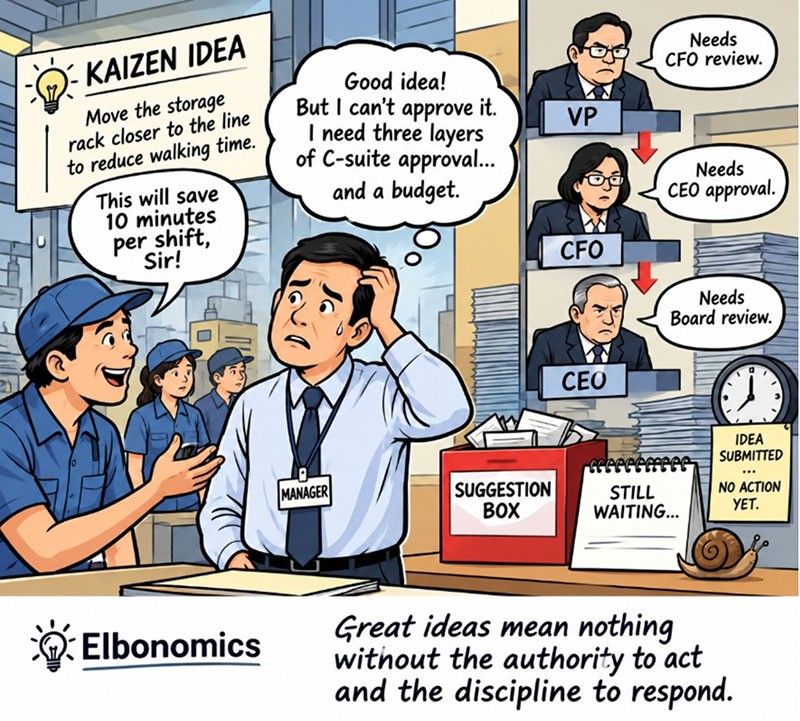
1. Lack of authority. They are not empowered to implement change brought about by their employees’ ideas. They support those ideas, but they often lack the authority or budget to implement them.
They hold titles like medieval warlords, yet they need three layers of C-suite approvals to buy a box of ballpoint pens or move the trash can three inches to the left of a work desk.
In solving this issue, I told their top management to set a clear threshold limit (like a $100 budget) where managers can immediately approve low-risk, low-cost ideas with zero health or safety implication.
Alternatively, empower team leaders, supervisors or managers to act as sponsors to defend a business case to decision-makers.
2. Management procrastination. When managers require their workers to submit ideas, but take too long to acknowledge them, the latter could experience feedback frustration. If this happens all the time, people would quickly realize that the suggestion box is simply a recycling bin.
Therefore, the solution is to implement a strict enforceable working day timelines like 48 hours for the acknowledgement. Then followed by a maximum five-to-ten-day schedule for evaluation and decision by a management committee, depending on the significance of potential savings and complexity of ideas.
In conclusion, don’t force employee ideas into a rigid, spreadsheet-driven financial forecast. Some improvements generate immediate savings; others identify capacity, improve safety, reduce frustration or prevent future losses.
All deserve attention, but their benefits should be measured appropriately within the culture of perpetuating small, daily improvements compounding so aggressively that waste never gets the chance to settle in.
Rey Elbo is a quality and productivity activist. Send your comments, stories or ideas to [email protected] or DM Facebook, LinkedIn, X or via https://reyelbo.com/contact-us.









- Latest
- Trending