


What’s the most difficult part of your job?

Last month, I spent several days as an unwilling guest in a hospital that offers a basic range of diagnostic and treatment capabilities.
Since there wasn’t much to do between blood tests, vital-sign checks and staring at the ceiling, I turned the experience into a field research project.
I asked about 20 nurses what they considered the most difficult part of their job.
Ninety percent gave the same answer: venipuncture – the delicate art of inserting a needle into a patient’s arm to draw blood or start an intravenous line.
Their answer didn’t surprise me. It was actually the first question I asked after an emergency-room nurse in the same hospital made several determined attempts to locate a cooperative vein in my arm.
By the fifth try, I was beginning to think my veins had joined a labor union and declared a strike. Despite the discomfort, I stayed calm and treated the nurse kindly. She appeared to be new or nervous. I’m sure she didn’t want me to become a human dartboard. I know, because I have a daughter-nurse who was on the same boat despite those cranky patients.
Three years ago, when I was hospitalized in a major hospital known to handle complex and high-risk cases, I encountered highly capable nurses equipped with a mobile vein finder. Why not?
A vein finder costs around $2,000. While not exactly cheap for some small hospitals, the investment may be justified by improved patient care and reduced nurse stress.
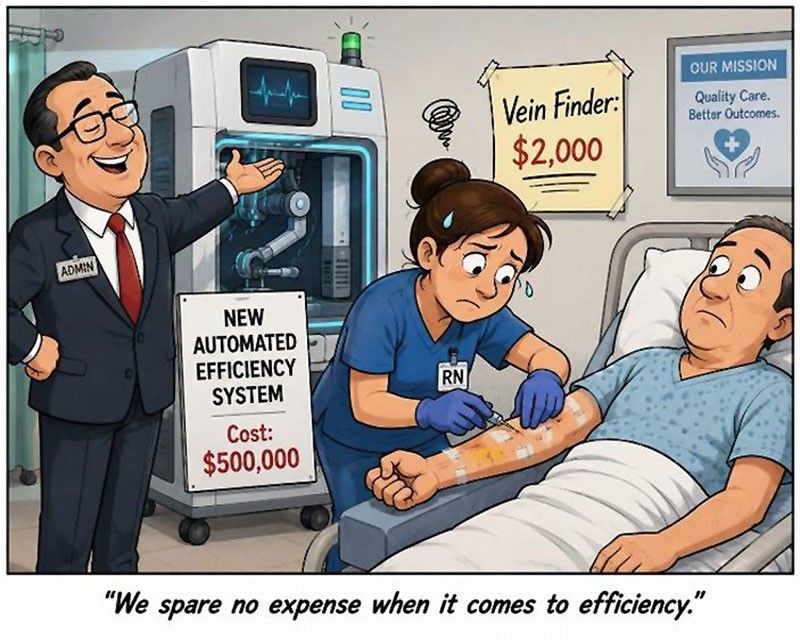
The question is – why do some hospital managers appear aloof in their workers’ difficulties?
Eliminating difficulties
This personal observation extends far beyond hospitals with many managers telling us: “If you choose to work for us, then do your best in whatever circumstances.”
Do they mean even at the expense of the customer or the patient? I hope not.
Dynamic managers who believe in Kaizen and Lean Thinking often focus on eliminating workers’ difficulties which translates to physical or mental overburden, strain or stress.
Japanese managers call it muri,one of the three evils of production aside from muda (waste) and mura (imbalance).
When done by nurses in a 12-hour work shift,muricreates fatigue and burnout that could lead to costly mistakes affecting patients.
It is the irony of modern business. They spend millions in acquiring machines running at peak efficiency without friction, yet we treat human beings like old machinery – running them beyond their capacity until they break down.
So, how do we solve this constant issue? There are sustainable and systematic procedures. Here are some of them:
1. Strip away the friction. Manyworkers want to do a good job except they are often blocked by awkward systems, missing or broken toolsor poor communication channels caused by their managers. Removing these bureaucratic issues softens the mental and physical strain of people and their customers.
2. Install an ergonomic system. The Japanese call this karakuri.They design work stations and assembly lines so a work piece becomes easily accessible to the worker. It is an ingenious system that relies heavily on nature’s gifts, such as gravity so a worker is not forced to lift heavy boxes or reach out for a tool or part.
3. Apply an error-proofing solution. Instead of steady worker vigilance that causes fatigue, dynamic organizations implement poka-yoke mechanisms. It’s done by redesigning the workflow so that potential mistakes are made physically impossible. Think of a microwave oven that you can’t operate if its door is open.
4. Ensure workers’ psychological safety. Create a blameless work culture. When something goes wrong, the manager’s immediate question should never be: “Who did it?” Instead, leaders ask a better question: “What in our system allowed this to happen?” Then, allow the workers to suggest a better way of doing things.
In summary, a difficult working condition is a defect in management design and workers can’t be optimized like machines. The best managers don’t ask workers to keep searching for invisible veins. They provide the tools, systems and support that make the veins easy to find.
If you fix the process by respecting human limitations, quality and productivity improvement could follow naturally.
Rey Elbo is a quality and productivity activist. Send your comment, question or story [email protected] DM him on Facebook, LinkedIn, X or via https://reyelbo.com


- Latest
- Trending


