No magic wand

In another decade when our turn again comes around to chair the Association of Southeast Asian Nations, let’s hope there will be no more protests that we’re entertaining beyond our means. Or that insatiable crooks are using the ASEAN summit to steal more from public funds.
If the incorrigible looters hadn’t bled national coffers dry, it could be easier to believe that P22.9 billion allocated over two years is people’s money well spent for hosting the year-long meetings and summits as ASEAN chair.
But because of what we’ve found out in the past year, and widespread suspicion that what we’ve uncovered is just the tip of the iceberg in the corruption problem, utilization of that P22.9 billion is going to face minute scrutiny.
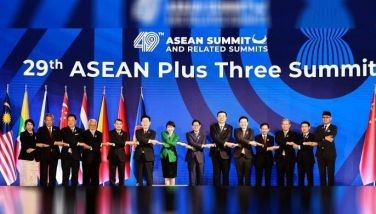
Outside the failure to finalize the Code of Conduct on the South China Sea, which was a long shot from the get-go anyway, there were several important regional and bilateral agreements signed during the ASEAN summit and related summits.
But their benefits will be felt in the medium to long-term. Our economy is currently sputtering from high inflation and slowing growth, and the insatiable greed and venality of the ruling political class.
The Philippine Chamber of Commerce and Industry said its members – mostly micro, small and medium enterprises – have run out of “magic wands” to stay competitive in 2027.
But there are some in the business community who haven’t lost hope. Their common suggestion – what they describe as a low-hanging fruit that can have a swift impact – is to fix the 2027 national budget.
It’s no magic wand, no silver bullet, but it can be a start.
* * *
Several congressmen have come out to defend their insertions in the National Expenditure Program (NEP) put together by the executive after months of preparations by the different agencies.
The congressmen are invoking their power of the purse. But it’s a power they have abused for personal gain, like their power to set the terms of barangay and Sangguniang Kabataan officials. There are surely incumbent SK members who are now overaged for their posts, thanks to repeated postponements of the BSK elections.
All those last-minute budget insertions, driven by short-term personal political objectives (and worse, corruption) wreak havoc on project implementation and long-term development planning.
Since my early days as a reporter, I’ve heard public works officials bemoan political interference in their projects. They complained that the politicians not only demanded implementation of their pet projects but also picked the contractors, including those not accredited by the department.
President Marcos, for all his faults, will be remembered for exposing this rot in the budget process and public works projects.
His effort to excise the rot has been an uphill battle, and he has been losing relatives and friends as a result. His credibility has also taken a hit as even his son, Ilocos Norte congressman Sandro, has been tagged in the questionable insertions in the 2027 spending bill.
* * *
There’s a suggestion from certain quarters: if lawmakers want to have a say in the preparation of the national budget, why can’t they be allowed to participate at the outset, through the regional development councils, with national and local governments and economic agencies participating?
At that level, lawmakers can propose their pet projects, with full transparency. The councils can deliberate on the usefulness of the projects, and forward the worthy ones to the multi-agency Development Budget Coordination Committee, which crafts the NEP.
Such participation in crafting the spending program can be presented as broad consultation with all government branches and agencies needing public funding, rather than interference by lawmakers in an executive function.
This is the spending program that the implementing arm of government, the executive, needs, and believes can be funded through projected revenues for the incoming fiscal year. This is what the Chief Executive needs to run the government.
Under this proposal, the legislature still retains its power of the purse; it will translate the NEP into law, the General Appropriations Bill.
* * *
It’s a safe bet though that this proposal will be dismissed by lawmakers who are insisting on their right to budgeting acrobatics including insertions, now repackaged as “institutional amendments.”
Despite the public outrage over what budget watchdogs have described as “the most corrupt budget ever” – the 2025 General Appropriations Act – and the runner-up, the 2024 GAA, this year’s GAA still contained questionable provisions that were struck down by the Supreme Court together with the 2025 and 2024 national outlays.
For 2027, lawmakers are again moving to use the national budget to finance their campaigns for the 2028 elections. Budget watchdogs have flagged “hard, soft and shadow pork”-type items in the 2027 GAB churned out by the House of Representatives.
Several HOR members have defended their predilection for pork and insertions, with an indignant House Deputy Speaker Ronaldo Puno decrying the “ignorance” of the watchdogs.
The ignoramuses are working with senators to overhaul the GAB passed by the HOR budget geniuses. With a tight period for the overhaul and the bicameral conference, however, many of those “institutional amendments” and “soft, hard, shadow” pork may still be approved.
While the reformers race against time, we can give the ignoramuses a medal for heroism in ensuring that it can no longer be business as usual in the budget process.




- Latest
- Trending