What shopping teaches us about wasteful motion

If you have a wife, daughter or girlfriend, you know the amount of patience you need when you accompany them in a shopping adventure. The experience is like an endurance sport, a psychological masterclass and an exercise in total surrender.
It’s a classic example where patience is no longer a virtue. Patience can’t even fit on a standard one to ten scale. Rather, it exists on a continuum that shifts depending on your age and what phase of the mall trip you have entered.
My worst experience happened in Tokyo many years ago, when my daughter and niece spent too much time shopping before our flight home. That made us missed our flight back to the Philippines. That was an expensive mistake that we can’t forget.
Today, my shopping trips with my spouse have evolved from romantic dates into full-scale budget expeditions during our weekly grocery runs.
Four decades ago, she would ask, “How does this look?” Today, her concern is more likely to be, “How long can we park for free with our senior-citizen privilege?”
And she’s no longer agitated by the allure of a department store except when there’s a grocery sale.
I don’t mind waiting for her while she’s enjoying the experience as I’m seated in a plastic bench for senior citizens that smelled like mushy, old books.
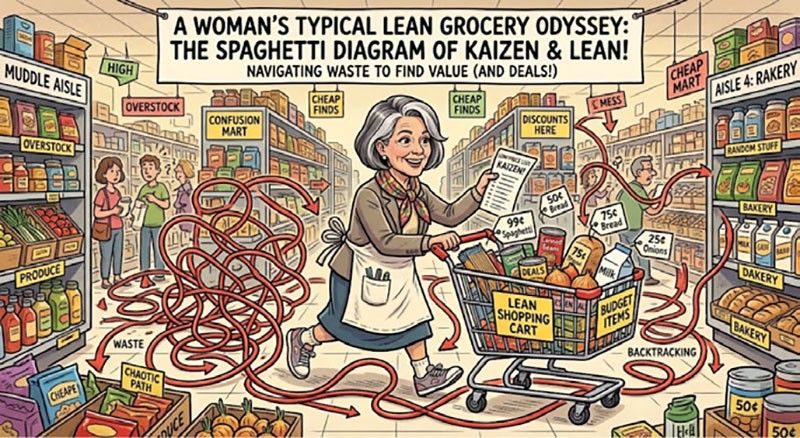
Waste of motion
Looking back at those hundreds of waiting hours, it’s easy to understand the meaning of a spaghetti diagram, a tool used in Kaizen and Lean Thinking (KLT) to map movement paths and identify unnecessary walking.
So, how can KLT help transform a complex, wasteful process into a streamlined, value-adding system? How do we reduce the waste of motion in a spaghetti diagram?
Using my experience in grocery shopping, the key is to list down all basic necessities limited to around ten items, that includes oatmeal, soya milk, raisin bread, gelatin, biscuits, eggs, fruits and veggies.
It takes no more than 15 minutes to do everything with the list. No excess motion, no waiting, no extra handling and no additional steps. Unfortunately, married life has its own timetable, and I have learned to follow my wife’s pace.
On the shop floor and in service areas, a spaghetti diagram can reveal unnecessary movement and other sources of inefficiency. Therefore, how would you start solving those issues? Here are the basic steps:
1. Define value and non-value-adding activities. In grocery shopping, customers value finding the items they need conveniently and completing their purchases efficiently at the checkout counter.
Compare that with non-value-adding activity like walking back and forth across the store.
At the shop floor, observe where processes have become invisible due to lack of labels, tangled with other items or whatever that makes them inefficient for everyone.
2. Measure the losses. What causes people to travel unnecessary distances, cross paths repeatedly or encounter congestion? Measure the total distance, frequency of trips and wasteful search time for tools and parts.
Quantify the cost of wasted labor time, unnecessary handling or other measurable losses, using reasonable assumptions.
3. Brainstorm improvements to the proposed layout. Focus on low-cost interventions. Some examples are relocating the machines, workstations, tools or raw materials so they become close to the point of use.
Visualize the waste of motion and inefficient routing. Use a cardboard layout to serve as the physical prototype of a proposed change.
4. Implement the changes. Apply the new layout, update standard work and retrain workers as needed. Continue supporting programs like employee suggestions and 5S Good Housekeeping.
Beware of health and safety concerns. To ensure success, pilot small changes as much as possible.
5. Monitor and sustain the changes. Create a new spaghetti diagram of the improved process. Compare before-and-after metrics of distance, time and frequency of worker trips. Quantify the gains in monetary value and demonstrate actual results to management.
Standardize the new flow. Watch out for any new issue. Repeat the cycle to sustain continuous improvement.
In everything that you do, remember that results become strong when the shop floor and service area workers participate in every step of the way. Then, don’t forget to celebrate the win with the team.
Rey Elbo is a quality and productivity activist.Send your comments, questions or stories to [email protected] or via Facebook, LinkedIn, X or https://reyelbo.com.








- Latest
- Trending