‘Good products come from good thinking’

A reader asked me on a Facebook chat: “Who is better – an individual genius who gives ideas worth millions or an army of problem-solvers giving their two-cents worth?” My answer is both. Giving ideas is not a zero-sum game.
All ideas are welcome regardless of its value. I learned it from Toyota’s model of soliciting and accepting hundreds of thousands of ideas, many of which are trivial like moving a trash can to a strategic location, adding a hook for efficiency or shaving three seconds off a certain procedure.
More importantly, for ordinary workers’ ideas, the risk, if any is minimized. Besides, no single idea has to be brilliant.
Both a genius idea and an ordinary worker’s two-cents idea have immense value in solving different problems. That’s why Toyota’s successful system deliberately uses both.
But that’s not all. An army of problem-solvers provides high participation rates and high implementation, turning them into a continuous improvement engine. However, the advantages of an army of ordinary problem-solvers are clear.
Ideas come naturally for people who are always at the shop floor rather than those who are practically hand cupped to their mahogany table.
While the ideas of some geniuses are hard to come by, ordinary workers make it almost a practical hobby to give ideas, at least in the case of Toyota and other dynamic organizations.
TPS 2.0
Toyota receives approximately one million suggestions per year from its workers around the world. “In 2023, some 810,000 suggestions were submitted, averaging out to 67,000 per month, or 14.4 per person over the course of the year,” according to Toyota Times.
The ideas are mostly small innovations rather than astounding breakthroughs. Credit goes to Toyota’s long-running Creative Idea Suggestion System established in 1951, as an integral part of the legendary Toyota Production System (TPS).
To my mind, however, TPS stands for something deeper. I prefer calling it the Thinking People Strategy (TPS 2.0), to emphasize the value of man’s rational thinking.
TPS 2.0 is strategically human. Because no matter how many buzzwords and theories you drop, nothing moves productively unless people think first. Sure, machines can automate tasks, but people must explore and decide which problems are worth solving.
Even AI can’t lead your morning meetings. At least not yet. That means, it isn’t about how fast you can tighten a bolt. It’s how effectively you can stimulate people’s thinking.
Lest you become confused. TPS 2.0 isn’t a feel-good poster in the breakroom or an off-site retreat driven by awkward icebreakers. It’s a mindset shift. It’s an idea destroying the quirks of command-and-control managers – that people must be encouraged and empowered to think.
Motion as progress
One caveat. You’ve probably seen it before. There are managers who mistake motion for progress. They attend long meetings to decide who should schedule the next meeting. It’s not work, but stagecraft.
Noise doesn’t equal progress. The busiest or talkative person in the room isn’t always the most effective. Sometimes, these people accomplish little beyond appearing occupied.
Taiichi Ohno (1912-1990), the father of the Toyota Production System said: “People continue to work at Toyota to think.” It’s not a poetic slogan, but a paraphrase of
“Good Products Come from Good Thinking” to remind every worker that great output begins with great ideas.
Such concept is enshrined in every Toyota location like the photo below taken in 2023 when I visited Toyota Kaikan Museum in Toyota City, Japan.
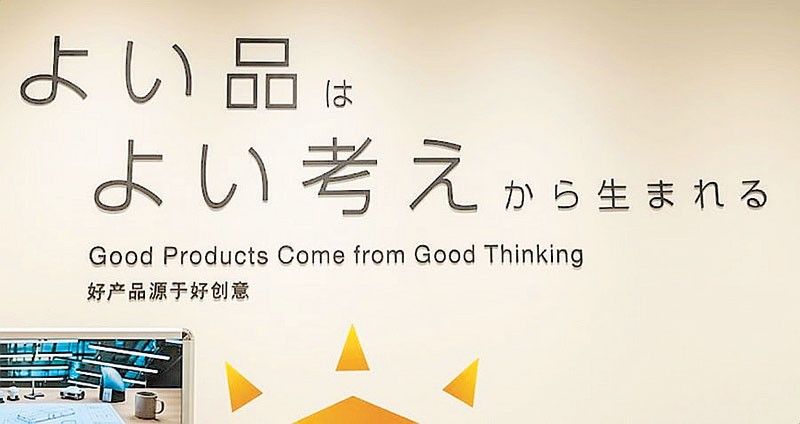
It reminds everyone, before doing something to ask: “Is there a better way of doing this?”
Unfortunately, in many organizations today, the moment someone stops to think, alarms go off. Managers panic, assuming it’s a rebellion. But Toyota proves otherwise: thinking isn’t downtime — it’s design time.
People think more effectively when they have the time and freedom to examine problems rather than simply follow instructions. That’s how organizations can encourage better thinking by rewarding employees who identify and implement useful improvements.
Therefore, good products come not merely from people who think, but from those who are encouraged to identify problems, test better methods, and turn good thinking into measurable improvements. People must think first to produce brilliant ideas.
That’s how good thinking makes good products and services.
Rey Elbo is a quality and productivity activist. Send your comments, questions or stories to [email protected] or via Facebook, LinkedIn, X or https://reyelbo.com.







- Latest
- Trending