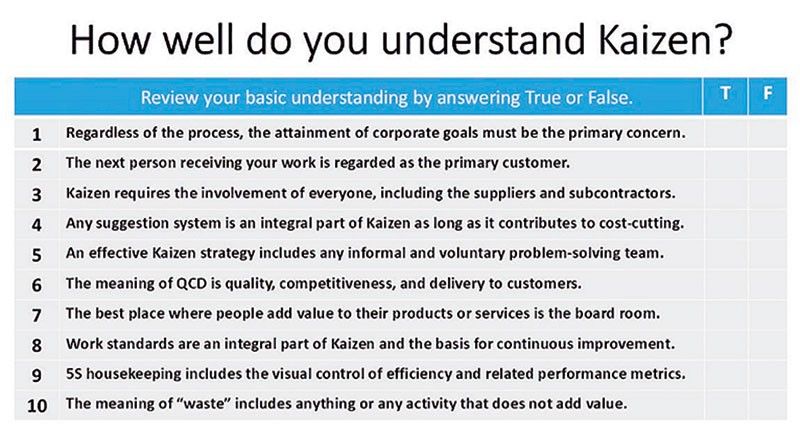
How well do you understand Kaizen?

Imagine unlocking a superpower that transforms ordinary routines into engines of extraordinary progress, but without overhauls, massive budgets or overnight miracles. That’s the quiet revolution of Kaizen.
Almost everyone in the corporate world knows it as the Japanese philosophy of continuous improvement that has powered Toyota’s legendary rise, reshaped organizations worldwide including banks and hospitals, streamlined supply chains and turned everyday workplaces into hubs of quiet innovation.
Kaizen thrives on the subtle art of relentless, incremental change: spotting tiny inefficiencies, empowering people to contribute ideas and compounding small daily improvements into sustainable results.
It invites you to question the status quo every single day, eliminate waste in every sneaky form using my favorite DOWNTIME memory jogger representing Defects, Overproduction, Waiting, Non-use of employee talent, Transportation, Inventory, Motion and Excessive processing.
Kaizen builds a system where people and processes improve together, continuously.
At its heart, Kaizen is democratic and human-centered. It rejects the idea that improvement is the exclusive domain of factory managers or management consultants. Instead, it insists that the people closest to the work hold the richest insights.
By fostering a culture of psychological safety, transparency and relentless curiosity, organizations unlock an army of problem-solvers rather than a handful of “black belters.”
The results compound: higher quality, lower costs, faster delivery, better employee engagement and customers who keep coming back. But how well do you really understand its essence beyond the buzzwords?
Before diving further, test your instincts against the fundamentals. What follows is a straightforward yet revealing True-or-False challenge drawn directly from the foundational ideas in Masaaki Imai’s classic book “Gemba Kaizen” (1997).
Master the basics: know your customer, define an efficient flow, visit the actual place of work (gemba), empower people, and be transparent about performance metrics. Then, you’ll see exactly why the simple Plan-Do-Check-Act cycle turns abstract theory into unstoppable daily momentum.
Be ready to live it, lead it and multiply it across your team. So, let’s find out if you’re a natural Kaizen practitioner or still warming up on the sidelines with only a few buzzwords.
Basic principles
To give you a complete look at Kaizen, I suggest you take a Kaizen IQ test and see if you’re a true master of subtle, relentless self-improvement or just a professional procrastinator with a fancy vocabulary. For your convenience, I have designed the following 10-point True or False quiz.
Before answering the quiz (see below), understand that Kaizen has five major, foundational principles: They are knowing your customer, defining the efficient flow, visiting the shop floor or back room, empowering people and being transparent with performance metrics.
Kaizen and Lean share many principles and practices, including PDCA (Plan-Do-Check-Act) Cycle, waste elimination, standardization and respect for people with the following strategies:
1. Plan by identifying waste and applying small adjustments.
2. Do by testing the small adjustment, preferably with a low-cost approach.
3. Check and monitor by measuring the results against baseline performance metrics.
4. Act by adjusting the change.
As soon as you are through answering the quiz, prepare to compare your answer with the following:
1. False. Focus on improving the process so you can achieve the best possible result.
2. True. It’s both the internal (your boss or colleague) and external customer.
3. True. Kaizen is not a lone ranger’s game. It requires everyone’s cooperation.
4. False. Employee and customer suggestions should not be limited to cost-cutting.
5. True. Whether formal or informal, all ideas or suggestions should be welcomed.
6. False. The correct operational framework is Quality, Cost and Delivery.
7. False. The best place to understand a problem is where it is located.
8. True. If there are no work standards, it would be difficult to do Kaizen.
9. True. Visual control makes standards and abnormalities easier to see and manage.
10. True. Non-value-adding activities should be eliminated, reduced or simplified.
Mastering Kaizen isn’t just about memorizing theory. It requires actively driving small, continuous process improvements, empowering teams, eliminating waste and standardizing workflows.
Scoring seven or higher on this quiz proves you truly grasp these basic principles and are ready to create lasting operational efficiency through relentless, incremental action with an army of problem-solvers. This insight reveals how small actions create massive impact.
Rey Elbo is a quality and productivity activist. Send your comments, questions or stories to [email protected] or via Facebook, LinkedIn, X or https://reyelbo.com.





- Latest
- Trending