Airbus pitches A220 to Philippines carriers
To connect small islands to foreign cities
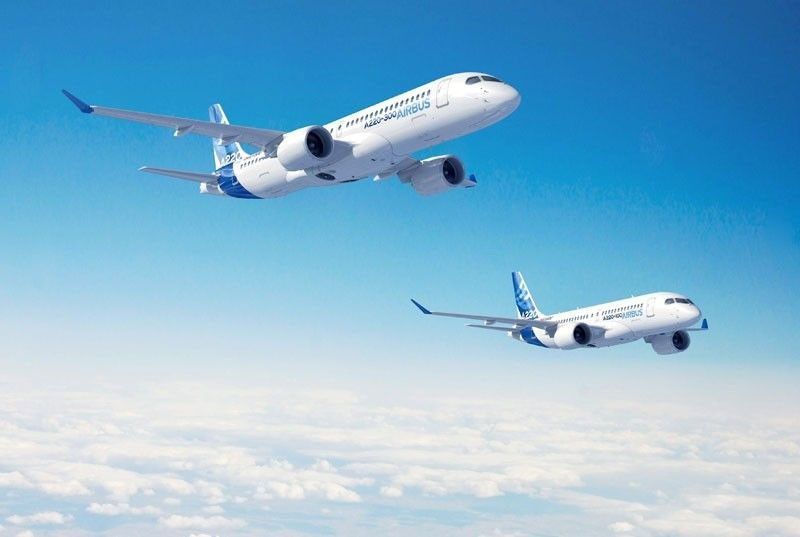
MANILA, Philippines — Aerospace giant Airbus is proposing to finally bring its only aircraft currently unavailable in the Philippines, the A220, that carriers can use to connect small islands to key cities abroad.
Airbus president for Asia-Pacific Anand Stanley has urged Philippine carriers to consider the smaller single-aisle A220 as an alternative to their turboprop fleet, which would be barred soon at the Ninoy Aquino International Airport (NAIA).
The A220 is the little brother of the A320, specifically made by Airbus to land in smaller airports that are incapable of handling larger single-aisles.
In spite of its smaller size, Stanley said the A220 brings competitive advantages missing in turboprops. The A220 can seat anywhere between 100 and 160 guests, whereas turboprops are limited to below 80.
Further, the A220 can fly up to 3,450 nautical miles, giving carriers the flexibility to use it either locally or internationally. Stanley said the A220 could change the game for island destinations in Visayas and Mindanao in reaching high-demand cities like Singapore and Taipei.
In September, flag carrier Air Nuigini became the 25th operator of the A220, adding the aircraft to its fleet to boost capacity for international flights.
“This aircraft is able to connect regional, smaller routes, but it is also able to do – for the size of this aircraft – ultra long-range routes, such as Papua New Guinea all the way to Singapore, which takes about six, seven hours,” Stanley told The STAR.
For Stanley, introducing the A220 to the Philippines could balance the need for the government to keep provincial airports as is, without having to convert them into larger gateways that require additional land and resources.
The A220 requires a runway of just 1,500 meters to land and take off, unlike the A320 that needs about 2,000 meters. As such, Stanley said carriers can maximize the A220 in linking tourist spots with their source markets.
“This is an aircraft that can do island airports, turn around and connect to places like Singapore, Australia, Hong Kong, Taiwan, which is extremely powerful in terms of connectivity. Today, we may need mega airports for these connections, but sometimes you need to balance this also with micro airports,” Stanley said.
No Philippine carrier currently operates an A220 on their fleet, as they manage flights with mostly larger single-aisles like the A320.
Still, Stanley is encouraged by the A220’s entry into Papua New Guinea, so he also wants to test whether the Philippines is interested in it.
Aviation consultant ACC Aviation estimates the A220 to cost $81 million for the smaller model A220-100 and $91.5 million for the wider variety A220-300.
As of August, Airbus has signed orders for more than 940 A220s from over 30 airlines globally. To date, the manufacturer has delivered 440 of the demand.
Currently, the A220 is flying on around 1,800 routes to roughly 480 destinations worldwide, and Airbus is gearing up the aircraft to lead the market for smaller single-aisles. Airlines are eyeing the A220 for its flying efficiency, burning 25 percent less fuel compared to previous generations.







- Latest
- Trending