How modern techniques are transforming ube farming in Bohol
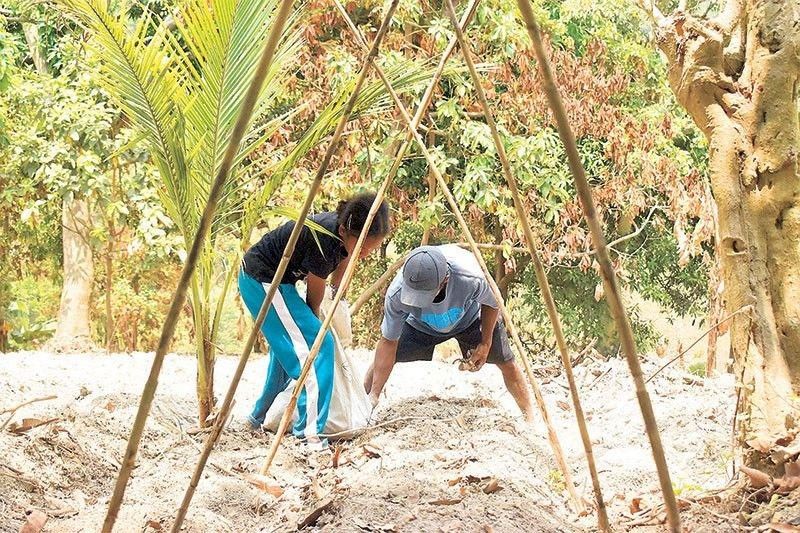
MANILA, Philippines — Farmers in the Philippines’ ube capital are being taught science-based techniques to boost purple yam production as global demand for the crop continues to grow.
Bohol is the country’s largest producer of ube, but its farmers are facing significant challenges, including the crop’s seasonality and a lack of planting materials.
Ube is traditionally planted during the May-June window, but a team of researchers from the Philippine Root Crop Research and Training Center (PhilRootcrops) of the Visayas State University has identified five purple yam varieties that can be planted outside the usual planting season.
These varieties include Ubi Kinampay, dubbed the “Queen of Philippine Yams;” Zambal, which bypasses the two-to-four-month dormancy period and local breeds Baligonhon, Inoringnon and Kabus-ok.
“We have proven that February planting is possible,” Marlon Tambis, PhilRootcrops director, said. “There are only aids in how to germinate ube in that month when it shouldn’t have germinated.”
“So far, we have shown that we also have a breaking of dormancy and propagation protocol in months when it doesn’t really grow naturally, and so far, we have demonstrated that to farmers,” he explained.
Another challenge is how to improve yields. The country’s ube production has significantly dwindled to just 14,000 metric tons in 2020 from 30,074 MT in 2006, according to the Philippine Statistics Authority.
Tambis’ group has begun training farmers to use an advanced method known as minisett — a rapid propagation technique that cuts the mother yam tuber into smaller, more functional pieces.
Developed in Nigeria in the 1970s, the minisett technique addresses the cost of replanting the entire mother yam tuber, which multiplies only up to five.
Under traditional methods, farmers can produce only seven to 10 planting materials from one kilo of ube. Using the minisett method, however, that number triples to over 30.
Tambis’ group is also working on the use of the tissue culture method, which they aim to deploy next year. Under this technique, tiny pieces of plant tissue, such as a cell or root tip, are grown inside glass jars or Petri dishes filled with a gel under strictly controlled temperature and light.
“When we say tissue culture, it means it is produced in the lab. It goes through very artificial conditions, and there is a long process before you can put it in the actual conditions in the field,” Tambis said.
“It first goes through incubation and hardening, and hardening is the critical part that will determine if it is really ready to be transferred to the field,” he added.
Tambis and his team’s initiatives are under the umbrella project titled “Enhancement of Ubi Production through Trials and Demonstrations of S&T-Based Farm Practices to Support Industry Development in Bohol.” They are in collaboration with the Bohol Island State University and receive funding from the Department of Science and Technology’s Philippine Council for Agriculture and Aquatic Resources Research and Development.
Food and beverage analytics firm Datassential reported that in the United States alone, ube offerings have surged 230 percent on menus over the past four years. One in four American consumers is now aware of this Filipino crop.
On Instagram, a quick search of #ube returns over 746,000 posts.
If the Philippines wants to keep up with rising ube demand, farmers should rely on a field that guarantees higher yields: science.
“Based on our scoping studies, their production practices are really not very scientific. So, there is a low adoption of necessary recommended practices or science and technology-based practices, which we need to address to improve the yield,” Tambis said.


- Latest
- Trending