


The son also rises in the Land of the Rising Sun
I was among those fortunate enough to witness what I can only describe as one of the most consequential state visits in recent Philippine diplomatic history.
When President Ferdinand “Bongbong” Marcos Jr. or PBBM touched down in Tokyo last May 26 for a four-day state visit, he carried with him the weight of 70 years of friendship and the ambitions of a nation determined to build something greater.
To understand why this visit matters, we need to go back to July 23, 1956, when the Philippines and Japan normalized their diplomatic relations. This was a period that carried with it as much moral significance as it did historical weight, coming barely a decade after two nations that had fought each other with devastating ferocity chose reconciliation over bitterness through the Reparations Agreement.

From those difficult beginnings, the relationship grew steadily into one of the most productive bilateral partnerships in Asia, with Japan becoming one of our top trading partners and largest sources of official development assistance, a journey that culminated in the Strengthened Strategic Partnership declared in 2015 by then President Benigno Aquino III and Prime Minister Shinzo Abe.
The 2026 state visit was the first of its kind by a Philippine president since 2015, coinciding with the 70th anniversary of normalized ties, and President Marcos was joined by a Cabinet delegation that included Foreign Affairs Secretary Theresa Lazaro, Public Works Secretary Vince Dizon, Tourism Secretary Dita Angara-Mathay, Trade Secretary Cristina Roque, and Ambassador Mylene Garcia-Albano, a lineup that signaled this was as much a business mission as a diplomatic one.
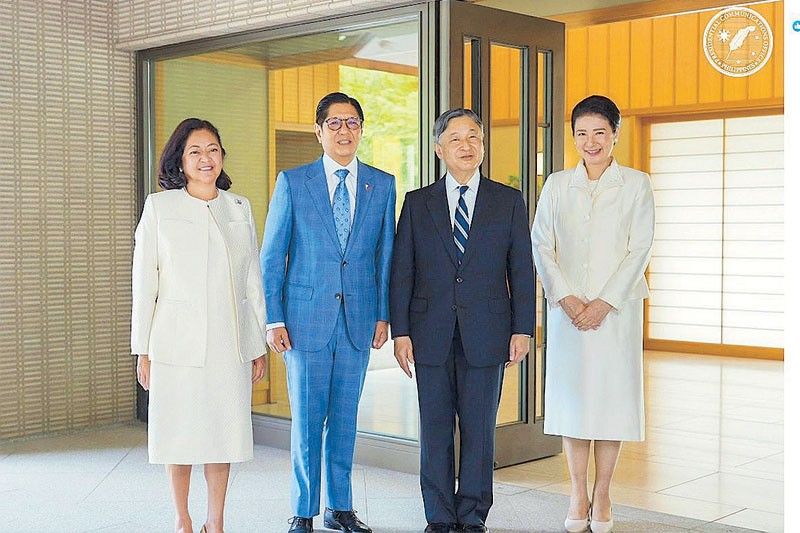
President Marcos Jr. and First Lady Liza Araneta Marcos were received by Emperor Naruhito and Empress Masako at the Imperial Palace, where the President was conferred the Grand Cordon of the Supreme Order of the Chrysanthemum, Japan’s highest imperial distinction. Mr. Marcos, in turn, conferred upon the Emperor the Order of Lakandula with the rank of Supremo, a mutual exchange of honors that reflected the kind of personal bond between two nations that took generations to build. The First Lady was likewise conferred the Grand Cordon of the Order of the Precious Crown.
President Marcos. also addressed Japan’s National Diet, becoming only the fourth Philippine president to receive this privilege after Presidents Quirino, Arroyo, and Aquino III, a distinction that said, plainly and publicly, that the Philippines was a serious partner whose relationship with Japan deserved to be treated as such.
The centerpiece achievement of the visit was the elevation of bilateral ties to a Comprehensive Strategic Partnership, formalized through a summit with Prime Minister Sanae Takaichi under the joint statement “Weaving the Future Together: Peace, Prosperity, Possibilities,” which expanded cooperation into energy security, artificial intelligence, space technology, and Mindanao development, while also launching negotiations for a General Security of Military Information Agreement and maritime boundary delimitation.
On the economic front, President Marcos’s engagements with Japan’s business community yielded approximately $4 billion in investment pledges, alongside signed agreements covering double taxation avoidance, agriculture and fisheries, health services, and human resource development, concrete outcomes that translated directly into expanded opportunities for Filipino workers and businesses.
Separate meetings with Furukawa Electric, Sumitomo Electric Industries, MinebeaMitsumi, and Tsuneishi Group produced P56.3 billion in expansion commitments spanning advanced electronics, semiconductors, precision manufacturing, and shipbuilding, investments that were expected to generate around 10,300 direct and indirect jobs, and that could position the Philippines as the world’s fourth-largest shipbuilding nation.
The Sumitomo Electric meeting deserves special mention: the company announced a P4.3-billion investment to build a new facility in Cabuyao, Laguna through its Philippine subsidiary First Sumiden Circuits, the country’s sole manufacturer of flexible printed circuits, producing components for smartphones, electric vehicles, and telecommunications equipment, with commercial operations targeted for April 2027.
What the Sumitomo investment signaled was not just confidence in the Philippines as a manufacturing destination, but our growing integration into the global supply chains for technologies that will define the next decade, and for the mining and resources sector I represented, this was a powerful reminder of the downstream opportunities that await our industry as demand for critical minerals and advanced materials continues to rise.
President Marcos returned home with far more than agreements and announcements. He returned with renewed proof that the choice made 70 years ago by two former adversaries to replace resentment with cooperation was the right one, and that the Philippines, when it shows up on the world stage and plays to win, beyond all the local political drama and noise, mostly fed by disinformation and lies, is fully capable of delivering results that matter to our people. *


- Latest


