UA&P: Ube sector must improve planting materials, productivity
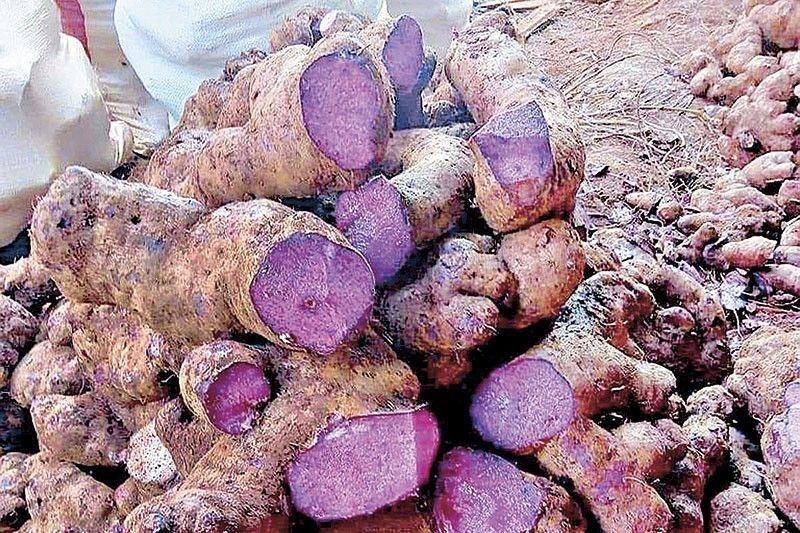
MANILA, Philippines — The Philippines must improve the availability of planting materials and farm productivity to strengthen the local ube industry, according to the latest policy brief by the University of Asia and the Pacific-Center for Food and Agri Business.
UA&P-CFA said the country’s ube industry has been limited by the quality of planting materials, amid the global spike in demand for the purple-colored yam.
The report noted that ube supply cannot quickly adjust to sudden increases in demand, as production typically lasts eight to 10 months starting between May and June or during the onset of the rainy season.
“Improving productivity will therefore require not only greater access to quality planting materials but also better production practices and research-based protocols for farm management, pest and disease control and nutrient requirements,” it said.
Although only a limited number of farms cultivate purple yam, production rose by 17 percent to a two-year high of 5,658 metric tons in the first half of 2026, up from 4,838 MT a year earlier, according to data from the Philippine Statistics Authority.
The UA&P-CFA noted that boosting domestic output will require not only more planting materials, but also improvements in farm productivity and cultivation practices.
Research and development initiatives can also help identify and propagate higher-yielding varieties while establishing science-based protocols for farm management, pest and disease control, and nutrient management.
It added that efforts to address tuber dormancy and the crop’s seasonal production cycle could ensure a more stable supply throughout the year.
The report also stressed that the industry must strengthen its postharvest and processing capacity as it moves into the wider domestic and international markets.
It added that better quality classification and harmonized standards can help improve consistency across fresh and processed products.
“Expanding domestic processing into products such as powder, halaya, jam and paste can also allow Philippine enterprises to capture more value within the domestic value chain while creating additional markets for farmers,” UA&P-CFA said.
It added that developing stronger postharvest and processing capabilities would ensure that increased production translates into products that meet market requirements.
To further improve the ube industry, Philippine Chamber of Agriculture and Food Inc. (PCAFI) president Danilo Fausto told The STAR that the government must assist in making more processing equipment and other post-harvest facilities available for producers.
“Further, we fully support the government policy to prohibit the export of raw ube to protect the industry from other countries who will produce their own using our raw ube as a source of their planting materials and compete with the Philippine ube,” he added.
In September, the Department of Agriculture (DA) announced that all fresh ube and propagative materials will no longer be exported to protect local planting materials.
The report noted that the suspension in the export of fresh purple yam and propagative planting materials has also highlighted the imbalance between growing market demand and the country’s current capacity to produce sufficient planting stock.



- Latest
- Trending