Garbage problem critical, says Marcos Jr.
Waste-to-energy facilities pushed
MANILA, Philippines — Refusing to call it a “crisis,” President Marcos however described as “critical” the garbage problem that has contributed to flooding in parts of Metro Manila and nearby areas hit by heavy rains from the southwest monsoon.
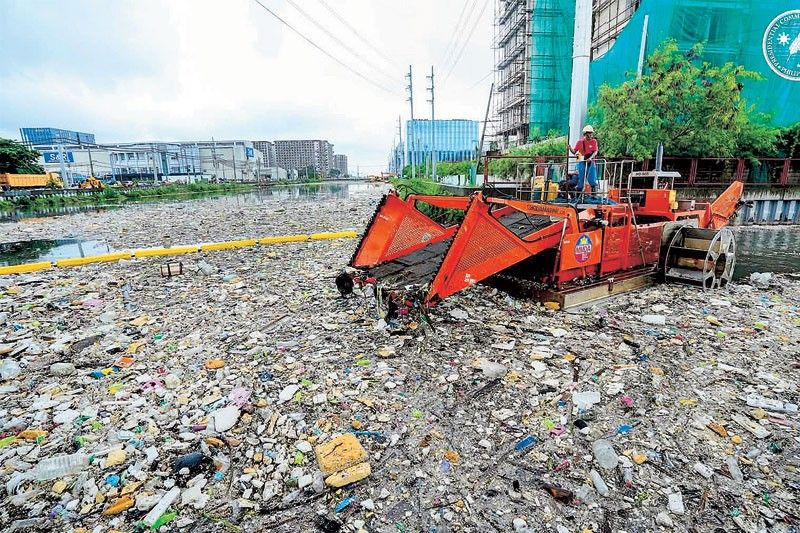
Marcos yesterday inspected clearing efforts at a rain-drenched pumping station along Jose W. Diokno Avenue in Pasay and the Redemptorist water channel in Parañaque, both of which accumulated a huge volume of garbage following the rains spawned by recent weather disturbances.
The President noted that the heavy rains, accumulated garbage that clogged the pumping station and a damaged trash flap resulted in massive water buildup.
“Yeah, it’s certainly… look at it. Does that look critical to you? It does to me... I wouldn’t call it a garbage crisis, but that is the problem that we are facing,” Marcos told reporters in Pasay when asked whether he categorizes the situation as a garbage crisis.
Aside from declogging operations, the government is determining the possible locations of waste-to-energy plants to minimize the hauling costs local governments would shoulder in transporting garbage.
“That is the only solution because the landfill is already full and it is becoming more costly... So instead of bringing (the garbage) to the landfill, it would be brought to the waste-to-energy plant,” Marcos said.
He acknowledged that setting up waste-to-energy plants is “not easy to do” because it requires putting a system together.
“We’ve never done it before, we still have to. Well, in terms of the technical side, that’s done... Now, what we are trying to do is to put the system together... how it will be, what is the relationship of the LGUs (local government units) to the waste-to-energy plant, where the locations are, what group is actually going to come in,” Marcos said.
“We already have identified, like I said they’re already auctioning… Maybe in a couple of months on how much will be sold or how much energy will be sold in the Department of Energy and at what rate,” he added.
For now, the government is undertaking clearing operations by removing garbage that may hamper the operation of pumping stations.
Asked about the proposal to impose stiffer penalties on improper waste disposal, Marcos said higher fines alone would not resolve the problem if residents do not have places where they can dispose of their garbage.
“It’s not useful to fine people for not throwing their garbage if there is no place to put their garbage,” Marcos said. “We have to provide facilities where people can throw garbage.”
Crisis for Dizon
Public Works Secretary Vince Dizon, however, said the garbage problem can already be labeled a crisis.
“This is really a crisis. This is really severe,” Dizon said in a separate media interview.
“Despite our efforts to clean our waterways, the garbage keeps coming back. In our experience, after conducting a clean-up effort, the next day, it is filled with garbage again, not just in Metro Manila, but in some areas in Bulacan, Pampanga. In areas all over the country, that is the experience every day,” he added.
Dizon also agreed with the proposal to slap stiffer penalties on indiscriminate waste disposal, saying the present situation is not sustainable.
“The government really needs to resort to drastic solutions,” he said, citing the administration’s plan to convert waste to energy.
Parañaque floodgates
Parañaque Mayor Edwin Olivarez, meanwhile, expressed support yesterday for the proposed con- struction of floodgates to address flooding in the city.
In an interview with “Storycon”on One News, Olivarez said flood control projects, while not “100 per cent effective,” were able to improve the overall situation in the city.
“It also made a big difference because the water receded quickly, he said in Filipino.
Parañaque was among the cities that recently experienced flooding due to heavy rainfall.
He defended the city government from criticisms, saying it conducts consistent dredging of waterways as part of the solution.
“What we’re discussing with the MMDA and the DPWH is to add floodgates (in the Parañaque River)… and pumping stations,” he added.
“There has been a significant improvement, but more needs to bedone. There should be an ultimatum to finally resolve our flooding prob- lem there,” he added.
As to the viral photos of the garbage in the Redemptorist area, Olivarez said it was due to the failed trash flap that would have prevented garbage from Manila Bay from coming in.
“The garbage did not come from inland,” he clarified. Olivarez said they welcome any investigation into the flood control projects in the city, saying these are mainly implemented by the national government. – Janvic Mateo, Kate Judson




- Latest
- Trending