The AFP @ 90 and cognitive defense
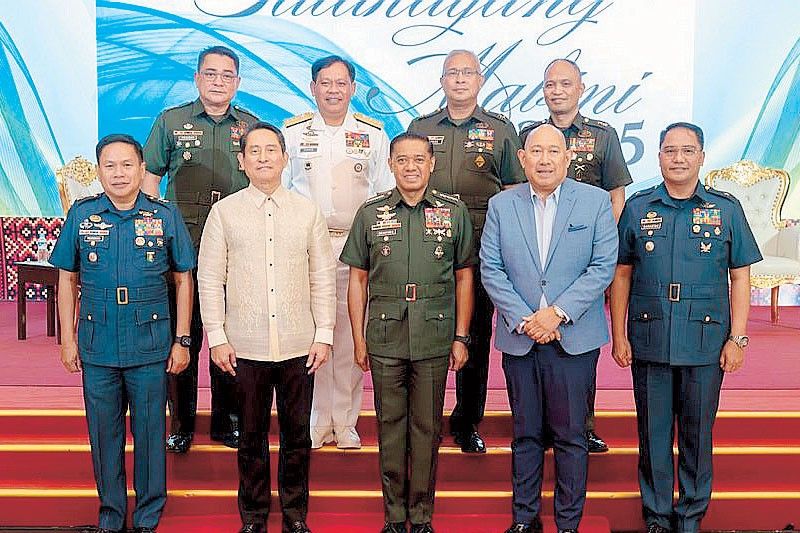
The Tejeros Hall of the AFP Commissioned Officers Country in Camp Aguinaldo, Quezon City was awash in crisp uniforms, polished medals, and the familiar shuffle of spit-polished shoes as the Armed Forces of the Philippines (AFP) marked its 90th founding anniversary. It was an event that blended ceremony, reflection, and a renewed call to national unity — with the theme “AFP @ 90: Matatag na Sandatahang Lakas, Sandigan ng Bagong Pilipinas,” a theme that embodied the commitment of the AFP to being the nation’s firm and long-standing pillar that guards its freedom on which the people rely.
I was invited to be a keynote speaker in the annual Talakayang Mabini, which served as a platform for high-level discussion on strategic issues affecting the country’s national security.
This year’s Talakayan upholds the theme “Archipelagic Defense through Multi-domain Operations: Readiness, Challenges and Ways Forward” and intends to evaluate the AFP’s defense posture, identify the operational gaps and determine effective strategies that can address all threats across all domains: Maritime, Land, Air, Cyber, Cognitive, Space and Electromagnetic Spectrum.
Ninety years after its establishment, the AFP continues to serve as the backbone of the nation’s security framework. From counterinsurgency operations to humanitarian missions during typhoons, earthquakes, and floods, the AFP has evolved into one of the country’s most indispensable institutions.
For my keynote, I was asked to discuss Archipelagic Defense through Multi-Domain Operations, focusing on Cognitive Defense.
Cognitive defense refers to “protecting the human mind from manipulation, misinformation, and cognitive attacks by building mental resilience, understanding biases, and promoting logical decision-making, often within broader ‘cognitive security’ or ‘cognitive warfare’ contexts, using psychology and neuroscience to counter influence operations that exploit vulnerabilities in perception and belief.”
It’s about defending your internal “operating system” from external interference to maintain autonomy.

As global tensions rise and technological competition intensifies, I underscored how the AFP has entered an era where traditional might is no longer sufficient.
I mentioned that the Philippines must strengthen its defenses against a fast-rising threat that targets public trust rather than physical territory and warned that disinformation and influence operations are emerging as key risks to national stability.
I said that the country was confronting a new form of conflict — “cognitive warfare,” where adversaries aim to weaken social cohesion and confidence in institutions.
“The new battlefield is the Filipino mind,” I emphasized. “Our adversaries do not need to fire a shot. It is enough to sow doubt, spread disinformation, erode trust in institutions, fracture our unity, and make us question one another.”
Cognitive threats can destabilize a nation without engaging its military forces. “You can weaken a society not by attacking its armies, but by attacking its confidence, its memory, its sense of identity, and its national purpose,” I added.
I then made a call for a coordinated response across government, business, media, and civil society, because the challenge “extends far beyond the AFP.”
I mentioned that disinformation can disrupt essential services as easily as physical attacks.
“A single falsehood about water, power outages, toll operations, or public health can cause panic or paralyze essential services.”
I cited our chairman Manuel V. Pangilinan’s long-standing view that information integrity is central to public stability: “Transparency is security. Truth is infrastructure. Trust is stability.”
Sectors across the economy must recognize their stake in the country’s information environment. I pointed to the mining industry as an example of how narratives can shape public perception and policy.
For years, responsible miners were overwhelmed by disinformation and foreign-influenced campaigns. “If we do not tell our story, someone else will — and not always truthfully.”
Initiatives such as the Towards Sustainable Mining (TSM) of the Chamber of Mines of the Philippines (COMP) and the Extractive Industries Transparency Initiative (EITI) show how data and transparency can rebuild trust.
I then remarked that the Philippines must cultivate a culture that values truth and resists manipulation. “A resilient nation is one where citizens think critically, the media verifies responsibly, institutions communicate truthfully, communities stand together, and no adversary can divide us with lies.”
I then closed with this statement that would hopefully resonate with all and sundry that were gathered there:
“In the end, the greatest victory is a people who believe in one truth — the truth that the Philippines is worth defending.” *



- Latest