A year after the quake Northern Cebu remembers the tremor, rises from the rubble
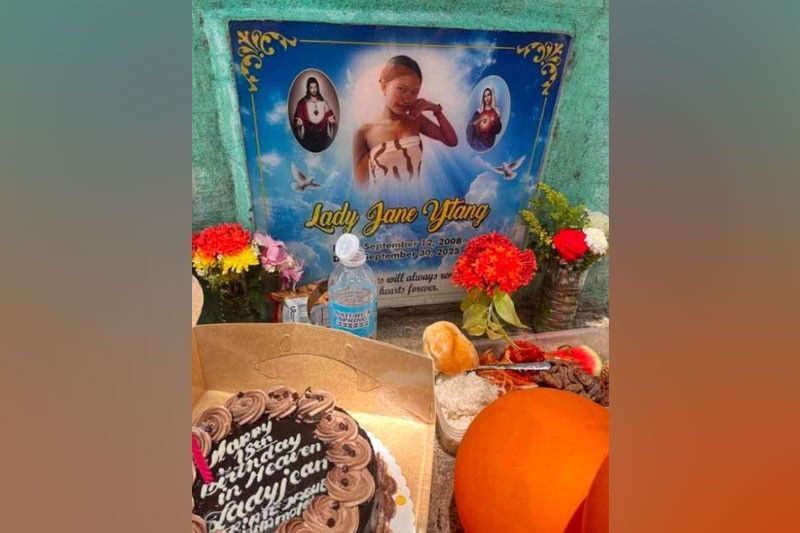
CEBU, Philippines — The cake was there. So were the decorations, and the food bearing the words, “Happy Birthday in Heaven, Lady Jean.”
But the girl who was supposed to turn 18 was not.
On September 12, 2026, Lady Jean Ytang’s family marked what should have been her debut.
For a lot of Filipino families, it signals a young woman’s passage into adulthood. For the Ytangs, it was a day of remembrance for a daughter whose life was cut short before she could reach it.
Lady Jean was 17 when the magnitude 6.9 earthquake struck northern Cebu on September 30, 2025. She was among 11 residents of Barangay Binabag who died after a rockslide hit their community in Purok Libas, Bogo City.
Her mother, Juvy, still remembers the daughter who was supposed to finish Grade 12, find work and help build a life beyond the small mountain community they once called home.
“Hapit na unta to siya mahuman og eskwela karon,” said Juvy, recalling how Lady Jean was already in Grade 12 and taking the General Academic Strand.
She was the third of six children.
“Buotan kaayo to, siya man na ang tig-bantay sa iyang manghud,” Juvy said, describing Lady Jean as a good daughter who had grown up helping the family.
On the night of the earthquake, Lady Jean was inside their home when the ground shook and rocks began to threaten the area. Juvy said her daughter ran toward the family and helped get them out of danger.
Her own room, Juvy recalled, was left largely untouched. But Lady Jean did not make it to safety.
She suffered a head injury after being struck during the landslide. Juvy said she and her husband were also injured and could not immediately carry their daughter to safety.
Rescuers had to make their way through the damaged and obstructed road before Lady Jean could be brought toward the main road and eventually taken to a hospital.
By then, she could no longer be saved.
The Ytangs then buried her alongside other residents of Binabag who died in the disaster.
On October 8, 2025, the 11 victims from the barangay were laid to rest at Corazon Cemetery in Bogo City.
Lady Jean’s story was also remembered by neighbors for what she did in the moments when the earthquake struck. She reportedly woke members of her household, including her newborn sibling, and helped move them away from danger before she herself was caught in the rockslide.
A year later, the family continues to return to places associated with her. They visit the cemetery, attend Mass and mark the date of her death with prayer.
“Sakit pa kaayo,” Juvy said, describing the continuing pain of losing her daughter while also losing the family home.
Once a home
Lady Jean's death was not the only loss in Purok Libas.
Once a small and vibrant mountain community in Barangay Binabag, the area now stands largely quiet, with houses abandoned and vegetation slowly overtaking structures that once held ordinary family life.
Clothes remain on rusting clotheslines. Broken toys and other belongings are scattered around properties that residents were forced to leave.
The silence is a stark contrast to the community that existed before the earthquake.
The September 30 earthquake and the resulting ground hazards claimed 11 lives in the community, many of them children.
The disaster also forced families to leave homes they could no longer safely occupy.
The Ytang family was among those relocated after the area was declared a no-build zone.
Juvy said they now pay P1,000 a month for their present place while continuing to rebuild their lives away from the community where they had lived.
The family's recovery remains incomplete.
Juvy said her husband, who worked as a carpenter, was also injured during the disaster. Their income remains limited, while the family continues to support children who are still in school.
The assistance they initially received from the government eventually stopped, she said.
What remains is the task of rebuilding through whatever livelihood opportunities they can find.
“Kinahanglan gyud maningkamot,” Jubi said, describing how the family has had to continue moving forward despite the loss.
For her, rebuilding is not only about replacing a house.
It is also about finding a way to earn again, put food on the table and keep the surviving children in school.
Life in tent cities
The same struggle is being experienced by other families displaced by the earthquake.
Rosalie Juevesano, who is currently staying in an LGU-managed temporary settlement, recalled escaping her home as the earthquake struck and ground hazards followed.
She said they encountered water, debris, and rocks as they fled. The family eventually sought refuge in a vacant area after neighbors called out to them.
Their original home was later declared unsafe because of ground instability and sinkholes in the area.
Juevesano said large sinkholes appeared in their community, while portions of their house and extension were affected by the movement of the ground.
The family moved to the temporary settlement on Oct. 17, where they have remained.
For Juevesano, the relocation provided a measure of safety, but it did not erase the trauma.
Her family is among those included in a Red Cross full-shelter assistance program, with construction expected to take place on land owned by her mother in the upper portion of Hagnaya-Sangi.
But the assistance has not reached all families at the same time.
Juevesano said some beneficiaries from other batches had already received material assistance, including P50,000 worth of materials, while her family was still waiting for its own shelter assistance.
For displaced families, however, a house is only one part of the equation.
“Ang need gyud namo ma'am kay panginabuhian gyud,” Juevesano said, identifying livelihood as their most pressing need.
She explained that returning to their old community is no longer an option because of the no-build declaration. Moving somewhere safer, meanwhile, means finding a way to earn in a new environment.
Her family has tried to restart a small neighborhood store at their relocation area, similar to the business they had before the earthquake.
But sales are not what they used to be.
The old community had more residents and customers. The new location has families coming from different barangays, leaving displaced residents to rebuild not only their homes but also the economic networks that once sustained them.
Some former neighbors have returned to coastal areas after repairing their houses, particularly those whose livelihoods depend on fishing.
Others have moved to safer areas.
The community that once existed in Purok Libas has therefore been scattered, not only geographically but also socially and economically.
A year later
The stories of Lady Jean, the Ytang family, and other displaced residents form only one part of the earthquake's continuing impact.
The September 2025 disaster was not confined to individual homes or communities. It damaged infrastructure, disrupted livelihoods, and created a recovery requirement that would take years and billions of pesos to address.
A Post-Disaster Needs Assessment presented to the Provincial Disaster Risk Reduction and Management Council estimated that rebuilding northern Cebu would require P19.28 billion, or nearly P20 billion, in recovery and rehabilitation funds.
The assessment estimated that the earthquake caused P9.24 billion in damages and P47.74 billion in economic losses across multiple sectors.
Infrastructure, including roads, bridges, ports, and other lifelines, accounted for P1.98 billion in damages and P67.73 million in losses, with at least P2.83 billion needed to fully restore the sector.
The rebuilding has already moved into concrete projects. At least eight bridges worth P159.732 million were undergoing repair and reconstruction, based on Capitol data cited in the report material.
These formed part of 13 bridge projects worth P276 million approved by Cebu Gov. Pamela Baricuatro to restore connectivity in quake-hit municipalities.
Among the projects were the rehabilitation of three bridges in Borbon, Cabica, Cadaruhan, and Tagnucan, worth P60.037 million; the Poblacion-Suba Bridge in Daanbantayan worth P33.344 million; and the Guadalupe Bridge in Bogo City worth P20.006 million.
Other projects included the Tabunok Bridge in Sogod, the Piyo Bridge in Tabogon, and the Lamintak Bridge in Medellin.
Schools also remain part of the long recovery.
Of the 269 planned Temporary Learning Shelters across Cebu, 252 had undergone bidding, with construction expected to begin by mid- to late June.
Seventeen projects, mostly intended for island municipalities, were to undergo another round of bidding after the initial allocation was found insufficient because of higher construction costs in island areas.
Meanwhile, earthquake victims in Bogo City received P32.15 million in financial assistance from the Cebu Provincial Government during a June 3, 2026, distribution.
The assistance covered 3,215 affected families from 29 barangays, with each family receiving P10,000.
But even as roads and bridges are repaired, temporary structures replaced, and financial assistance distributed, the recovery remains visible in the lives of families who have yet to return home.
In Bogo City and San Remigio, THE FREEMAN found residents still staying in temporary homes, Department of Social Welfare and Development tents, and makeshift light-material structures.
One resident interviewed said the Bureau of Fire Protection delivers water every Sunday, which families try to make last for the week; when supplies run short, they turn to a nearby well.
At Bogo City Hall, temporary offices have also been established, while repaired roads and bridges now carry traffic again. Yet traces of the earthquake remain visible.
The numbers show the breadth of the disaster.
But in Northern Cebu, its meaning is still measured differently: in an abandoned house, a family trying to restart a small store, a mother visiting her daughter's grave, and an 18th birthday celebrated with a cake for someone who never got to turn 18.
For Juvy, the earthquake did not end when the ground stopped shaking.
“Wala unta ni mahitabo. Wala unta maibanan akong mga bata,” she shared crying, wishing the tragedy had never happened.
The September 30 quake that jolted Northern Cebu left 79 dead and injured 599.
A year later, the north continues to rebuild. But for the families there, recovery is not simply about restoring what the earthquake damaged; it is about learning to live with what can never be restored.
Rising from the ruins
Bogo City, the ground zero of the earthquake, is now recovering and rehabilitating, with residents largely back to their livelihoods and businesses.
Mayor Maria Cielo “Mayel” Martinez said the city has made significant progress in repairing roads, schools, public facilities, and other infrastructure that were damaged, although several rehabilitation projects remain unfinished.
“The biggest change is that people are back to their normal day-to-day lives,” Martinez said, noting that the city has moved from emergency response and the restoration of basic services to longer-term rebuilding.
“We are already in the recovery and rehabilitation stage, but we are not yet finished,” she said in a statement.
Martinez said the city continues to maximize its resources and coordinate with national government agencies and non-government organizations to address the damage, noting that Bogo, a fourth-class component city, faces limitations in funding, technical personnel, and time.
One of the major projects is the rehabilitation of Bogo City Hall.
Immediately after the earthquake, city government offices were transferred to temporary facilities to keep essential services running. Operations were later established in modular and annex facilities within the City Hall compound while the main building underwent structural assessment.
The assessment found that the building’s foundations remained sound. The city now plans to remove the damaged second floor and undertake major structural retrofitting of the remaining structure.
Construction is targeted to start this year after the completion of necessary documentation and clearances.
The city is also working on the overhaul of the Bogo City Public Market and the repair of Polambato Port.
Road rehabilitation
Bogo’s rehabilitation efforts also center on its damaged road networks. In 2026, the repair efforts accelerated, which led to multiple completions.
Among the completed projects are the P14.99-million Poblacion road rehabilitation package covering A. Mansueto, Dela Vina, and Sor. D. Rubio streets, and the P24.97-million package covering Maharat, P. Rodriguez, F. Manubag, and Pandan-Lower Pandan Road.
Rehabilitation and reblocking projects remain ongoing in Banakod, A. Pedroza, San Vicente, S. Verallo, M.H. del Pilar, Pelaez, Marangog, and Taytayan-Tolibao, as well as various farm-to-market roads.
Schools remain a priority
The city also continues to work with the Department of Education (DepEd) and other agencies and development partners to repair earthquake-damaged schools while ensuring the continuity of learning.
Bogo seals a pact with DepEd to support the construction, improvement, and rehabilitation of school buildings.
The city also extended assistance to all 38 public elementary and secondary schools through Brigada Eskwela, providing construction materials, information technology equipment, and other resources.
Shaping long-term projects
As the massive devastation left the city scarred, Bogo moves forward with long-term development at hand.
This includes the rehabilitation of the four-storey Legislative Building in Barangay Cayang, which is now 77 percent complete as of August 25, 2026, while the Track Oval project, including high-mast lights, site development, grandstand, and perimeter fence, had reached 66 percent completion.
Both projects, however, are targeted for completion this year.
A third Primary Care Facility, envisioned as a Mega Diagnostics Center, is also set to be constructed to provide more advanced laboratory and diagnostic services to Bogohanons.
The new public cemetery in Barangay Malingin, on the other hand, is now complete.
Martinez said, however, that reconstruction projects must undergo various technical and safety requirements.
She said some projects have taken longer than expected because the city cannot immediately proceed from damage assessment to reconstruction. According to her, necessary clearances must be secured first.
Martinez also said the city cannot devote all its resources to earthquake rehabilitation as it must continue providing regular services and assistance to the public.
She added that the government also has to confront the reality that the earthquake also affected local revenues, as some facilities and operations were temporarily closed or operated at limited capacity while repairs were undertaken.
Temporary shelter vacated
Currently, the temporary tent city in Barangay Cogon has already been vacated.
Before leaving, families were assessed. Some were transferred to National Housing Authority housing in Barangay Banban, while those whose homes remained repairable were provided construction materials based on their needs.
Structures deemed unsafe, Martinez said, should remain unoccupied until the necessary repair, retrofitting, or demolition is undertaken.
Preparing for the next challenges
While earthquake rehabilitation remains a priority, Martinez said the city is also preparing for other challenges, including rising fuel prices and the projected Super El Niño.
Martinez acknowledged that the past year has not been easy for residents but said the city government would continue supporting families and communities as rehabilitation efforts move forward.
“We have done it before, and we are doing it again now,” she said.
“There will always be hope, and your local government will continue to be here for you. We will continue working, seeking support, and doing what we can to help our people recover,” she added. — (FREEMAN)





- Latest