A phoenix at sunrise
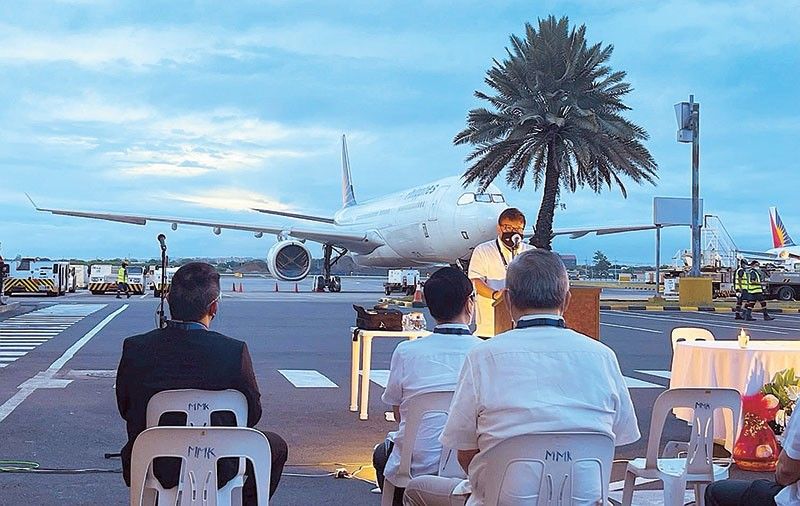
Philippine Airlines during the Covid pandemic
(First of a series)
MANILA, Philippines — Over five years ago, on a Friday morning in the early fall in New York City, Philippine Airlines (PAL) filed for reorganization under Chapter 11 of the US Bankruptcy Code in the Federal Court for the Southern District of New York. After more than a year of grinding negotiations and paperwork with creditors while trying to survive the COVID-19 pandemic, PAL was finally getting its day in court.
Today, after almost 20 quarters that have likely been the most profitable in its history, PAL has just placed a confident bet on its future, having issued $350 million in bonds and confirmed orders for 15 new Boeing 787 Dreamliners and nine Airbus A350-1000s, in addition to the 10 already being delivered.
This is the human story of how Asia’s oldest airline, now 85 years old, not only survived but thrived when the world almost shut down air travel during the pandemic.
Asia’s oldest airline
PAL was founded in late February 1941, after Andres Soriano and other wealthy businessmen purchased the franchise of the defunct Philippine Island Aerial Taxi Company and incorporated PAL.
The Iloilo-Negros Air Express Co. (INAEC) founded in 1935 by wealthy sugar barons, already flew to more destinations and had a larger fleet. From its infancy as an air-taxi company serving wealthy Spanish and American businessmen in Manila, PAL was never inevitable.
Within months of its founding, PAL was at war, flying supply and evacuation missions to and from the front lines as the US Armed Forces in the Far East retreated to Bataan. Its Beechcraft 18s and pilots continued these missions until Japanese aircraft finally caught up with them in late February 1942. INAEC’s entire fleet was caught on the ground in Iloilo three days after the war began.
After the war, PAL was reconstituted by Andres Soriano with surplus US military aircraft and veteran pilots.
By mid-1946, it was flying American G.I.s home, becoming the first non-US airline to fly across the Pacific.
From the beginning, PAL had been sheltered, but languishing, in the shadow of politics.
The 1970s brought Martial Law, and PAL again fell under direct government control. Its domestic operations entered the jet age with the BAC-111, while its international routes began filling with a new type of traveler: the overseas Filipino worker.
Kapitan
Corazon Aquino became the president of the Philippines in 1986, and in 1992, her administration sold 67 percent of PAL to PR Holdings, enabling Dr. Lucio “Kapitan” Tan, a self-made billionaire with interests in tobacco, liquor and banking, to take control.
He became chairman and CEO of PAL in 1995 and led a multibillion-dollar fleet renewal.
Just in time for the Asian Financial Crisis of 1997.
Following the catastrophic effects of the Asian Financial Crisis and labor disputes that led to a complete 14-day shutdown, PAL submitted a “standalone” rehabilitation plan to the Philippine Securities and Exchange Commission in late 1998.
The plan required receivership or external oversight of the company’s assets and operations, which lasted nine years.
PAL was released from receivership in October 2007, but further challenges – including domestic competition from Cebu Pacific, the downgrade of the Philippines’ aviation safety rating by the FAA and EASA, another labor strike in 2011 and continuing financial difficulties – meant continued instability.
In 2012, Kapitan sold 49 percent of PAL to San Miguel Corp. and let it manage the airline. He took back control two years later.
By 2019, PAL had experienced two consecutive years of losses, faced an increasingly tenuous debt position and further losses, and had sold 9.5 percent of its holding company to All Nippon Airways to raise capital.
Kapitan had sunk billions of dollars into PAL and would put in even more to keep it aloft.
I learned later that, despite the scale and breadth of his commercial empire, he carried only one business card.
It read: Chairman and CEO of Philippine Airlines.
The challenge
In the spring of 2019, Kapitan asked me to lead the turnaround of a perennially troubled enterprise. In late July, the Board confirmed me as its president and COO.
So I left my home and family in Los Angeles and returned to the Philippines to lead PAL.
I had no idea what I was getting into.
I discovered both daunting challenges and great potential.
PAL was an inefficient enterprise with a long history of losses; massive debt; obsolete business processes; four-star service standards operating out of one of the world’s worst airports; capable flight and cabin crews administered by a sclerotic bureaucracy; a proud but demoralized workforce with a history of difficult labor relations; opaque and erratic governance and large, agile and tough competitors.
But in 2019, PAL was a then-79-year-old airline whose legacy and history remained inseparable from the Filipino experience after World War II.
It was the flag carrier of a fast-growing Southeast Asian nation; a bridge across the Philippine archipelago to the world and the link between millions of overseas Filipinos and their homes and families.
PAL carried the Philippine flag.
And in its planes flew the hopes and dreams of millions of Filipinos on their journeys to meet the future.
2020
As 2019 ended, PAL had assembled a new team and made progress tackling its challenges. Kapitan had invested another $225 million in the company while committing a further $375 million.
Then, in January 2020, just south of Manila, Taal Volcano erupted.
Volcanic ash from the massive eruption shut down Ninoy Aquino International Airport for more than 14 hours, cancelling hundreds of flights and essentially dismantling PAL’s biggest hub and base. We had to thread it all back together, flight
by flight, while caring for more than 30,000 displaced passengers.
The year had started with a “bang.”
Taal turned out to be just the opening act.
Editor’s note: In this special series, former Philippine Airlines president and COO Gilbert Santa Maria takes us inside the flag carrier’s fight for survival during the COVID-19 pandemic, a time when nearly every airline across the globe grappled with the worst turbulence. This is the story of PAL’s remarkable turnaround, told by one who was at the helm when the airline faced one of the toughest periods in its 85-year history. A similar version appeared on Yale Insights.
(To be continued)





- Latest
- Trending