Remittances hit year-high in June

Inflows reach $3.39 billion
MANILA, Philippines — Remittances from overseas Filipino workers (OFWs) rose to $3.39 billion in June, the highest monthly level since December last year, as money sent home continued to support household spending despite a moderation in the growth of cash transfers.
Data from the Bangko Sentral ng Pilipinas (BSP) showed personal remittances increased by 1.8 percent from $3.33 billion in June 2025. The latest amount was the highest since December 2025, when personal remittances reached $3.89 billion.
Personal remittances cover cash sent through banks and informal channels as well as remittances in kind.
Meanwhile, cash remittances coursed through banks grew by 1.7 percent to $3.04 billion from $2.99 billion a year earlier.
The June cash remittance level was likewise the highest since December 2025, when it reached $3.52 billion. However, the 1.7-percent annual growth was the slowest since February 2022, when cash remittances expanded by 1.3 percent.
For the first half, personal remittances climbed by 2.4 percent to $19.12 billion from $18.67 billion in the same period last year.
Of the total, cash remittances also increased by 2.4 percent to $17.15 billion from $16.75 billion.
The BSP said the sustained inflows “continued to support recipient households’ income, spending and overall domestic demand.”
Robert Dan Roces, group economist at SM Investments Corp., said remittances continued to provide a steady source of support for household consumption despite the modest pace of growth.
“From an economic perspective, remittances remain a steady source of support for household consumption,” Roces said.
“While the 1.7-percent growth is modest, these inflows provide OFW families with additional income for food, retail, housing and other essential spending. This should help sustain domestic demand, although inflation will continue to weigh on purchasing power,” Roces added.
UnionBank chief economist Ruben Carlo Asuncion said slower cash remittance growth likely reflected several factors, including uncertainties stemming from the Middle East conflict.
“Lingering uncertainties arising from the Middle East conflict have weighed on labor deployment and raised concerns over employment prospects for some OFWs in the region,” Asuncion said.
“Higher living costs in host economies may have also constrained the amount available for transfer, while base effects from relatively stronger inflows a year ago likely contributed to the softer year-on-year growth rate.”
Despite these headwinds, Asuncion said the continued expansion and relatively high absolute level of remittances suggest that OFWs remain employed and continue to provide an important source of support for household consumption and broader economic activity.
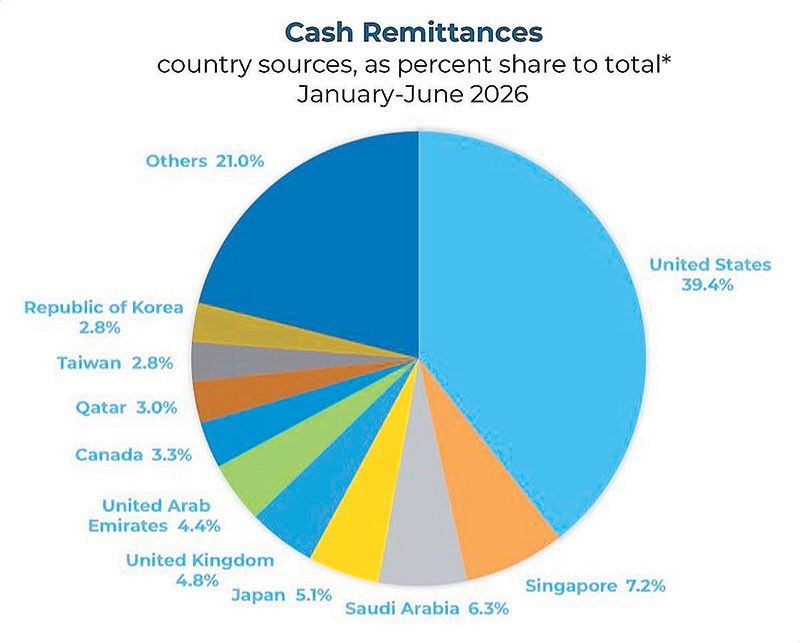
The United States remained the largest reported source of cash remittances in the first half, accounting for 39.4 percent of the total. Singapore followed with a 7.2-percent share, Saudi Arabia with 6.3 percent, Japan with 5.1 percent and the United Kingdom with 4.6 percent.
Remittances remain an important source of foreign exchange for the Philippines and a major support for domestic consumption.
BSP data showed personal remittances were equivalent to eight percent of gross domestic product, while cash remittances accounted for 7.1 percent as of the second quarter.








- Latest
- Trending