A signal of friendship

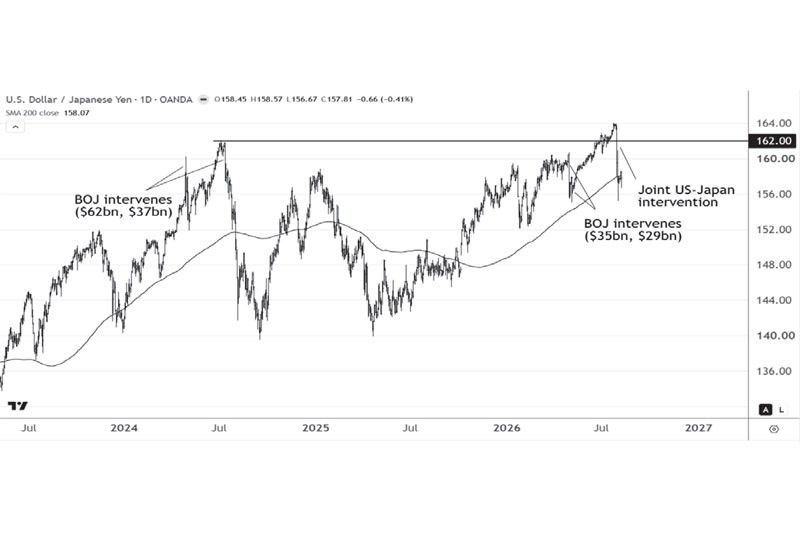
On July 30, the Japanese yen staged one of its most violent reversals in decades. It had weakened to nearly 164 per dollar, its lowest level in 40 years. The yen then surged to an intraday high of 155.20 when Japan and the United States stepped in. By last Friday, the yen was trading around 158, but the message to currency traders was already clear.
This was no ordinary intervention. Japan has stepped into the currency market several times in recent years. But this time, Washington joined Tokyo in buying the yen. It was the first joint US-Japan operation to buy yen since the Asian financial crisis in 1998. It also brought back memories of one of the most important coordinated currency interventions in history – the Plaza Accord of 1985.
From 164 to 155
The chart below shows the dramatic reversal. USD/JPY had broken above the important 160 level and then surpassed its 2024 high near 162. The move accelerated toward 164 before intervention sent the dollar tumbling to 155.20. From a technical standpoint, what looked like a powerful breakout above 162 suddenly became a failed breakout. The 160 level now becomes important. Traders who had become accustomed to betting against the yen were reminded that the authorities can change the market very quickly.
A one-way street
Trading currencies was very different then. During the Plaza Accord, more than four decades ago, there were no smartphones, and we had no Bloomberg terminals. I remember asking Reuters to send stock and currency quotes to my pager. I charted currencies by hand using logarithmic graphing paper and pasted the charts on the wall. Earlier that year, dollar-yen had traded around 260 before the major economies agreed to bring down the value of the dollar.
The G-5 agreed that the US dollar was too strong and backed that view with coordinated intervention. Target prices were set by the central banks – first 220, then 200, 150 and 120. I would sometimes ask one of our staff to stay in the office at night and watch certain technical levels for me. Even after policymakers indicated that the adjustment had gone far enough, the yen continued strengthening and broke 100. For traders, it became almost a one-way street.
‘A signal of friendship’ – Trump
That Plaza Accord experience is why the July 30 joint intervention caught my attention. More than four decades later, the US and Japan are once again sending currency traders a message. This time, however, the message is aimed at those betting relentlessly against the yen. President Donald Trump described America’s participation as “a signal of friendship” toward Japan. Treasury Secretary Scott Bessent went even further, saying the US would not hesitate to participate in further joint intervention.
Protecting the Treasury market
The US also has its own reasons to be concerned. Japan is the world’s largest foreign holder of US Treasuries, with about $1.14 trillion as of May 2026. Large-scale intervention could force Tokyo to sell Treasuries, adding pressure to US bond yields. Bessent has called for the Fed’s FIMA repo facility to be expanded. This would allow Japan to raise dollars against its Treasuries rather than sell them.
Making yen shorts expensive
Intervention alone cannot permanently reverse a currency’s direction. Japan’s earlier interventions produced only temporary rallies. But coordinated US-Japan intervention changes the risk-reward for speculators. With the possibility of further Bank of Japan rate hikes, shorting the yen becomes much more dangerous and expensive. Yen shorts must now worry about sudden intervention and another violent reversal.
Asian currencies get relief
The intervention matters beyond Japan. The yen is one of Asia’s major currencies, and its weakness had become another source of pressure on regional foreign-exchange markets. A more stable yen removes some of that pressure. The improvement has spread across Asia, led by the Korean won, with the rupiah, baht, Singapore dollar and yuan also strengthening over the past month.
Peso gets a respite
The Philippine peso has also benefited. After falling to a record low of P61.85 per dollar in mid-July, it strengthened back below P61 this week. It closed at P60.90 last Friday, its strongest level in more than a month. The rebound reflected not only the yen intervention but also lower oil prices and improving sentiment toward Asian currencies. For the Philippines, that is welcome news. A firmer peso helps contain import costs and gives the BSP more room to focus on inflation and the domestic economy. After weeks of trading near record lows, the peso finally has some breathing room.
Clarification: Last week, in “The Big Bounce,” we wrote about Citadel Securities’ market commentary and Citadel’s purchase of Situational Awareness LP’s public-equity portfolio. We subsequently received a letter noting that Citadel and Citadel Securities are separate entities. Citadel is a hedge fund, while Citadel Securities is a market maker. The letter also stated that the two events were coincidental and unrelated.
Philequity Management is the fund manager of the leading mutual funds in the Philippines. Visit www.philequity.net to learn more about Philequity’s managed funds or to view previous articles. For inquiries or to send feedback, please call (02) 8250-8700 or email [email protected].


- Latest
- Trending