Inflation slows to 6.2% in July

But El Niño poses risk to food prices
MANILA, Philippines — Inflation eased for the third straight month in July, driven by the slower increase in transport costs, according to the Philippine Statistics Authority (PSA).
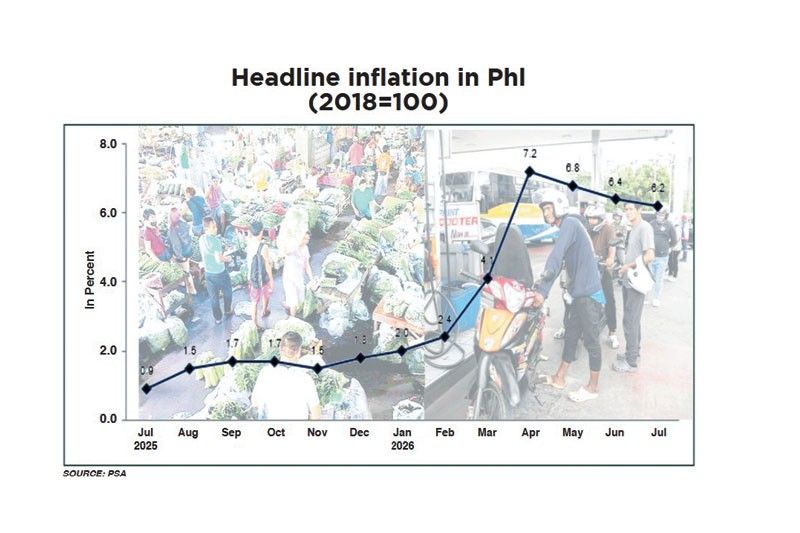
In a press briefing, National Statistician Dennis Mapa said inflation, or the overall increase in prices of goods and services, slowed to 6.2 percent in July from 6.4 percent in June.
However, the July inflation result is much higher than the 0.9 percent print in the same month last year.
While the latest figure is within the Bangko Sentral ng Pilipinas’ 5.6 to 6.6 percent forecast for July, it remained above the two to four percent target band for the year.
The downtrend in overall inflation was primarily driven by the slower increase in transport costs at 11.9 percent in July from the previous month’s 12.8 percent.
Department of Economy, Planning and Development Secretary Arsenio Balisacan said the slower price increases show that government interventions are helping ease the impact on households.
“While inflation is moving in the right direction, our work is far from over. We will continue advancing measures to keep essential goods affordable while creating more opportunities for a better quality of life,” Balisacan said.
Malacañang also welcomed the latest inflation figures, with Palace press officer Claire Castro saying they “were encouraging developments.”
“However, the administration remains vigilant as geopolitical tensions in the Middle East and the continuing effects of El Niño still pose risks to food and energy prices,” she said in Filipino.
“Our broader objective remains clear: to reduce the cost of daily living, strengthen food and energy security, safeguard the purchasing power of Filipino households, and sustain economic growth that benefits every Filipino family,” she added.
Mapa, however, said that while inflation has been on a downtrend for the last three months, there are still risks that may drive up inflation.
He said movements in prices of certain commodities with substantial weights such as food and electricity are expected to affect overall inflation.
“We have to see the trend, if this will continue in the next months,” he said.
Also contributing to the July inflation result was the slower increase in education service rates, at 1.9 percent from the previous month’s four percent.
Restaurant and accommodation services’ rates also rose by a slower pace of 6.8 percent in July from the previous month’s seven percent.
Meanwhile, food inflation was steady at 5.3 percent in July as lower meat prices and slower increases in vegetable prices offset sharper rice inflation.
Rice inflation rose to 17.1 percent in July from the previous month’s 15 percent.
Mapa said the latest rice inflation is the highest since July 2024 when it reached 20.9 percent.
From January to July, average inflation stood at five percent.
Moody’s Analytics assistant director-economist Sarah Tan said in an email that she expects disinflation to continue, but at a slow and uneven pace.
“The outlook also largely depends on developments in the Middle East and their impact on global commodity prices,” she said.
She also cited the looming El Niño phenomenon as an upside risk to inflation.
“Hotter and drier conditions in the second half of the year could weigh on agricultural output, exacerbating food supply constraints and putting further upward pressure on food prices,” she said.
Severe El Niño may worsen food inflation
S&P Global Ratings also said the Philippines faces heightened food inflation and agricultural risks from a potentially severe El Niño this year, although early government preparations could help contain the damage to the broader economy.
In a report, the debt watcher identified the Philippines among the Asian economies where prices are already rising sharply, alongside India, Vietnam and Indonesia, leaving households more exposed to further weather-related supply disruptions.
“Households in these countries are more vulnerable to further weather-related supply shocks,” S&P said.
Food accounts for 35 percent of the Philippine consumer price index, one of the highest among the six South and Southeast Asian economies assessed by S&P. Agriculture, meanwhile, represents about nine percent of the domestic economy.
The rating agency said rice, sugarcane and coconut are the Philippine crops most likely to be affected by El Niño, while reduced rainfall could also disrupt hydropower generation.
S&P said the El Niño episode that began this year would affect Asia-Pacific mainly through weaker rainfall and broader climate disruptions. The primary transmission channels include reduced agricultural output, higher food prices, diminished hydropower generation, vegetation fires and haze.
Lower rainfall could reduce crop yields, delay planting and harvesting cycles and weaken rural incomes. Smaller agricultural output could also disrupt food supply chains and push consumer prices higher.
The threat comes as energy prices and transportation and production costs are already rising across much of the region. Disruptions in fertilizer supplies due to the conflict in the Middle East could further complicate agricultural production.
However, the debt watcher noted that food inflation across Asia remains below the widespread price surge recorded in 2022, giving policymakers some room to manage the expected increase in prices.
For the Philippines, S&P cited contingency planning, advance food imports and coordination with farmers as the main measures that could limit supply disruptions. – Kate Judson


- Latest
- Trending