‘No legislative involvement in drafting budget’

MANILA, Philippines — Legislators do not participate in drafting the National Expenditure Program (NEP), the Department of Budget and Management (DBM) clarified yesterday.
Budget Secretary Amenah Pangandaman stressed that coordination with lawmakers happens at the agency level, particularly with the Department of Public Works and Highways (DPWH) and not with the DBM itself.
“Not in the budget department, but in departments like the DPWH. Meaning, it is in the request of the DPWH,” Pangandaman told The STAR in response to Bonoan’s remark that congressmen have leadership allocations in the proposed budget.
The NEP, also known as the President’s budget, is prepared by the executive branch and serves as the basis for the General Appropriations Bill (GAB).
DBM Assistant Secretary Rolando Toledo emphasized that the NEP is strictly an executive undertaking and noted that the budget agency has no knowledge of the proponents behind agency submissions.
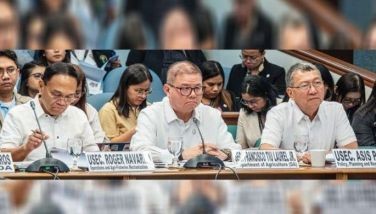
“That is because the DPWH will say and submit their budget, so we don’t know what transpired during the preparation of their proposed budget being submitted to us. That is their practice, not ours,” Toledo said during a Senate Blue Ribbon committee hearing on alleged flood control anomalies.
He added that the DBM does not evaluate projects unless they are included in proposals submitted by departments and agencies, such as the DPWH, which form the basis of the NEP.
Bonoan earlier admitted that the DPWH had accommodated legislative requests in its budget submissions to the DBM.
“What we wanted to actually do, under this administration, we wanted it already to be included in the NEP. So that by bicameral conference, the NEP should already be intact,” he said. “This is with the hope that the NEP will not be touched anymore when it reaches the bicameral conference.”
Bonoan referred to these as “leadership allocation,” explaining that certain senators and district representatives request priority projects to be included during budget formulation.
Based on DBM’s Budget 101, line departments and implementing agencies prepare and submit detailed budget estimates and rank programs, activities and projects.
The DBM then issues a budget call and holds technical budget hearings. Once the proposal is transmitted to Congress, it becomes the GAB, which, upon approval and enactment by President Marcos, serves as the national budget for the following year.
For 2026, the government initially prepared an expenditure plan exceeding P10 trillion, but this was trimmed to P6.793 trillion due to limited fiscal space.
DPWH Secretary Vince Dizon later presented the department’s revised budget at P625.78 billion, a 30-percent reduction from its earlier P881.31-billion proposal.
Plenary deliberations
Meanwhile, after more than a month of committee hearings, the appropriations panel of the House of Representatives concluded its scrutiny of the proposed P6.793-trillion budget for 2026, paving the way for plenary debates.
“We reaffirm our commitment to strengthen transparency, accountability and public participation in the budget process,” said panel chair Rep. Mikaela Angela Suansing, who led the chamber’s examination of House Bill 4058, along with vice chair Rep. Albert Garcia.
The measure outlines the executive department’s proposed GAB for fiscal year 2026, based on the NEP submitted by the DBM, which will later undergo the same scrutiny in the Senate.
“Our task ahead is to ensure that every peso appropriated in this P6.793-trillion budget is invested where it matters most – uplifting lives, protecting communities and securing our nation’s future,” Suansing added. — Delon Porcalla





- Latest
- Trending