GDP slows to 2.3 percent, weakest in 5 years
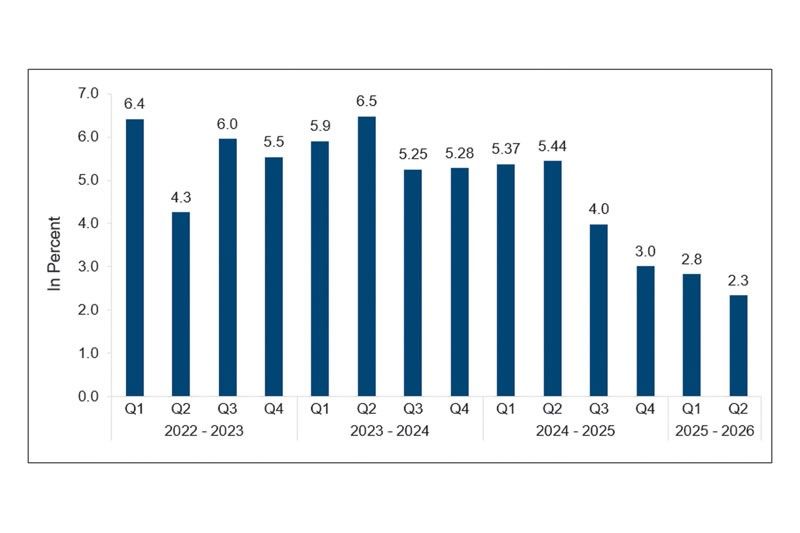
MANILA, Philippines — The Philippine economy grew at its slowest pace in five years to 2.3 percent in the second quarter as the Middle East conflict kept household consumption subdued while an infrastructure scandal curbed investments and public construction, the Philippine Statistics Authority (PSA) said.
In a press conference yesterday, National Statistician Dennis Mapa said the latest gross domestic product (GDP) growth figure was slower than the 2.8 percent recorded in the first quarter and the 5.4- percent growth posted in the second quarter a year ago.
First-semester growth averaged 2.6 percent, which could make the already downgraded 3.5 to 4.5 percent annual government target unachievable.
This also marked the lowest growth since the 3.8-percent contraction in the first quarter of 2021 during the pandemic. Excluding the pandemic, the figure was the slowest expansion since the fourth quarter of 2009.
Despite the slower growth reflecting challenges faced by the country, Malacañang is confident that the economy would rebound in the second half.
“Domestic demand remained subdued, mainly because of total investment, and continued to contract as public construction declined. Household consumption growth also moderated amid higher inflation, job losses and lower remittance receipts arising from the Middle East conflict,” Department of Economy, Planning and Development Secretary Arsenio Balisacan said.
“However, government final consumption spending accelerated as social assistance was expanded to cushion vulnerable household sectors,” Balisacan added.
On the demand side, gross capital formation contracted by 9.2 percent in the second quarter, worsening from the 3.1-percent decline in the first quarter and a reversal of the 0.9-percent growth in the second quarter of 2025.
General government construction contracted sharply by 32.4 percent in the second quarter, primarily driven by “continuous cautiousness of the infrastructure-related agencies,” particularly the Department of Public Works and Highways (DPWH), which is now implementing stricter validation measures for its civil works projects.
Household consumption grew at a slower pace of 2.8 percent year-on-year from 5.2 percent a year ago. This was the lowest print since the 4.8-percent decline in the first quarter of 2021. Outside the pandemic, this was the weakest since the third quarter of 2010 at 2.6 percent.
Government spending picked up to 8.3 percent in the second quarter from 4.8 percent in the previous quarter, but it was lower than the 8.7-percent expansion in the second quarter of 2025.
Balisacan said there are also “clear areas of strength,” with agricultural output recovering due to the help of favorable weather conditions.
Main contributors to the growth were wholesale and retail trade, repair of motor vehicles and motorcycles, education and manufacturing.
Among the major economic sectors, agriculture, forestry and fishing expanded by 2.7 percent, while services grew by 4.5 percent in the second quarter of 2026. Meanwhile, industry declined year-on-year by 2.4 percent.
Gross national income, which includes net earnings from abroad, decelerated to 2.2 percent in the second quarter, a slowdown from the 2.9 percent in the previous quarter and 8.1-percent growth recorded in the second quarter last year.
The Department of Budget and Management has started mobilizing funds for 2026 infrastructure projects to the DPWH in late June, with contracts awarded in June and July.
To meet the lowered 2026 growth target of 3.5 to 4.5 percent, Balisacan said the economy must expand by at least 4.4 percent in the second half.
“This will be demanding, but the target remains within reach if we act with urgency, discipline and close coordination across government,” he said, citing plans to accelerate the implementation of high-impact infrastructure projects.
Palace press officer Claire Castro attributed the slowdown in the second quarter to “unusual events,” especially the impact of the Middle East conflict that affected inflation, fuel prices, jobs and remittances, along with the temporary slowdown in public construction.
“This result (2.3 percent) was lower than we had hoped. The numbers show the challenges we have faced, but they do not determine the country’s long-term direction. This slowdown is only temporary,” Castro said in a statement.
Meanwhile, Balisacan said easing price pressures could give the Bangko Sentral ng Pilipinas (BSP) less reason to tighten further, although monetary authorities would still have to consider other domestic and external factors.
The BSP has raised its benchmark interest rate by a cumulative 50 basis points this year, bringing the policy rate to 4.75 percent after back-to-back 25-basis-point increases in April and June.
Ser Percival Peña-Reyes, director of the Ateneo Center for Economic Research, also said that the weak second-quarter performance substantially reduces the likelihood that the BSP would deliver another rate increase at its Aug. 27 policy meeting.
But Peña-Reyes said the central bank is confronted with competing considerations. Economic activity has weakened sharply while inflation risks remain.
If the central bank decides further tightening is necessary, Peña-Reyes said another 25-basis-point hike would be more proportionate, while a 50-basis-point increase would be difficult to justify without significant new upside risks to inflation.
Chinabank Research likewise expects the deteriorating growth picture to limit the BSP’s room for additional tightening, forecasting at most one final 25-basis-point increase in August as inflation remains above target. — Helen Flores






- Latest
- Trending