With or without crisis: More Pinoys pedaling their way to work
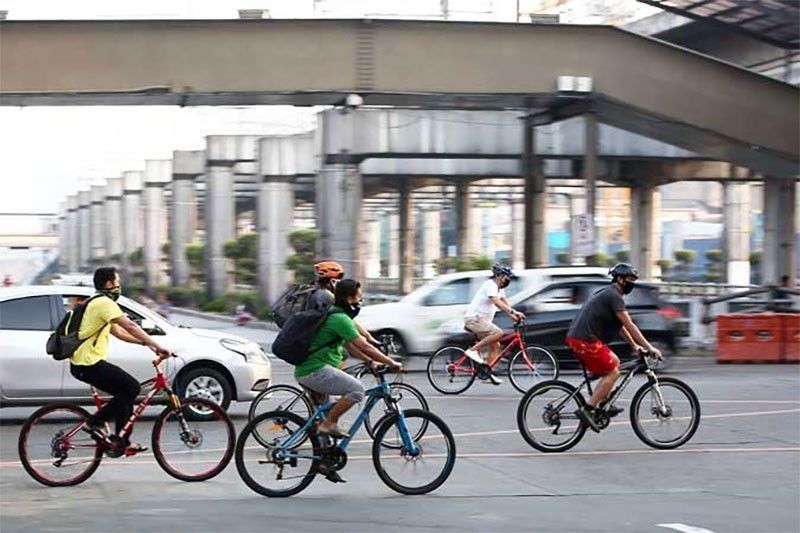
MANILA, Philippines — If there is one truth the government must accept now, it is that tens of thousands of Filipinos are abandoning the commuting hassle by pedaling their way to work.
EDSA, the country’s busiest road network, sees at least 6,166 bikers daily between Monumento in Caloocan and SM Mall of Asia in Pasay, based on a single whole-day data collected by the Department of Transportation (DOTr).
However, those numbers pale in comparison to the daily average of 22,992 bikers going through EDSA as tracked by Bilang Siklista, a citizen-led initiative to count cyclists on Philippine roads.
Further, Move As One Coalition coconvenor Robert Siy said the numbers could have risen by as much as 20 percent after fuel prices ballooned to new highs due to recent tensions in the Middle East. As such, there might be nearly 27,600 bikers traversing EDSA daily.
Whichever data is to be believed, the fact remains that there are now thousands of Filipinos who bike major roads like EDSA to clock in at work. And yet, the harsh reality for cyclists is that the government is spending less to build and maintain safety lanes for them.
In Metro Manila, the current bike lane network spans about 475 kilometers, of which 60 percent or 275 kilometers are dedicated for cyclists, but without physical separators.
In the absence of bollards and curbs, cyclists expose themselves to danger on these bike lanes, as motorists can intrude their way to get ahead in traffic.
“They are not integrated into a network and they have many gaps; most are just marked by paint, so motor vehicles constantly intrude; and riddled with potholes and hazards like protruding metal grates and submerged manhole covers,” Siy told The STAR. There are three kinds of bike lanes classified by the Department of Public Works and Highways. Class 1 is considered safest, separating bikers and motorists; Class 2 is dedicated, but protectors vary from bollards and curbs, to road markings; and Class 3 is shared road with vehicles.
The DOTr is developing the Active Transport Strategic Master Plan (ATSMP) that aims to gather data and provide insights on the use of bike lanes and pedestrian walkways. Initial results shared by the DOTr with The STAR showed that seven in 10 Filipinos use their bike to get to work.
Citing data from the ATSMP, Transportation Undersecretary Mark Steven Pastor said the median distance for work- related cycling is 5.14 kilometers, a typical distance for bus and jeep rides.
“So what the data tells us is that cycling has evolved into a practical, everyday mode of transport, especially for short to medium distances,” Pastor told The STAR.
As more Filipinos now bike to work, it becomes suspect why the budget for active transport has been unpredictable since 2022.
At the close of the pandemic in 2022, the DOTr received P2 billion for active transport buildup. Afterward, the budget was reduced by 65 percent to P705 million in 2023; hiked to P1 billion in 2024; clipped to P60 million in 2025; and raised to P105.38 million in 2026.
Under the Marcos administration, the DOTr has set out on a mission to build 2,400 kilometers of bike lanes by 2028. As of April, it has completed just 41 percent, or 982 kilometers, of that goal, and yet the budget is inconsistent every year.
For 2026, the DOTr plans to expand the bike lane network by 59 kilometers, with 35 kilometers up for rehabilitation.
When diesel prices reached P170 per liter in April, Pastor said the DOTr has noticed an increase in biking volume, and the expectation is these new cyclists would likely retain this lifestyle even when petroleum costs normalize.
“This indicates that cycling is no longer just a response to temporary conditions, but has evolved into a consistent and dependable mode of transport for many Filipinos,” Pastor said.
Siy said the oil price shocks have forced a number of car owners to try biking to work. However, the majority of new cyclists were commuters who shifted to cycling after public transport supply fell short because of fuel price hikes.
“With the fuel crisis recently, my estimate is that these numbers have further increased by at least 15 to 20 percent. This is based on reports of bicycle shops where bikes are selling like hotcakes, and the shops are running out of stock,” Siy said.
In EDSA’s bike lanes, the DOTr monitored the highest cycling footprint in the corridor leading to financial district Ayala Avenue, with 1,468 bikers in a day.
This is followed by Ortigas, including Shaw Blvd., with 1,295, and Monumento, with 1,280, indicating that biking is really becoming a transit of choice by thousands of workers.
To date, the number of bikers in EDSA account for one percent of the road’s daily traffic – still few compared to motorists, but picking up steadily every year.
“We have often heard the view that ‘I would be cycling if only the bike lanes were safer.’ In spite of this, many Filipinos cycle out of necessity, despite the dangers,” Siy said.
In the 2025 report of Bilang Siklista, it was highlighted that biking traffic tends to go up on roads with well-marked or protected lanes, such as EDSA. On the contrary, lower cycling volumes are observed in areas where bike lanes are partially obstructed.
In Shaw, for example, daily biking traffic dipped by 41 percent to 3,900 in 2025, from 6,652 in 2024, as cyclists dealt with several obstructions on the road like construction works and deep-seated potholes.
The report echoed what the United Nations Development Programme (UNDP) said in 2023, that for the Philippines to sustain its cycling gains, it must invest more in bike lanes.
“These results are consistent with the UNDP’s observation that connected and protected cycling networks are essential for maintaining high ridership,” the report said.
For 2027, Pastor is proposing a budget of up to P1 billion for active transport, asking legislators to consider the growing number of cyclists on the road. Aside from bike lanes, the DOTr has also started building end-of-trip facilities to support bike-to-work Filipinos.
Currently, there are only two end-of-trip facilities with shower amenities, where cyclists headed to work can freshen up. In Iloilo City, the DOTr wants to build four of these facilities, along with 32 biking sheds and 232 parking racks.
The DOTr is also heeding the UNDP’s advice to integrate transport networks, as it connects bike racks with public utility vehicle (PUV) stops for ease of transit.
In Quezon City, the DOTr is undertaking a P121.45-million project to build 12 kilometers of bike lanes in Quezon Avenue, install end-of-trip facilities in 23 schools and construct 12 PUV stops in Camp Aguinaldo.
For Siy, Filipinos shift to cycling partly for health reasons but largely, for economic purposes. He contextualized the recent cycling boom on a larger picture where the economy expanded by only 2.8 percent in the first quarter and inflation hit a three-year high of 7.2 percent in April.
“The promotion of walking and cycling, both zero-emission and low-cost, makes a lot of sense. (By) shifting to walking and cycling, we enable many Filipinos to place more food on their table and have more money for health care,” Siy said.


- Latest
- Trending