When high tide hits: Floods take toll on livelihoods in Hagonoy
Special Report
MANILA, Philippines — Christmas holidays in San Agustin, Hagonoy once sounded like the whir of a grandmother’s sewing machine and the rustle of toys wrapped for neighborhood children.
Celerina Eugenio, 65, has been sewing since she was 15 – dresses for festival dancers, curtains for neighbors and robes for saints – piecing together a modest livelihood that brought in around P20,000 a year. It was never much, but it was enough for her happiness, enough to keep her small tradition alive: giving children toys bought from Divisoria every December.
Last year, she still managed to give those toys even with water lapping at her doorstep. But this year, the tide rose faster than her savings.
“Nakaraang taon, kahit may tubig nakapagbigay pa rin ako kahit papaano. Pero ngayon, hindi na sigurado,” she recalled in an interview.
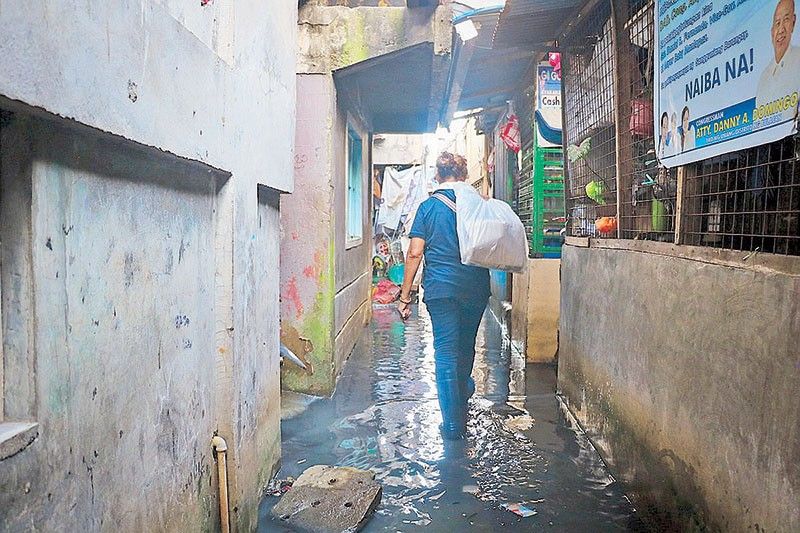
Even without rain, water now rises to the fourth step of her house. Streets, although paved with concrete, are like canals. Furniture has been given away or moved upstairs, sewing machines sit on beds and the narrow living space has become even tighter. What used to be year-long income has disappeared into brown water that no longer recedes.
A microeconomy underwater
A few blocks away, Fely de Jesus keeps a small balut, penoy and animal feeds store in Hagonoy. It had never been flooded this badly before. One morning, she woke to the sound of water rushing past her doorstep.
“Nang nagising ako, rumaragasa na yung tubig,” she recalled.
The flood came fast. Sacks of feeds softened and collapsed in the water. Trays of eggs toppled over. Their storage room, usually dry and orderly, was soaked through by noon.
Almost everything was damaged. To keep the business running, she had to borrow again. “Daming nalubog kaya nangutang kami ulit,” she said.
Nearby, tricycle driver Ronaldo Villanueva, 51, said survival now requires investment. He had his vehicle raised called “giant tricycles” so he could drive through deeper water. It cost him roughly P10,000. Fares change with tide levels, from P30 to as high as P80.
“Nakatulong kahit papaano kasi mataas na yung tricycle ko,” he said. “Dati hindi ako makalabas nang maaga dahil hinihintay kong bumaba ang tubig.”
The economic toll is no longer seasonal. It is daily, embedded in fares, inventory losses, repairs and the constant lifting of appliances and beds.
Infrastructure that cannot keep up
Floodwaters have long shaped life in Hagonoy, a town facing Manila Bay, wedged between the Pampanga and Angat Rivers.
Department of Environment and Natural Resources (DENR) data shows sea levels in Bulacan rising three times faster than the global average. Over extraction of groundwater and land subsidence have worsened the effect.
Yet residents say the bigger problem is not nature alone but the slow pace of infrastructure meant to protect them.
Data from the government’s Sumbong sa Pangulo platform shows that the P77 million flood mitigation structure in San Agustin, contracted in 2023 under WAWAO Builders, remains incomplete. Residents say they have yet to feel the difference.
Barangay Captain Jayson Mendoza said the community has lived with persistent flooding throughout his 12 years in office, relying on elevated pathways and fast repairs. But the water continues to rise faster than the roads.
He said the local government keeps upgrading cemented pathways because it is the quickest fix available, yet even these stopgap measures are now overtopped. Check gates built to control water flow no longer hold back the tide.
He believes only national level projects can change the trajectory. “Hindi lang naman siguro ako, lahat ng tao dito sa Hagonoy, syempre, ang gusto nating makarating sa taas ay mai-ayos yung buong flood control. Hindi band-aid solutions lang para mawala yung ating problema,” he told The STAR in an interview.
He pointed to the long discussed megadike or coastal road meant to stretch from Manila Bay across Bulacan, Pampanga and Bataan.
Even the barangay’s limited finances reflect the strain. Ten percent of their annual budget goes to calamity allocations but the amount is stretched across 4,759 households. It is rarely enough to cushion the losses.
The airport, the land and the waterline
Residents also point to changes brought by the Bulacan Airport reclamation. Several sources told The STAR that tides have become higher in recent years, attributing it to altered water flow and displaced soil.
As an engineer, Mendoza explained it through a familiar image, a basin filled with water.
“Kung binuhusan mo ng isang sakong buhangin, aapaw yan,” he said. Reclamation, he believes, added to rising water although he noted that projects of such scale cannot simply be halted. Dredging is proposed by some but he said views differ on whether it would help.
“Sana yung totoong master plan ang susundin. Panalangin dahil kahit ang munisipyo, hindi kayang pigilan ang pagbaha kung hindi maitatama yung flood control dito sa bayan ng Hagonoy,” he added.
For many, the issue is less about pointing to a single cause and more about wanting a comprehensive, consistent master plan that is not broken into scattered and easily politicized parts.
Voices from higher ground
Not all houses in San Agustin are built the same. Some families have second floors or sturdier structures but even these have not escaped the rising tide.
Seny Santos, 78, said water reaches only their ankles because they live in a taller house. Yet the flooding from recent typhoons still entered their yard. Their protection depends on sandbags permanently stationed at the door.
Irene Liongson, 82, said the floods in mid 2025 reached 4.9 feet, high enough to float furniture.
She recalled watching her narra set, bought with her retirement pay, drift across the living room.
“The first floor is useless now,” she said. “Hindi na nagagamit totally.”
Both residents said some flood control projects were “ghost projects” – planned, funded but never built or built improperly. They speak not in policy language but in lived losses.
“Kailangan parusahan para mahinto,” Seny said. “Kailangang may makitang bilanggo.”
A town measuring time by water levels
Residents adapt in small ways, raising tricycles, moving furniture upstairs, keeping sandbags ready, but these are defensive acts, not long-term solutions.
Celerina’s sewing income has vanished. Fely’s store has flooded twice. Ronaldo’s repairs eat into his earnings. Seny and Irene live upstairs watching the first floor surrender to water.
Livelihoods rise and fall with the tide.
Floods are economic signals, quiet but overwhelming. They erase savings, raise operating costs and force families to redesign their days around water.
Yet even in frustration, hope surfaces in clear sentences.
Irene hopes that the Department of Public Works and Highways Secretary will deliver on his promise – that the guilty will be sent to jail by Christmas.
In Hagonoy, families still mark their calendars not just with fiestas and holidays but with high-tide warnings already printed on the pages. For residents like Celerina, the hope is simple, a Christmas spent dry, a year measured not by water levels but by the ordinary days they once had.
(Maicah Rachel Eugenio is a fourth-year BA Journalism student from the Polytechnic University of the Philippines. She produced this report as part of her internship at The STAR)





- Latest
- Trending