Inflation heats up to 7.8% in October
MANILA, Philippines — Inflation in October rose at its fastest pace in nearly four years, driven by higher energy and transport costs, the Philippine Statistics Authority (PSA) said.
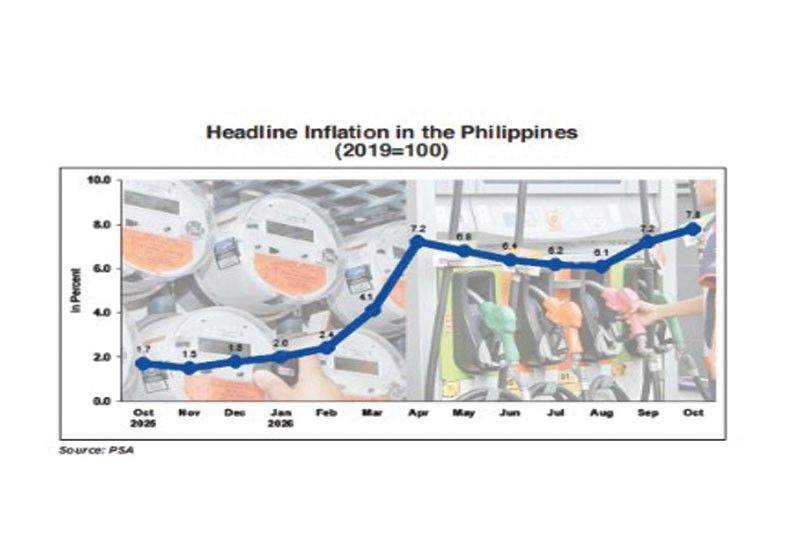
In a press conference, National Statistician Dennis Mapa said that headline inflation – the annual change in prices of goods and services purchased by Filipinos – accelerated to 7.8 percent in October from the previous month’s 7.2 percent and 1.7 percent in the same month last year.
He said the October inflation print was the highest since February 2023, when it hit 8.6 percent.
Still, the latest inflation reading was within the Bangko Sentral ng Pilipinas (BSP)’s forecast range of 7.1 to 8.1 percent for the month.
Core inflation, which excludes volatile food and energy items, also quickened to 5.4 percent in October from 4.8 percent in September.
Mapa said this was the highest core inflation since September 2023, when it was at 5.9 percent.
As inflation picked up, the peso’s purchasing power declined to 72 centavos in October, based on 2018 prices.
The uptrend in overall inflation was driven mainly by a faster annual increase in transport costs at 20.1 percent in October, up from 14.6 percent the previous month.
A faster increase in housing, water, electricity, gas and other fuel costs at 9.3 percent in October from the previous month’s 8.4 percent also pushed overall inflation higher.
Meanwhile, food inflation eased to 6.4 percent in October from 6.8 percent in the previous month amid better weather conditions and improved supply. The slowdown in food inflation was mainly driven by the slower increases in fish and vegetable prices, the PSA said.
However, rice inflation quickened to 20.7 percent in October from the previous month’s 20.3 percent. This was the highest level since July 2024, when it was at 20.9 percent.
From January to October, inflation averaged 5.6 percent, above the government’s two to four percent target band.
Mapa said that El Niño is expected to affect the supply of agricultural products and, in turn, food prices.
He also cited rising global energy commodity prices and local transport fares as other risks. “We have continuous challenges. It will be there in the coming months for energy commodities, food prices and, of course, other passenger transport by road and other inputs. We’re monitoring this.”
Chinabank Research said that inflation could pick up further and peak just above eight percent next month, with El Niño putting pressure on food supply.
It also said core inflation, which the BSP tracks for its policy decisions, is expected to stay above five percent until the first quarter of 2027.
“This keeps the door open for another 25-basis-point BSP rate hike in December to help contain the broader spillover from supply-side pressures,” Chinabank Research said.
However, it said the third quarter economic performance would be another factor in the BSP’s next move, as further tightening could weigh on the already slowing economy.
At its policy meeting last month, the BSP raised the key policy rate by 50 basis points to 5.50 percent.
To address inflationary pressures, the Department of Economy, Planning and Development (DEPDev) said the government will continue to provide support to strengthen agricultural production and logistics and assist sectors affected by higher energy costs.
Government support being provided includes seeds, machinery, training and credit assistance, as well as fuel subsidies for farmers and fisherfolk.
“We will continue strengthening targeted interventions that support producers, improve supply and provide relief to vulnerable sectors,” DEPDev Secretary Arsenio Balisacan said.
“By improving agricultural productivity and logistics and addressing constraints in food and energy supply, we can ease price pressures, protect purchasing power and build greater resilience against external shocks,” he said.









- Latest
- Trending