‘Art should not be hidden away’

Thus declared Bangko Sentral ng Pilipinas (BSP) Deputy Governor Berna Romulo-Puyat at the unveiling of Kultura. Kapital. Kasalukuyan: Contemporary Art from the Bangko Sentral ng Pilipinas Collection at the National Museum.
“Art should not be hidden away. It should be seen, explored, and discussed,” Puyat pointed out. “It is always meaningful to be surrounded by art not only for its beauty but also for the stories it tells.”
“At the Bangko Sentral ng Pilipinas, we have built a remarkable collection of Filipino art. Yet without a dedicated museum, many pieces have remained in storage or appeared only in offices and meeting rooms,” she revealed, adding, “This collaboration with the National Museum allows us to share more of our collection in a space where it can be fully appreciated.”

Former Central Bank Governor and art patron Jaime C. Laya said the collection was “brought together to illuminate an aspect of our country’s wealth in talent, in culture, and in history.”
“The art world now is more complex and entirely different from what it was in past years,” he noted.

“In the past, not long ago, the visual arts were understood to cover mainly paintings and sculpture and to a lesser extent, works on paper. However, now we have conceptual art, we have digital art, we have installations considered as an art form. Environmental art, even graffiti is considered as a special art,” he pointed out.

“And so this is something that is, I suppose, puzzling and difficult but in all other respects exciting as the future path and the future development of the Central Bank collection,” Laya added.
The exhibit spans Galleries 18 and 19, following two key themes, Pagmulat and Pagtanaw.
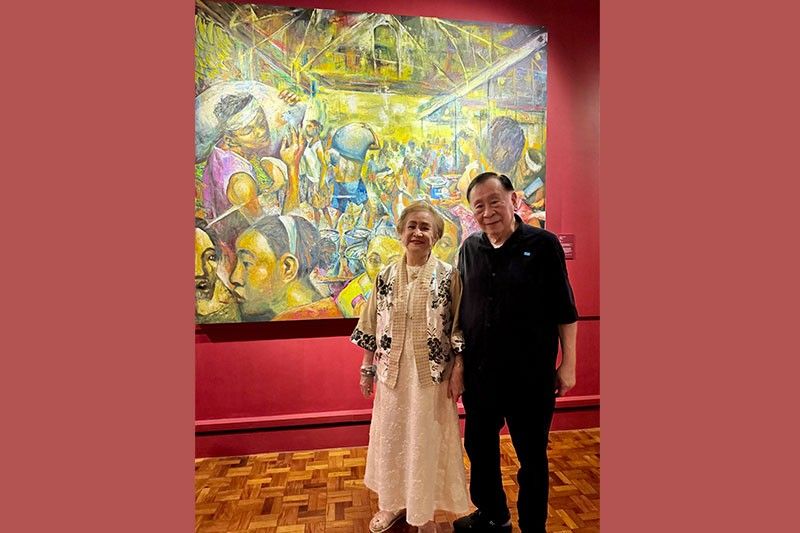
“While the BSP is known for works by Filipino masters, today we shine a light on contemporary artists whose perspectives and experiences continue to shape our national identity,” said Puyat, who joined us as we toured the galleries.
“Through this exhibit, we hope to inspire more people to engage with Filipino art and reflect on how it tells our shared story.”
‘Social mirrors’
Art has evolved because it mirrors the times and the upheavals in technology.
According to the organizers of the exhibit, which will run till November 2027, “The political landscape in the mid-1980s marked a turning point for Philippine contemporary arts. Artists moved beyond Western influences and explored themes rooted in indigenous knowledge, folk traditions, and regional stories. As the country found its new voice, Philippine contemporary art began gaining global recognition.”
“Today, contemporary art is in constant motion — ever-evolving and deeply reflective of society’s shifts. Filipino artists continue to push boundaries, experimenting with new media, techniques, and themes that speak of collective stories that shape the nation.”
Pagmulat includes works that reflect scenes from daily life. Themes include work, home, family, and shared moments that form part of collective memory.
Pagtanaw features works from the late ‘80s to more recent years, highlighting changing styles, techniques, and subjects, offering insight into contemporary Filipino art.
Kultura. Kapital. Kasalukuyan. includes works by over 30 artists from different generations and regions, including Antonio Austria, Pablo Baens Santos, Santiago Bose, Brenda Fajardo, Roberto Chabet, Charlie Co, Danilo Dalena, Ofelia Gelvezon-Tequi, Mario Parial, Ma. Victoria “Ambie” Abaño, Leonard Aguinaldo, Imelda Cajipe-Endaya, Marina Cruz, Patricia Eustaquio, Emmanuel Garibay, Geraldine Javier, among others.
They highlight art as both cultural assets and social mirrors. *


- Latest