


Lemlunay: Rediscovering paradise & identity

Long before the introduction of Christianity in the Philippines, there existed lemlunay, or the concept of paradise among the T’bolis, an indigenous people of South Cotabato.
It is this paradise of everlasting bliss and delight that is celebrated in the book of poetry of National Artist Virgilio Almario: “Lemlunay: Pagunita sa Gunita (A Reminder for Memory),” which had its launch at the Old Capitol Building of Antique last week. Instrumental for the book’s publication and launch in Antique is Sen. Loren Legarda, dubbed by Almario as “diwata ng sining at kultura ng Pilipinas” and “diwata ng Antique” for her abundant contributions to the arts and culture of the country.
“Sa kulturang T’boli, ang lemlunay ay nangangahulugang sagradong pook paraiso — isang lugar ng kapayapaan, kasaganahan, at pagbabalik-loob. Isang lupang pinapangarap balikan, hindi man pisikal, ito’y tila alaala na parte ng ating kamalayan (In the T’Boli culture, lemlunay means a sacred paradise — a place of peace, bounty, and conversion. It is a land which people dream to revisit, if not in its physical state, at least in the memory of consciousness),” said Legarda before she introduced Rio Alma, nom de guerre of the National Artist.
“Hindi lamang ang mga T’boli ang may ganitong konsepto ng paraiso. Marami tayong mga lumad na may sariling konsepto ng paraiso. At iyan ay patunay ng ating kasaysayan din na talagang hindi tayo pagano. Hindi tayo mangmang (It is not only the T’boli people who have a concept of paradise. Other indigenous people also have their own concept of paradise. And that proves in our history that we are not pagans, we are not ignorant),” Rio Alma, for his part, said during the launch.
“When Magellan arrived in the Philippines, we already had our own concept of religion. We had our concept of paradise and heaven. We had gods and goddesses that we worshipped. That’s why I say we are not ignorant, we are not poor, we are not without intelligence. Even before, we already had dignity as a country, as a race,” said Rio Alma.
Lemlunay contains 30 poems of Rio Alma captured beautifully in 174 pages. All the pages are a feast for the senses because on them are Philippine cultural and anthropological scenes. The poetry tome, with translations by Marne Kilates, is bookended by images of t’nalak, an abaca textile woven by the T’boli. The design of the t’nalak photos is that of banggala pattern, woven by the late Lake Sebu’s “dream weaver” Lang Dulay, recipient of the Gawad sa Manlilikha ng Bayan (National Living Treasures Award) given by the Philippine government. The book’s fly leaves are themselves silent poetry and in their stillness they seem to provide a beautiful introduction to Rio Alma’s genius; and a conclusion to his dream of further progress for the Philippines’ arts and culture.
In “Pagdungaw Mo…,” Rio Alma gives a glimpse of urban living albeit in decay. Even in its sordid state, the society is not without a muse, a diwata in the poet’s mind-eye. The poem is a commentary, a critique on a society so advanced yet backwards, too. In between the compass of modernity is an aspiration of an ideal world. And like the lemlunay of days of yore, paradisiacal places are found — in the mind. The poet is a hopeless romantic — his heart yearns for a better Philippines, in deed and identity.
Rio Alma is a master storyteller, too, in “Si Gabriela sa Kanto ng Makati Avenue.” The poem is history told in 33 lines. It is rich in heroism, humanity, humility. How a statue of Gabriela Silang — cold and alone in the middle of a burgeoning financial district — is a warm reminder to all and sundry that even the ordinary can be a hero.

“Dalit sa Adobo” is a short, sweet and savory tale told in five lines. It has the atmosphere of an extended traditional haiku if only for the serenity it provides. It’s about relationships at home, perhaps between a mother and her child. It’s pieta in poetry — only with remnants of peppercorn and bayleaf. But it’s also a tale of friendship because friendship is also a lemlunay, a paradise that is worth keeping, celebrating, venerating.
“Pangarap ng Saranggola,” with all its pages done in pink, is a poem within a poem. Or a poem within an idealism. It starts with “Ang iminulat ng panaginip|Ay hindi na muling pumipikit.” It’s a political statement — because poetry is both personal and political. And it warrants the background of the poet for introspection: Rio Alma went underground as an activist poet during the time of martial law.
“The Philippinization concept of Rizal should be completed — it is the concept that the Filipino people should be free and should be freed from poverty, corruption and deception,” said Rio Alma at the launch attended by Antique’s politicians, cultural workers, businessmen, teachers and students.
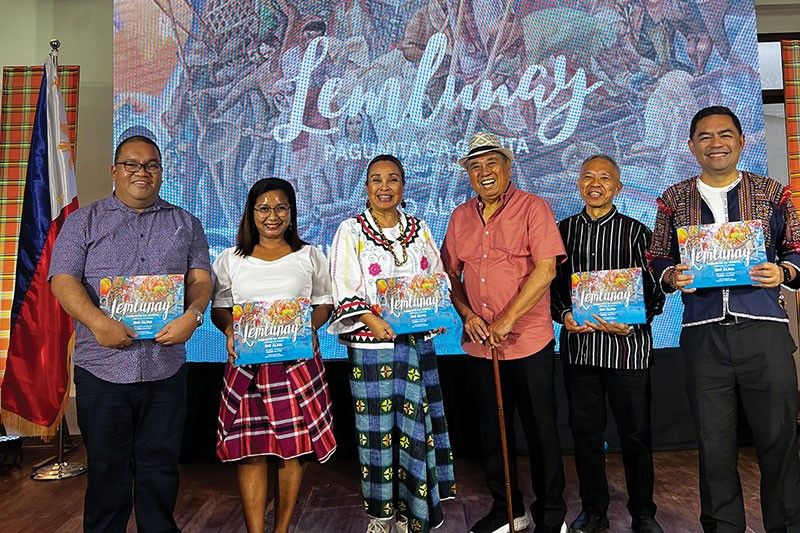
A dyed-in-the-wool Antiqueño, Dr. John Iremil Teodoro, a full professor of Literature at the De La Salle University, read the poem “Lemlunay” and translated it to Kinaray-a, the dialect in Antique. He delivered a 15-minute lecture on the importance of Kinaray-a literature. He was also commissioned by Legarda, lover of everything Antiqueño because she also traces her roots to the province, to translate the whole poetry book “Lemlunay: Pagunita sa Gunita” to Kinaray-a.
“Kung ang ating tunay na hangarin ay masilayan at madama ang inaasam na lemlunay — kailangan nating kilalanin na ang ating alaala ay ang ating lakas, kailangang balikan ang gunita upang marating ang landas tungo sa mas malalalim na pagkilala sa ating sarili at sa ating bayan (If our real intention is to feel and have a glimpse of the desired lemlunay, we need to acknowledge that our recollection is our strength, we need to go back to our memory to find the way to a deeper understanding of our race, of our country),” Legarda said.
“Lemlunay proves that our soul best expresses itself through art and literature,” Rio Alma said.
“Dahil sa aking palagay, mamatay ng lahat, mawala ng lahat, kung ang mga sining ay nariyan, hindi mawawala ang ating sarili (It is my own belief that even when everything dies, even when everything is gone, when art is preserved, we don’t lose ourselves),” Rio Alma concluded.



- Latest


