


Standing for principled peace
This is more personal to me, not because I was there, but because of what had taken place.
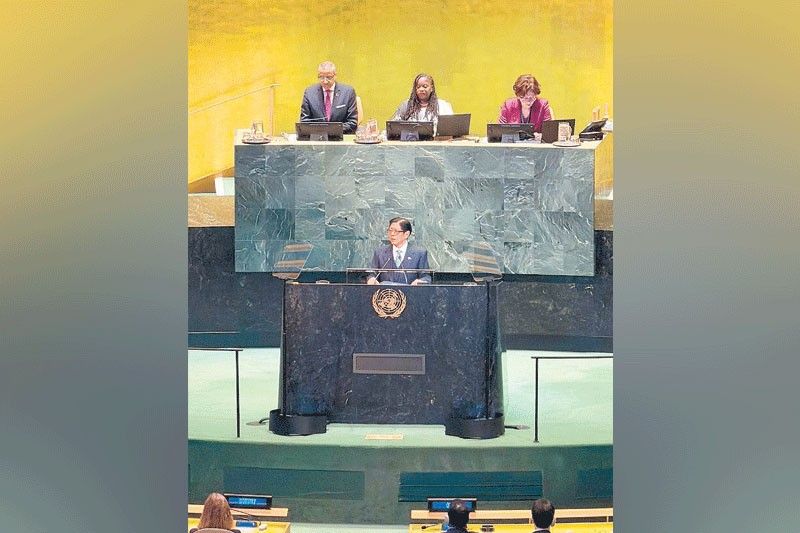
On the morning of March 10, 2026, President Ferdinand “Bongbong” Marcos Jr. (PBBM) stood at the podium of the great hall of the United Nations General Assembly, before delegates representing 193 nations, and spoke for nearly 23 minutes — not as a supplicant, but as a statesman.
PBBM did not arrive on a routine diplomatic errand, but in a world convulsing from open war. By the end of February, the United States and Israel had launched what they called preemptive strikes on Iran, killing its supreme leader and dismembering its military command. Iran retaliated with missiles and drones. The Strait of Hormuz was threatened. Airspace shuttered. Oil prices spiked. And for a nation with an estimated 2.4 million overseas workers living across the Middle East, the crisis was not abstract — it had already claimed a Filipino life: Mary Anne Velasquez De Vera, a 32-year-old caregiver from Pangasinan, killed by shrapnel in Tel Aviv on Feb. 28.

Into this maelstrom walked a Philippine president, treaty-bound to the United States, geographically pressured by China in its own waters, and called to speak before the very body created in 1945 to prevent such catastrophes. The diplomatic tightrope could not have been strung higher, so to speak.
What President Marcos offered the General Assembly was neither the strident partisanship of a superpower nor the studied silence of a nation too timid to speak. He offered something rarer: the voice of a principled middle. He called for restraint, for civilian protection, for unimpeded humanitarian access, and for all parties to return to the negotiating table.

He did this while conspicuously arranging no meeting with President Trump — a deliberate signal that Philippine foreign policy is independent, that it will not be scripted by Washington, even as it honors the Mutual Defense Treaty (MDT).
Critics questioned the timing. They missed the point. The UN was precisely where the Philippines needed to be — not merely to advocate for peace in the abstract, but because 2.4 million of our own people were caught in the crossfire. The DFA’s framing was apt: the UN is the most appropriate venue for this president to call for peace and the safety of all civilians, especially our countrymen.
Then there is the Security Council bid — which some dismiss as ordinary statecraft and others misread as being solely about China and the West Philippine Sea. It is neither. President Marcos put it precisely at the podium: “a non-permanent seat on the UN Security Council is not a right of any State, but a privilege earned through consistent, dedicated, meaningful and concrete partnership.”
I believe the Philippines has earned this privilege. We were at San Francisco in 1945 when the United Nations was being established. We helped draft the 1982 Manila Declaration on peaceful dispute settlement. We have deployed 15,000 troops across 22 peacekeeping missions on four continents. We paid our UN budget assessments in full within thirty days in January 2026 and were included in the UN Honor Roll. Four prior terms on the Council speak for themselves.
What a Filipino voice on the Security Council would mean in the current moment is not difficult to articulate: the Indo-Pacific is the strategic center of gravity of the 21st century; its tensions carry consequences beyond regional borders; and among all the nations who might occupy a non-permanent seat, few have more directly at stake — or more demonstrated commitment to multilateralism — than the Philippines.
I want to dwell on a phrase the President used: principled peace. It is not peace at any price. It is not the peace of submission. In the context of the West Philippine Sea, it is a declaration that we will not trade our legal rights for quiet. A Security Council seat does not resolve that dispute, but it extends our strategy — assertive, transparent, legally grounded — to the highest forum available and helps shape the norms that make eventual resolution more possible.
To those who argue the Philippines cannot afford moral independence from Washington given our defense treaty: the New York trip itself refutes the charge. Mr. Marcos met with US Undersecretary of Defense Elbridge Colby and reaffirmed the MDT — while simultaneously declining, politely enough, to be cast as Washington’s voice on the Middle East. That is not naivety. That is precisely the kind of statecraft a nation of our size and standing must practice.
The rules-based international order is under unprecedented strain. Permanent Council members launch wars without authorization. Humanitarian law is flouted openly. The multilateral system that the Philippines helped build is being tested in ways its founders did not anticipate.
This is precisely the moment when a nation like ours must not retreat into silence. PBBM stood in the General Assembly and said, in effect: we believe in this system — not because it is perfect, but because the alternative, a world governed by the law of the largest gun, is infinitely worse. The Philippines stands ready, always, as a voice for principled peace.
I believe him. More importantly, I believe in what that phrase demands — not just of our diplomats, but of all of us as Filipinos who understand that peace is never simply given. It is built, one principled stand at a time.
In New York last March, President Marcos did more than lobby for a Security Council seat. He reminded a fractured world — and a watching region — what this country stands for. *



- Latest


