


Energy security

Just recently, President Ferdinand “Bongbong” Marcos Jr. officially declared a state of national energy emergency through Executive Order No. 110. The declaration was prompted by the ongoing conflict in the Middle East, which the President cited as posing an imminent danger to the availability and stability of the country’s energy supply, particularly given the disruptions in global oil production and the threat posed by the closure of the Strait of Hormuz — a critical corridor for international oil shipments.
We all know that as a net importer of petroleum products, the Philippines remains highly dependent on external sources of fuel supply and is therefore vulnerable to such disruptions.
In our current review on the stability and security of our energy supply, I point once more, as I have done before, to nuclear energy as a potential key component for a sustainable, long-term energy future for the Philippines.
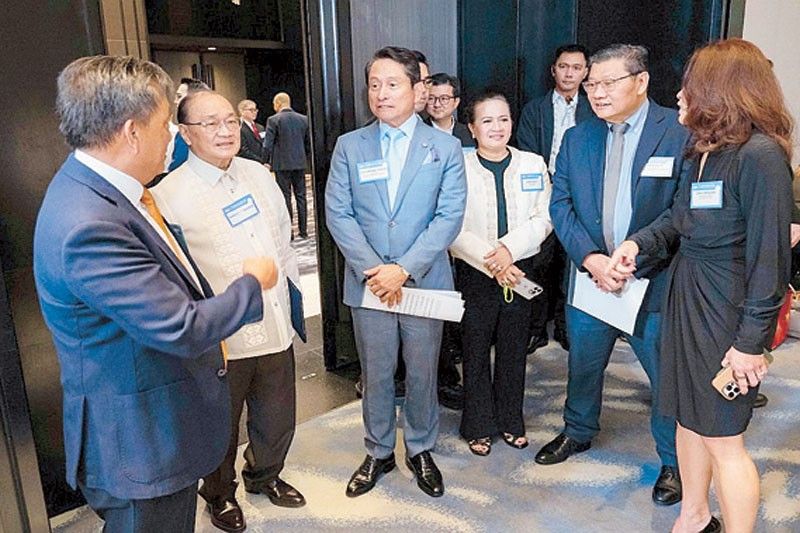
Last month, amid the handshakes and ceremony of the Philippines-Korea Business Forum, Manila Electric Company (Meralco) chairman and CEO Manuel V. Pangilinan (MVP) put pen to paper on what may be one of the most consequential energy agreements in the country’s modern history.
Meralco signed a memorandum of understanding with South Korea’s state-owned nuclear operator, Korea Hydro and Nuclear Power (KHNP), and its official export credit agency, the Export-Import Bank of Korea (KEXIM), to explore the feasibility of developing nuclear energy and modernizing the Philippine power grid.

This signing was not just another corporate ceremony. The framework establishes a basis for research and development, knowledge exchange, and potential financial arrangements as the Philippines seeks to diversify its energy mix and address chronic power supply issues.
For the Philippines — a nation that pays some of the highest electricity rates in Southeast Asia, imports most of its fuel, and is racing against a clock ticking toward an energy crunch — the stakes could hardly be higher.
The partnership centers on Meralco’s Nuclear Energy Strategic Transition (NEST) program, which aims to incorporate nuclear power into the country’s energy mix. In practical terms, the MOU lays out a wide-ranging agenda.
Under the agreement, the three organizations will collaborate on reactor design and engineering, exchange technical and regulatory information, and strengthen local nuclear legal and institutional frameworks. The agreement also covers training programs, employee exchanges, and knowledge-sharing initiatives to build local technical capability and support long-term operational readiness.
Under the partnership, Meralco will work with the Korean firms to advance potential early-stage project development, including public acceptance initiatives, planning, and site selection studies. These initiatives are deemed critical in evaluating the feasibility of building nuclear projects in the Philippines.
On the financial side, KEXIM would provide financial support for nuclear projects involving Korean firms, while KHNP would supply the technology. Meralco, KHNP, and KEXIM will also work together on business and financial modeling to support future nuclear developments. As part of this effort, KEXIM will explore potential financing structures and credit facilities for Meralco’s prospective projects involving KHNP and other Korean enterprises.
KHNP is no small player. KHNP, a subsidiary of Korea Electric Power Corporation (KEPCO), is South Korea’s largest power generation company. KEXIM is the country’s state-owned export credit agency that provides financing support.
MVP framed the deal in frank terms. “Nuclear energy is a way to diversify our portfolio and reinforce energy security while offering a degree of insulation from fuel market fluctuations,” he said. He added that the partnership gives Meralco access to proven global expertise to study technology, business models, and financing options with greater depth — calling it “an early but consequential step in this important process.”
The Korean deal does not stand alone. It is the latest in a series of moves by Meralco that signal a serious, multi-fronted push toward nuclear power.
Through a $2.8 million technical financial assistance grant from the US Trade and Development Agency (USTDA), Meralco PowerGen (MGEN) will conduct a study on the viability of small modular reactor (SMR) deployment in the Philippines and identify a preferred technology and sites for development.
Starting in April, Meralco said it would begin identifying potential sites suitable for SMR facilities, in coordination with government agencies such as the Department of Energy and the Philippine Nuclear Research Institute. Site selection will consider technical, environmental, and regulatory factors.
The broader government target is ambitious: the Philippine Energy Plan 2023–2050 targets at least 1,200 megawatts of nuclear capacity by 2032, increasing to 2,400 MW by 2035 and 4,800 MW by 2050 under the Clean Energy Scenario.
The partnership with KHNP and KEXIM supports Meralco’s goal of delivering the first kilowatt-hours of nuclear power by 2032.
To understand the urgency behind Meralco’s Korean deal, one must grapple with the Philippines’ deeply precarious energy situation. With electricity rates among the highest in Southeast Asia, nuclear energy offers a reliable and cost-effective solution to the country’s energy challenges.
The Philippines is dangerously over-reliant on fuel sources that are either depleting, imported, or subject to volatile global prices. The Philippines imports 95 percent of its crude oil and nearly all refined products from the Middle East, with 91 percent of LPG also sourced there, leaving it highly vulnerable. Coal accounted for roughly 62 percent of the nation’s electricity generation mix in 2024 and is projected to decline only marginally to about 60 percent by 2027 despite renewable expansion.
Meanwhile, the Malampaya gas field — which once supplied roughly 30 percent of Luzon’s power — is near the end of its productive life, and as a result, the Philippines has had to send diplomats to Indonesia to negotiate for continued coal supplies.
The comparison with South Korea is sobering. South Korea started its nuclear program at roughly the same time as the Philippines. It now has 24 nuclear power plants, and its electricity rate is about half that of the Philippines.
Overall, electricity demand could rise threefold by 2040 in the Philippines. Renewables will play a growing role, but their intermittent nature — solar generates only during daylight, wind only when conditions permit — means they require a reliable baseload backup. Today, that backup is coal. Nuclear power offers a path to change that equation fundamentally.
The Philippines finds itself at a rare and fleeting convergence of political will, legal framework, international support, and private sector ambition. President Marcos has made nuclear energy a stated national priority.
The window to meet the 2032 nuclear target is narrow. Site selection, reactor procurement, regulatory licensing, construction, and commissioning are all processes measured in years, not months. Every year of delay pushes that first kilowatt-hour of nuclear power further into the future — and keeps Filipino households and businesses locked into among the most expensive electricity in Asia.
As MVP put it succinctly: “It simply is right for the country and for Meralco to take nuclear, and we are prepared to act as thought leaders in this regard.”
The deal signed in Pasay City in March will not build a single reactor on its own. But it represents something increasingly rare in the Philippines’ long-troubled energy story: a concrete, financed, technically grounded step forward — with credible partners who have done it before.
Meralco, the nation’s largest power distributor, is betting on nuclear. This may be the only way out of the looming energy crisis and the current expensive electricity trap. *



- Latest


