Ang Pasko ay Sumapit!
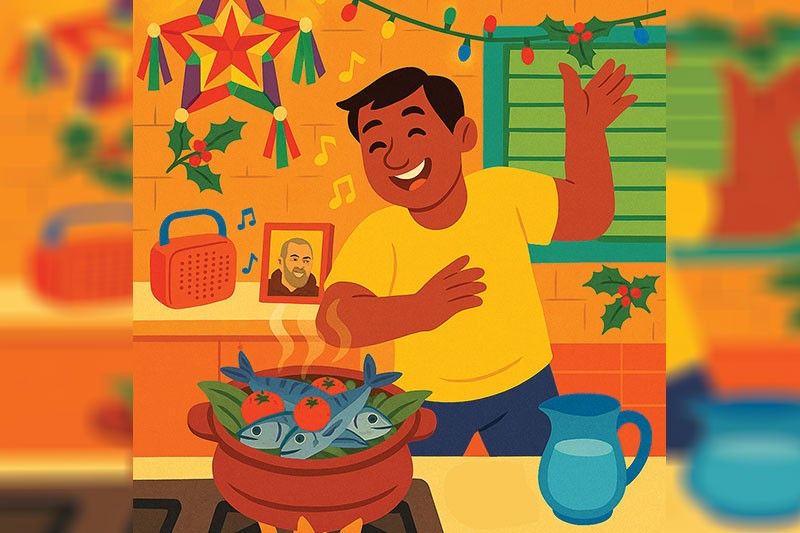
Pinoy Christmas songs were already playing in the house that Thursday, 9 a.m. There was excitement in my youngest brother Rod’s face as he put to full blast the volume of the Bluetooth speaker he recently received as an early gift from his US-based best friend Fe. Always jolly Rod, a public high school teacher, was prancing to Ang Pasko ay Sumapit in the kitchen as he layered the bottom of the clay pot with banana leaves. Then one by one, he filled the pot with the fresh tulingan (skipjack tuna) he bought from the market early that day. Sinaing na tulingan, the recipe of which he learned from Candida, was what we would eat for dinner. Yes, dinner. Our late mother only served sinaing na tulingan if it was cooked for eight hours. Malambot pati tinik.
The fresh tulingan actually came with a little image of Padre Pio in another container. Food and faith were together in the bag. The former is nourishment for the body; the latter is all-around sustenance. Faith, after all is the food of the soul that knows “worrying is worthless,” to quote Fr. Dave Concepcion in one of his inspiring homilies. Rod, faithful and hopeful, woke up early that day to hear Mass at the Monastery of St. Clare in Cabuyao. He gifted me with the blessed image of Padre Pio. When he handed the image to me at home, I was replaying in my mind how Fr. Dave once quoted Padre Pio that worrying robs us of our joy. Fr. Dave said, “Worrying is like sitting on a rocking chair. It keeps you busy. It brings you nowhere.”
That morning, however, Rod cracked me up and brought me somewhere when he continued to dance in the kitchen as he gingerly piled the fish in the pot like a work of art. He learned it from our late mother: cooking is an art and music, whether sung or heard from the radio, is a reason a dish also becomes delicious. The dancing was something he learned from our mother, too.
Nanay, when she was alive, would skip and hop in the kitchen, no kidding, when she was in her most jubilant mood. She would dance her way to the kitchen to the tune of O, Maliwanag na Buwan.
Going back to Rod and to his kitchen magic, he added dried kamias and whole ripe tomatoes atop the pile of fish, then showered the pot with rock salt. A pitcher of water was added. By this time, my youngest brother was lip-synching the Christmas carol. Then he added another layer of banana leaves on top of everything. The earthen lid sealed the deal, so to speak. The stove was put on high fire. As high as the spirit of the cook who created a stage for his antics in the kitchen.
Ten minutes into his cooking bonanza and the stove ran out of gas. That did not dampen Rod’s spirit. Nothing could steal his joy. He dialed the number of the LPG guy in the neighborhood and waited a few more minutes for the change of gas tank.
While waiting for the LPG tank to be replaced, the Christmas carol looped non-stop. This time the Madrigal Singers were singing “Sa Paskong darating, Santa Claus n’yoy ako rin. Pagkata kayong lahat ay nagging masunirin. Dadalhan ko kayo, ng mansanas at ubas. May kendi at tsokolate. Peras, kastanyas na marami.”
At this juncture, my eldest brother Ronnie came out of his house and joined the reverie. He used to sing that song when he was a kid going house to house for a caroling in Gulod. He reenacted his childhood memory and, with pots and pans in hand, joined Rod in the kitchen. And in our backyard, the spirit of Christmas — the season of hope and joy — was alive as Kuya played the instruments like they were drums and cymbals.
That moment, I thought I didn’t want to be upstaged. I rose to my full height and danced, too. Just me, Rod and Kuya. We were kids again with the age of 59, 53 and 49. When Ryan Cayabyab’s Kumukutikutitap played, Rod and I sashayed in the lawn. Kuya’s roosters crowed. The dogs barked. And Lei, Rod’s puspin, was jumping up and down her cage.
Some neighbors tiptoed and craned their necks from our gate to find out what the revelry was all about. It was a happy, beautiful day.
The beauty of the day reminded us how we used to regale our mother with joy when she was still alive. After the death of our father in 2010, our mother spiraled into expected melancholy so we took it upon ourselves to bring back the smile on her face. We kept her company and we made sure she was never alone 24/7. Because Candida’s language of love was cooking sumptuous food, we kept her happy in the kitchen many times. We sang and danced with her in the kitchen until she smiled sincerely again. Soon, she was laughing anew. And that happened when we had an impromptu cotillon for her under the himbaba-o tree. One by one, her five sons curtsied before her and treated her like a queen on the makeshift dance floor.
Humor runs deeply in our blood so every member of the family is a joker. There was never a day that we did not laugh — except on two occasions, the days when we became orphans. But we somehow managed to rise above grief. True, grief has no expiration date, so does joy. So my brothers and I, because most of us live in one compound, find comfort in each other. Cresencio Sr. and Candida taught us well to love each other and to be each other’s cheerleader. So, whatever the challenge is, as long as we volt in, we’re fine.
When the LPG guy arrived, we were winding up our dance number. Liza, our funny help, almost blistered her hands from clapping. She prepared yummy ginisang ampalaya for lunch. But of course, the piece de resistance was the tulingan.
Rod turned on the stove and for eight hours did not leave the kitchen. Nanay said sinaing na tulingan was a jealous dish. It did not want your attention elsewhere otherwise the pot would stick and the dish would burn. It required patience and concentration. The attention Candida devoted to this dish was like her personal meditation. So Rod copied her energy. He stayed in the kitchen, making sure that every so often he would replenish the water in the boiling pot. He entertained himself by playing Pinoy Christmas carols. He hummed with his Bluetooth speaker: “Sa may bahay, ang aming bati. Merry Christmas na maluwalhati. Ang pag-ibig, pag siyang naghari, araw-araw ay magiging Pasko lagi. Ang sanhi po, nang pagparito. Hihingi po ng aginaldo. Kung sakaling kami’y perwisyo, pasensya n kayo’t kami’y namamasko.”
His voice was course, hoarse. He was happy.
And all the while, the image of Padre Pio that he gave me was on the kitchen table. The smile on the face of the saint seemed to foretell of a sumptuous dish and beautiful days to come.
The scrumptious dinner was later on served. It felt like we partook of the Noche Buena. It felt like Christmas that day. *



- Latest