


Gratitude & Greatness
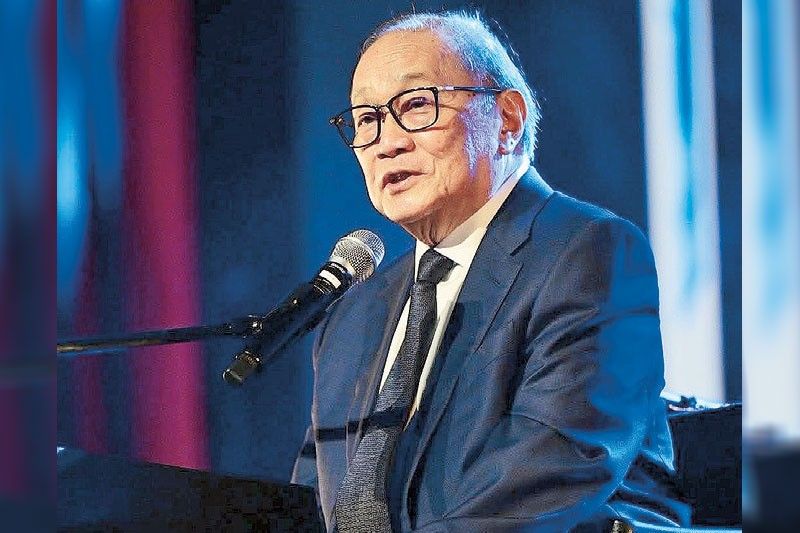
There are anniversaries that mark time, and there are anniversaries that make meaning. The celebration of First Pacific Company Limited’s 45th year belonged firmly, irrevocably, to the second category.
I say this not as a matter of corporate courtesy, but as someone who has spent a significant portion of his professional life inside the orbit of the enterprise that First Pacific built in this country, and who understands what that 45-year story actually required of the people who lived it.
The milestone evening at the Meralco Theater in Pasig City drew business leaders and distinguished guests to a program of unusual ambition, a large-scale production featuring National Artist Maestro Ryan Cayabyab as musical director, the Philippine Philharmonic Orchestra, and performances by Lea Salonga, Jessica Sanchez, and Dylan Menor, directed with characteristic flair by Rowell Santiago.
It was, by any standard, a fitting tribute to a company that has come to occupy an outsized place in the economic life of the Philippines. But the evening’s truest moment had nothing to do with the music, as magnificent as it was. It had everything to do with a man who, surprisingly to most, appeared in a wheelchair, telling an audience of some of the most powerful people in the country what he has learned about walking.
That man, of course, was none other than the chairman himself, Manuel V. Pangilinan, or MVP as he is fondly called, the founder, managing director and CEO of First Pacific, the figure whose vision has shaped every significant investment this group has made in the Philippines and elsewhere in the world over the last three decades or so.
When MVP spoke at the Meralco Theater, he did not speak as a man reviewing his portfolio. He spoke as a man reviewing his life, and the distinction mattered enormously.
MVP set aside his usual boardroom formality to speak openly about recovery after a major knee surgery, acknowledging that the simplest physical tasks now feel like major achievements.
He spoke of standing up. He spoke of walking across a room. He deployed the dry humor that those who know him have come to expect, remarking, with a smile, that standing up now feels like winning a badminton championship, and that finding a comfortable sleeping position requires more engineering than designing a power plant. In doing so, he accomplished something that very few figures of his stature ever managed: he reminded a room full of powerful people of their shared, fragile humanity.
The image that stayed with me longest, however, was not a quip but a confession. MVP told the audience that his fleet of luxury vehicles had, for the moment, given way to a single, aging van, a 16-year-old, thrice-depreciated vehicle, because it was the only one that could carry him, his wheelchair, and what he called his hope for recovery.
He said that real wealth was not parked in any garage. It was present in that theater — in family, in friends, in faith, and in the stubborn determination to stand and walk again.
I have worked alongside many executives in my career. I have sat through many speeches and have even written a lot of them. I have heard the language of resilience instrumentalized in corporate communications until it has lost almost all of its original meaning.
What MVP offered that evening was none of that. It was something unguarded and genuine, the testimony of a man who has spent his adult life in constant forward motion, reckoning honestly with the fact that the body has its own agenda and does not negotiate.
He insisted that the evening was not a story about loss or about pain, but about resilience, about courage, about learning to slow down, to heal, and to appreciate the people who stand beside us when life changes course.
Coming from almost anyone else, that would have been a platitude. Coming from a man who started First Pacific at 35 with six people and 50 square meters of rented office space in Hong Kong, who returned to the Philippines in 1998 to rescue a struggling national telecommunications company, and who has spent the years since building an investment group woven into the fabric of this nation… it was a philosophy earned through decades of actual consequence.
As someone whose work sits at the intersection of business and public life, I am perhaps more attuned than most to the ways in which corporate narratives are constructed, polished and deployed. I am also aware that the most durable reputations are not constructed at all. They accumulate through decisions made in private, through governance maintained under pressure, through the willingness to be held accountable not just to shareholders but to the communities in which one operates.
MVP noted that what accumulated over 45 years of complete honesty and disciplined governance was a group that found itself woven into the fabric of daily Filipino life. That is an extraordinary thing to be able to say about any enterprise, much less one headquartered in Hong Kong, operating across multiple sovereign jurisdictions, subject to the scrutiny of regulators, investors, and civil society on several fronts simultaneously.
It is the kind of outcome that does not happen by accident, and that cannot be manufactured by communications departments, however capable. It happens because the people at the top of an institution make choices, year after year, that are consistent with a set of values they actually hold.
MVP holds those values. I have seen them in operation.
None of this, of course, should be read as a valediction. Manuel V. Pangilinan is not going anywhere. He said plainly that he has no intention of remaining in a wheelchair for long, that he looks forward to completing his recovery, returning to work, and playing badminton again. Those who know him will understand that this is not bravado. It is a statement of intent from a man who has spent his life converting intent into consequence.
And there is consequence to be made. As MVP himself wrote in his most recent letter to First Pacific’s stakeholders, the group’s companies continue to evolve through targeted new investments and organic growth, with an overall operational outlook that is promising and expectations of continuing earnings growth in the years ahead. The pipeline is real and it is significant.
In Mindanao, the Silangan Project stands ready to contribute its first earnings to First Pacific this year, arriving at a moment when the global conversation around critical minerals has made copper and gold as strategically important as any asset in the country’s ground.
In Singapore, the group has delivered a new fast-start power plant on time and on budget, and has awarded contracts for a new combined-cycle facility scheduled to come online in 2029.
The machine MVP built continues to expand, even as its chief architect pauses to mend.
That, to my mind, is the most reliable testament to what 45 years of institution-building actually looks like. A company that functions at the highest level of its ambition even as its leader takes time to recover is a company that was built to last — not merely to perform during the tenure of a single, exceptional individual.
First Pacific was born in Hong Kong, but a significant part of its soul was shaped here — by the Philippines, by its complexity, by its people, and by the particular challenge of trying to do serious business in a country that demands both technical competence and genuine commitment to community. MVP understood that challenge from the moment he returned home in 1998, and it has informed every major decision this group has made in the years since.
On the evening of the 45th anniversary celebration, as Lea Salonga’s voice filled the Meralco Theater and the guests of First Pacific settled into the warmth of a celebration well deserved, I found myself thinking, ruminating, on this single line MVP delivered from his wheelchair that will remain with me for a long time.
“God, after all, does not write in straight lines.”
Forty-five years of First Pacific is proof of that. So is the man who helped write them. *


- Latest


