Philippines misses goal of South China Sea code during ASEAN chairship
MANILA, Philippines (Updated 6:43 p.m.) — The Philippines will close its term as ASEAN chair without its most coveted target: a binding code of conduct for the South China Sea, as negotiations for the text have only reached 80% agreement at the close of Manila's year as head of the bloc.
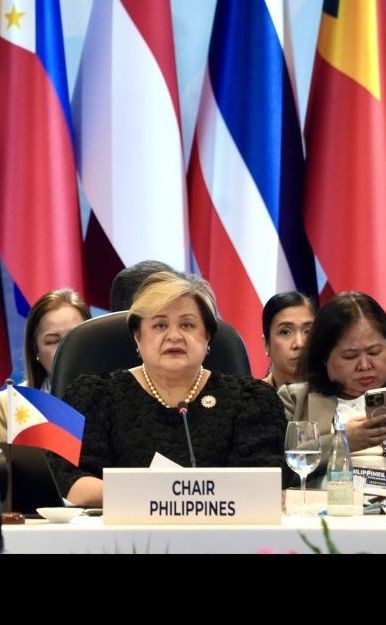
Foreign Affairs Secretary Theresa Lazaro on Sunday, November 15, said the unfinished document will now fall within the ambit of Singapore as it assumes the chairship next year.
"We leave this almost 80 percent finished document to Singapore for the next year," Lazaro told reporters at the end of the first day of the 49th ASEAN Summit.
This falls short of the aspiration President Ferdinand Marcos Jr. had sought from the start of the country's leadership of the bloc: to finally bring to conclusion the long-delayed negotiations for a binding code that will guide countries' conduct in the resource-rich waters.
After the 48th summit in Cebu in May, Marcos then called a finished code by year's end "one of our aspirations as chair of ASEAN for 2026."
Originally, ASEAN ministers and China had agreed in 2023 to speed up the talks and conclude them within three years. No new deadline has yet been set.
The code is meant to set rules of behavior in the South China Sea, where China Coast Guard ships have repeatedly clashed with Philippine vessels in waters Manila calls the West Philippine Sea.
Beijing claims nearly the entire waterway, despite a 2016 arbitral ruling in The Hague that found its sweeping claims had no legal basis. The Philippines, Vietnam, Malaysia and Brunei have overlapping claims.
The talks have dragged on for more than two decades since ASEAN and China signed the non-binding Declaration on the Conduct of Parties in the South China Sea (DOC) in 2002 but did not agree on a single draft text to negotiate until 2018.
The parties have so far only ironed out differences on one of four major contentions or "milestone issues": specifically, how the code of conduct will relate to the 2002 declaration.
Lazaro said parties have agreed that the declaration would serve as the code's foundation and that the code would build on its principles with more effective and substantive rules on conduct at sea.
The parties also agreed that the code would double as a platform for voluntary maritime cooperation. It is meant to manage differences at sea and not to settle the underlying territorial disputes, Lazaro said.
Malaysia, which coordinates ASEAN's relations with Beijing, co-chairs the negotiations with China. But Lazaro said the Philippines, as ASEAN chair, had been "shepherding the whole process," holding nine rounds of negotiations and two senior officials' meetings this year, or roughly one meeting a month.
The bloc has so far not set a new deadline, but Lazaro said the parties plan to keep working toward an effective and substantive code "at the earliest possible time."
China's resistance to a legally binding code of conduct that would police vessels' actions at sea has been seen as the primary reason why the code remains out of reach despite years of negotiations.
Lazaro did not detail the main hurdles that kept Manila from reaching its goal this time, but said the Philippines would have been able to get to the end of negotiations had it been given at least five more months of talks.
"Negotiations are negotiations are negotiations. In other words, the 10 ASEAN countries plus China have also, of course, different views on how things are," Lazaro said.
"I think there was not enough time. If we were given probably another five to six months, I think we can finish that," she said.
Some "sensitivities" remain, Lazaro said, such as the question on whether the code should be legally binding, as such a status would require "a notification process on the part of certain ASEAN member states."




- Latest
- Trending