Cebu office transactions drop to 11 in Q2 as demand softens
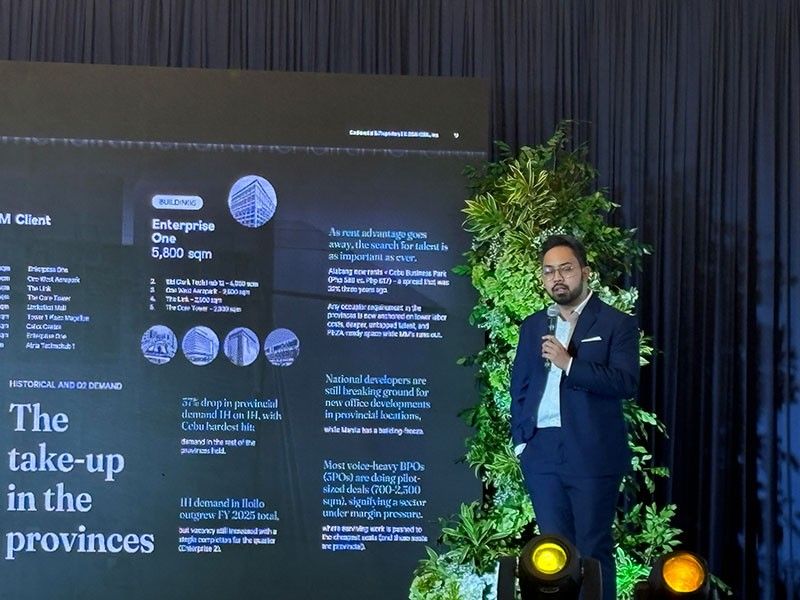
CEBU, Philippines — Cebu’s office market is showing signs of softer demand as companies take smaller spaces and transaction activity slows, even as developers continue to add modern, high-quality buildings to the province’s growing office portfolio.
Angelo Petilla, associate director for office leasing at CBRE Philippines, said Cebu recorded about 9,200 square meters of office transactions in the second quarter of 2026, spread across 11 deals. That compares with about 30 transactions in the previous quarter.
Average transaction size was about 840 square meters during the quarter, up from roughly 500 square meters in the previous quarter but below the approximately 1,200-square-meter average recorded in the first half of 2025.
“Transaction size is down. Transaction count is also down,” Petilla said during Arthaland’s Cebu office market forum at Cebu Exchange.
Despite the slowdown, Cebu remained the best-performing province among the country’s five tier-one provincial markets, posting about 9,200 square meters of quarterly take-up, according to CBRE data presented by Petilla.
Cebu’s overall office vacancy stood at 13.9 percent in the second quarter, slightly higher than 13.6 percent in the previous quarter. Petilla said the increase marked the first uptick in vacancy in five quarters, although he described the market’s position as still favorable.
The market faces a more significant test as additional supply comes online.
Cebu currently has about 181,000 square meters of available office space, with roughly 100,000 square meters concentrated in Cebu IT Park and Cebu Business Park, Petilla said.
Another 90,000 square meters of supply is expected by year-end, he said, as developers bring new buildings to the market.
That pipeline is equivalent to about two years of Cebu’s current demand, underscoring the pressure developers and landlords may face in attracting occupiers.
ARTHALAND adds Grade A supply
Against this backdrop, ARTHALAND Corp. has played a significant role in expanding Cebu’s elevated office supply through Cebu Exchange, its landmark Grade A office development in Cebu IT Park.
The development adds to Cebu’s growing pipeline of premium, sustainability-driven office space, giving companies more modern alternatives while strengthening the quality of the city’s commercial real estate stock.
ARTHALAND brought together business leaders, real estate professionals and industry stakeholders for a market forum at Cebu Exchange on Aug. 7, where CBRE presented its assessment of Cebu’s office market and the evolving requirements of occupiers.
Cebu Exchange is positioned around flexible office ownership and leasing options, including warm-shell units ranging from about 170 square meters to 490 square meters, as well as move-in assistance for businesses preparing their spaces for operations.
The project is also positioned as a sustainability-led development, with ARTHALAND describing Cebu Exchange as the world’s largest EDGE Zero Carbon-certified development.
The addition of Cebu Exchange is significant as companies become more selective about office locations, weighing not only rents but also building quality, operating efficiency, sustainability, flexibility and long-term asset value.
Traditional firms gain share
The composition of office demand is also changing.
While the IT-BPM sector remains the largest contributor by space, traditional businesses are accounting for a growing share of transactions, Petilla said.
Traditional companies represented about 65 percent of transaction count in the first half of 2026, indicating a broader base of occupiers beyond outsourcing and technology firms.
For IT-BPM companies, meanwhile, cost optimization remains a key consideration, with firms increasingly looking at provincial markets to reduce both rental and operating expenses.
That dynamic could continue to support Cebu and other tier-one cities despite the slowdown in overall demand.
In Cebu, 54 percent of second-quarter transactions were concentrated in Cebu IT Park, while 66 percent were signed with local developers, highlighting the continuing strength of locally developed business districts.
Cebu Business Park also performed strongly, with less than 10 percent of its office inventory vacant, according to CBRE.
Mactan, by comparison, recorded vacancy of about 31 percent, reflecting the challenge faced by locations competing for occupiers seeking centrally positioned offices.
For Cebu’s office market, the combination of moderating demand and a substantial development pipeline is likely to make building quality, location and operating efficiency increasingly important in the competition for tenants.
The market may have to absorb a substantial amount of new inventory before demand catches up, but the continued investment in higher-quality office stock suggests developers are positioning Cebu for the next phase of occupier growth rather than simply for current demand.





- Latest