DOE: PUV fuel subsidy to continue until year-end
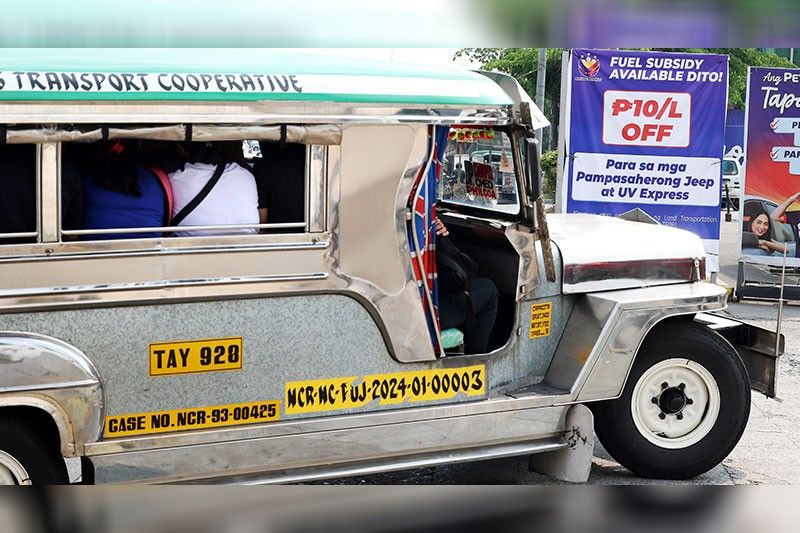
MANILA, Philippines — The government’s fuel subsidy program for public utility vehicle (PUV) drivers will continue at least until the end of the year due to still-volatile pump prices, according to Energy Secretary Sharon Garin.
“I believe (it will continue) while we still have the problem on fuel, as long as we have funds and the government can still pay for it because this is an expense for the government,” Garin told reporters on Monday.
“We will try to keep it there until supply lasts or until the problem goes away.”
Elevated pump prices have already burdened PUV drivers, shrinking the earnings they bring home.
Since Aug. 15, the government has raised the fuel subsidy to P12 per liter from P10. With the subsidy capped at 150 liters per week, drivers can save up to P1,800.
The government has already shelled out P491.61 million in fuel subsidies for 96,197 unique beneficiaries, according to Oil Industry Management Bureau chief Rino Abad.
Drivers can avail themselves of the subsidy at any of the 3,312 participating gasoline stations.
Abad said the fuel subsidy program will undergo monthly review to determine the budget needed based on the number of PUV drivers availing themselves of discounts.
Fuel prices up today
The continued subsidy comes as motorists are set to face another round of fuel price increases today, with pump prices expected to rise by as much as P5 per liter amid heightened volatility in global oil markets.
The Department of Energy announced maximum price hikes of P2.49 per liter for gasoline, P3.84 for diesel and P5.01 for kerosene.
“Our prices can go up or down in a matter of one week. It really depends on how the negotiations in the Middle East conflict happen,” Garin said yesterday.
She added that diplomatic efforts between the US and Iran have slowed, bringing uncertainty to global markets, particularly in the Mean of Platts Singapore, the benchmark used in pricing fuel products in the Philippines.
Garin and other energy officials admitted that the roots of the problem, the Gulf War and Iran’s blockade of the Strait of Hormuz, are not going away.
“It seems like the problem is still persisting. The parties are not agreeing on anything and, unfortunately, we are suffering from that,” the energy chief said. “That’s why we’re still on high alert as far as the oil crisis is concerned, monitoring every week and coordinating with all the oil companies.”
As a net oil importer, the Philippines relies heavily on crude from the Middle East and refined petroleum products from other Asian countries.
“That means a conflict thousands of kilometers away can eventually reach the jeepney driver filling his tank, the farmer transporting produce, the business delivering goods and the family managing its weekly budget,” Garin said.
She also admitted that even if the state of national energy emergency lapses next year, fuel prices may not return to pre-war levels.
While the country cannot reduce its import dependence overnight, the energy chief said the government is taking steps to lessen its vulnerability to global supply disruptions.
In particular, the Marcos administration is moving to establish a strategic petroleum reserve, a government-held emergency fuel buffer that can be tapped during major global supply disruptions.
State-run Philippine National Oil Co. already began the studies for this initiative, hoping to have at least one storage tank ready by the end of 2027.
“Our objective is that we will hopefully have around 15 tanks, but that will take time because it is a very expensive and long process. But we need to start,” Garin said.
As of Aug. 14, the Philippines’ average fuel inventory stood at 58.34 days, based on the latest DOE data. — Brix Lelis



- Latest
- Trending