


Philippines, Canada upgrade ties to strategic partnership
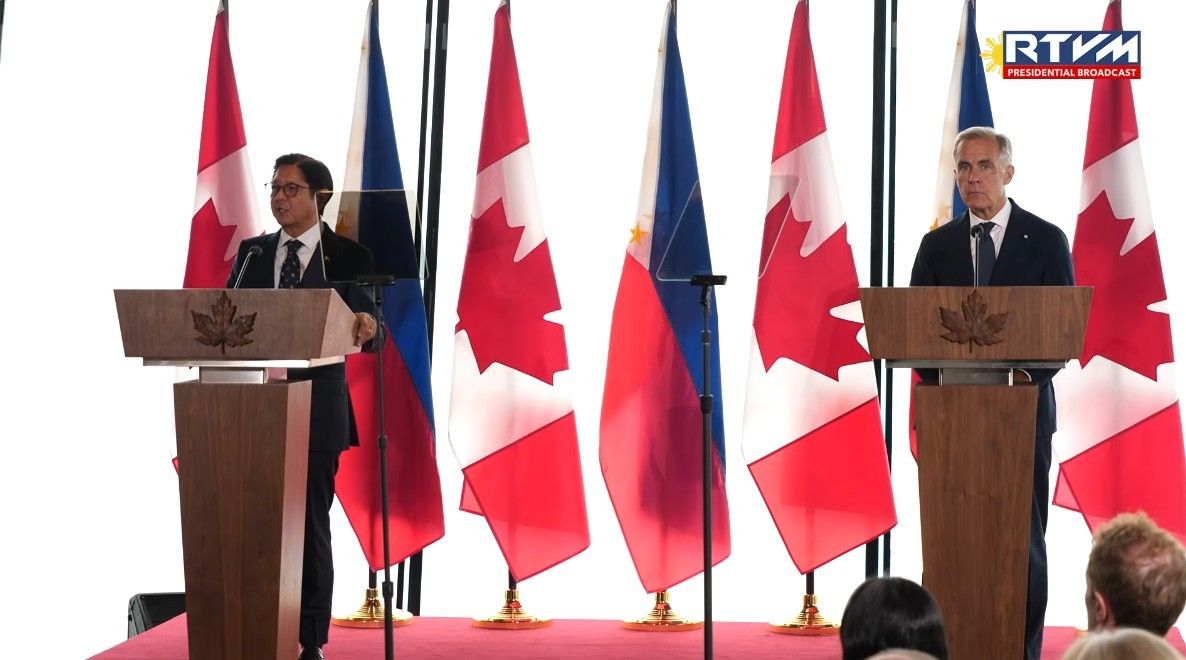
MANILA, Philippines — The Philippines and Canada elevated their ties to a strategic partnership on Thursday, July 2, alongside a push to close a free trade deal before the year ends.
President Ferdinand Marcos Jr. announced the boost in ties after meeting Prime Minister Mark Carney at the Vancouver Convention Centre, on the first visit by a Philippine head of state to Canada in 11 years.
"We have tasked our Foreign Ministers to draw up a Plan of Action to pursue our shared commitment to work together in adapting to shifting global realities, addressing shared challenges, and building capacities for a future-ready partnership," Marcos said in a joint press statement with Carney.
Canada becomes Manila's newest strategic partner, joining Japan, Vietnam, Australia, South Korea, and India.
The two leaders also witnessed the signing of four agreements covering energy, natural resources, labor, and tourism.
Trade deal on the clock
Ottawa is eyeing a Canada-Philippines free trade agreement by the end of this year, a deal Canada expects to boost bilateral trade by nearly 200 percent by 2035.
Canada is also negotiating a Canada-ASEAN free trade agreement, targeted for completion this year under the Philippines' ASEAN chairship.
The Philippines is Canada's sixth-largest export market in Southeast Asia.
Defense pacts stack up
Marcos said robust defense and security cooperation "underpins the strong momentum" of relations between the two sides.
He and Carney welcomed the status of visiting forces agreement previously signed in Manila, now awaiting ratification by both legislatures, along with the Mutual Logistics Support Arrangement and a Statement of Intent on Strengthening Defense Cooperation.
The SOVFA, signed last November, is Canada's first in the Indo-Pacific and provides the legal framework for joint military activities and the presence of foreign troops during exercises and training.
It needs Senate ratification before taking effect.
The logistics and defense cooperation documents were signed in Ottawa in June, when Defense Secretary Gilberto Teodoro became the first Philippine defense chief to visit Canada.
Marcos also thanked Canada for its Dark Vessel Detection program, a satellite system that tracks ships that switch off their location transmitters, a tactic used by Chinese coast guard and suspected militia vessels in the West Philippine Sea.
The Philippine Coast Guard has used the technology to monitor Chinese incursions.
Deployed free of charge since late 2023, the system's original term is winding down, and Marcos said he has asked for access for another five years.
"I conveyed keen interest in the continuation of the DVD program in Philippine waters," Marcos said.
Arbitral award, diaspora
With the Philippines marking the 10th anniversary of the 2016 arbitral ruling on the South China Sea next week, Marcos thanked Canada for its consistent support for a rules-based order under the UN Convention on the Law of the Sea and for upholding the legally binding award.
The security buildup with Ottawa comes as Manila widens its network of defense partnerships in response to increasingly aggressive Chinese actions in the West Philippine Sea, the part of the South China Sea that falls within Manila's exclusive economic zone.
There are nearly one million Filipinos in Canada, based on 2021 census data.
In his remarks, Marcos credited the Filipino diaspora for being the "heart and soul" of the two countries' strategic partnership.
"I am glad to see and hear from our Canadian friends that the one million strong Filipinos in Canada are valued and respected for their positive contributions to the Canadian society, economy, and government," he said.





- Latest
- Trending


