


Farmer invents affordable fertilizer
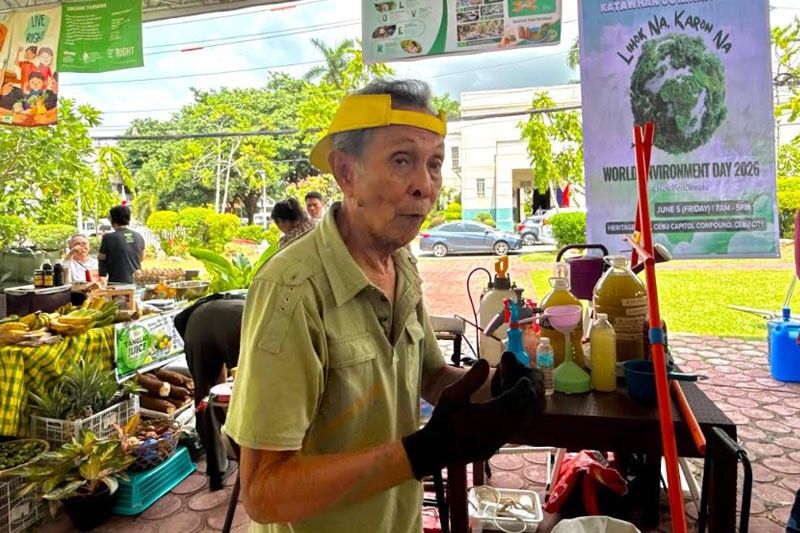
CEBU, Philippines — In a row of booths displaying customized packaged products, potted flowers, and neatly arranged fruits, one stall stood out, featuring only gardening tools and a colored liquid stored in a recycled water bottle.
Manning that bare table was Robert Bajenting, 83, a farmer from Poblacion, Argao, Cebu, who spent 35 years of his life at the Department of Agrarian Reform (DAR) and remains an advocate of sustainable and affordable farming practices.
During the World Environment Day 2026 celebration at the Heritage Park of the Cebu Provincial Capitol on Friday, June 5, 2026, Bajenting got the chance to showcase his innovation, which he calls a “cocktail juice.”
In his presentation, the colored liquid, or “cocktail juice,” was described as an organic fertilizer that farmers can apply through soil drenching, stem application, and foliar spraying. He said that 50 milliliters of the solution is enough for a 5-liter sprayer.
In an interview with THE FREEMAN, Bajenting shared that he had witnessed for years how local farmers grappled with rising input costs, making cultivation difficult and less profitable.
“In agriculture, importante ang cost-saving. Unsaon pagprodukto nga di gasto aron inig baligya di sad mahal,” he said.
Even at his age, more than a decade after retiring from DAR in 2010, he continues to advocate for sustainable and affordable farming practices, as these remain a challenge for local farmers today.
This led him to spend seven days perfecting a stock solution that could serve as a low-cost alternative to synthetic fertilizers, using readily available leaves from guava, avocado, malunggay, papaya, mulberry, and seaweed.
According to him, he spent only ?600 on a bottle of organic detoxifier, which he used to treat the shredded leaves and ensure that no bacteria or fungi would develop. One bottle of detoxifier could process enough leaves to produce more than one gallon of stock solution.
“Pila ra may gasto aning mga bayabas og malunggay nga 200 grams,” he said, noting the affordability of the fertilizer.
According to Bajenting, sustainable farming requires “good soil,” while synthetic fertilizers introduce chemicals that may affect soil fertility and pose risks to human health.
“Usually, naanad na atong mga farmers nga mamalit lang og synthetic fertilizer nga mahal kaayo,” he said, highlighting that farmers lack awareness of organic farming.
Aside from that, Bajenting also developed a modified permaculture system called “Swale Technology,” which can collect 20 to 22 cubic meters of rainwater from a 500-square-meter area.
Using a handwritten poster containing a conceptual visualization of his settlement design, he passionately explained an integrated and diversified agroforestry system that helps improve soil fertility.
Bajenting may have spent most of his life working in the fields, yet he continues to advocate for change, adding that those experiences have made him more capable of contributing to it.
“You cannot change an urban environment if you do not know where or how to do it,” he said.
He is currently working alongside Cebu Institute of Technology–University on its existing urban gardening initiative and the university’s future plan to create a pocket forest.
He may have had only a plain table and an undecorated setup, but his stall still drew attention, with a few passersby stopping out of curiosity at the simplicity of his booth.
What he had on display was enough, as beyond his innovations, he also brought with him the hope of more sustainable and affordable farming for the wider agricultural community.
As Bajenting said, “Participate, contribute, and make a difference,” calling on the younger generation to see farming not as a burden, but as a system they can help transform. — Jhiezel Jane D. Camarillo - CNU Intern/IHM (FREEMAN)


- Latest


